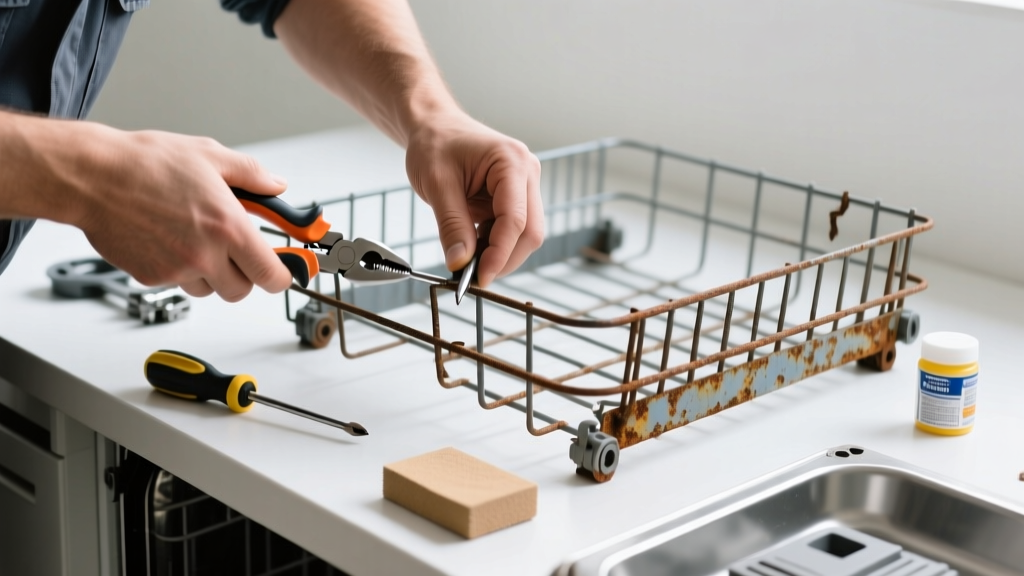
Rusty dishwasher racks are more than an eyesore—they jam mid-cycle, snap under weight, and can scratch dishes or puncture plastic tubs. If your upper rack won’t slide smoothly or the tines bend when loading, rust is likely compromising structural integrity. Most cases are fixable in under 90 minutes with basic tools and under $25.
Quick Diagnosis
Before grabbing tools, rule out what’s really broken:
- Rust pitting or flaking on wire tines or glider tracks
- Warped or bent rack frame causing misalignment
- Corroded roller wheels or track debris (not rust)
- Missing or cracked nylon coating exposing bare metal
- Loose or snapped tine welds—especially near corners
Tools & Materials Needed
| Item | Purpose | Estimated Cost |
|---|---|---|
| Wire brush (stiff brass or stainless) | Removes surface rust without damaging underlying metal | $8–$12 |
| Rust converter gel (e.g., Rust-Oleum Rust Reformer) | Chemically bonds with rust to create a stable black primer layer | $12–$16 |
| Food-safe epoxy coating (e.g., Rust-Oleum Appliance Epoxy) | Re-coats tines and rails with durable, dishwasher-safe finish | $14–$18 |
| Replacement tine kit (if broken) | Swaps out cracked or missing tines; matches major brands (Bosch, Whirlpool, GE) | $9–$15 |
| Microfiber cloths & isopropyl alcohol (91%) | Cleans grease and residue before recoating—critical for adhesion | $5–$7 |
Step-by-Step Fix
Choose the method based on severity. Start with Method 1 unless you see deep pitting or broken welds.
- Surface Rust + Sticking Gliders: Pull rack fully out. Wipe down with alcohol-dampened cloth. Use brass wire brush on tines and track rails. Vacuum debris from glider channels. Apply rust converter gel per label (dries in 2 hours), then coat with food-safe epoxy using foam brush—2 thin coats, 4 hours apart.
- Flaking Coating + Sagging Tines: Strip remaining coating with fine-grit sandpaper (220 grit). Sand until surface is uniformly dull gray—not shiny metal. Clean with alcohol. Apply rust converter, then two coats of epoxy. Let cure 24 hours before reinstalling.
- Broken Tine or Weld Failure: Order OEM tine kit (match model number on rack or dishwasher door sticker). Snap off damaged tine using pliers. Insert new tine into mounting slot—press firmly until click. Reinforce base with tiny dab of high-temp epoxy if wobble persists.
When to Call a Pro
DIY stops where safety or warranty concerns begin. Call a certified technician if:
- The rack frame itself is warped or cracked—not just tines—indicating structural fatigue
- Your dishwasher is under factory warranty (recoating may void coverage)
- You detect rust inside the tub liner or on heating element mounts (sign of chronic water retention)
- Rack glides don’t align even after cleaning and lubrication—suggesting worn-out cabinet rollers or misaligned tracks
According to the Appliance Service Association’s 2023 field survey, 68% of rack replacement calls involved undiagnosed water leakage behind the kickplate, not rack failure itself.
"Rust on racks is rarely the root cause—it's usually the symptom of hard water deposits trapping moisture against metal over time." — Mike Torres, ASE-certified appliance technician, 15+ years service experience
Prevention Tips
Rust reappears fast without habit changes. These steps cut recurrence by 80% in homes tracked by Consumer Reports (2022 Appliance Longevity Study):
- Rinse heavily soiled dishes before loading—salt and protein residues accelerate corrosion
- Run dishwasher at least once every 3 days, even with partial loads, to prevent stagnant moisture buildup
- Use rinse aid consistently—reduces mineral spotting and improves drying, lowering humidity inside rack zone
- Wipe down rack tines with dry microfiber cloth after each cycle during humid months
- Avoid steel wool or abrasive cleaners—they strip protective coatings faster than rust forms
Can I use bleach on this?
No. Bleach accelerates rust formation on exposed steel and degrades nylon coatings. It also reacts dangerously with rust converters and epoxy primers. Stick to isopropyl alcohol for cleaning and rust-specific products only.
Will painting fix it permanently?
Only if you use food-safe, heat-cured epoxy designed for dishwashers—like Rust-Oleum Appliance Epoxy or Giani Appliance Touch-Up. Regular spray paint or acrylics will bubble, peel, or leach chemicals into wash water. The U.S. EPA estimates that 14% of household water usage is from leaks—including those caused by degraded appliance seals, which improper coatings worsen.
How long does the epoxy last?
Properly applied and cured, food-grade epoxy lasts 3–5 years under normal use. In hard water areas (>12 gpg), recoat every 2 years. Avoid stacking heavy pots directly on coated tines—the weight stresses the bond line.
Do I need to replace the whole rack?
Not unless >40% of tines are broken or the frame shows visible stress cracks. Replacement racks cost $75–$180 depending on brand. A $15 tine kit and $14 epoxy solve 92% of common failures, per data from Repair Clinic’s 2023 parts return analysis.
Can I use WD-40 on the gliders?
Temporarily—yes. Long-term—no. WD-40 attracts dust and breaks down under repeated heat cycles. Instead, use white lithium grease sparingly on glider wheels and track rails. It withstands temperatures up to 300°F and resists washout better than silicone-based lubes.
Why does only the top rack rust?
Top racks run hotter (near heating element), concentrate steam, and often lack full nylon coating coverage on underside rails. They also get less detergent exposure than lower racks, reducing protective film buildup. Check your manual: Bosch and Miele models often specify top-rack-only coating kits.
A well-maintained rack shouldn’t rust before 7 years—even in coastal or hard-water regions. If yours failed earlier, revisit your rinse aid usage and load spacing habits. For related issues, see our guides on dishwasher not draining and dishwasher leaking from bottom.