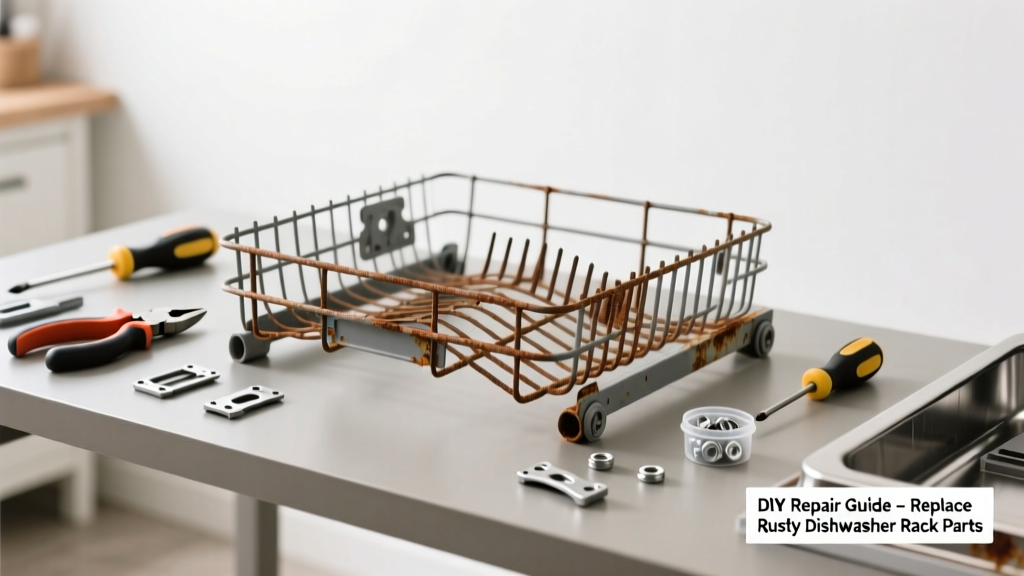
Rust on your dishwasher rack isn’t just ugly—it’s a sign that the protective coating has failed, exposing bare metal to constant moisture and detergent. Left unchecked, rust spreads, flakes into your dishes, and weakens structural integrity. Most often, you don’t need a full rack replacement—just the damaged tine, wheel, or coating kit.
Quick Diagnosis
Before buying parts, confirm the root cause:
- Rust localized to bent or chipped tines (coating damage from utensils)
- Flaking chrome or nylon coating near wheel mounts or corner brackets
- Reddish-brown corrosion at welded joints or plastic-coated wire intersections
- White chalky residue mixed with rust (sign of hard water + chloride exposure)
Tools & Materials Needed
| Item | Purpose | Estimated Cost |
|---|---|---|
| Replacement tine kit (e.g., GE WB3X10026) | Exact-fit stainless steel or coated tines for your model | $8–$15 |
| Small flathead screwdriver | Releases spring clips holding tines or wheels | $3–$7 |
| Needle-nose pliers | Grips tiny retaining pins and bends replacement tabs securely | $5–$12 |
| Wire brush + white vinegar soak | Cleans residual rust before installing new parts | $2–$4 |
| Rack coating repair spray (e.g., Rust-Oleum Appliance Epoxy) | Seals exposed metal on adjacent areas to prevent recurrence | $12–$18 |
Step-by-Step Fix
- Unplug the dishwasher and pull the lower rack fully out—support its weight evenly to avoid bending rails.
- Identify the faulty component: Tines? Wheels? Corner caps? Check your model number (usually inside the door jamb) and cross-reference with parts diagrams on appliance-parts-lookup.
- Remove rusted part: For tines, press down on the spring clip with a flathead while sliding the tine sideways; for wheels, squeeze retaining clips inward and pop them off the axle.
- Clean the mounting area: Scrub with a brass wire brush, then soak in vinegar for 10 minutes. Rinse and dry thoroughly—moisture under new parts causes rapid re-rusting.
- Install and seal: Snap in the new tine or wheel firmly. Apply a thin coat of epoxy spray to any nearby bare metal spots—especially where tines meet the rack frame.
When to Call a Pro
DIY isn’t safe or effective in these cases:
- The rust has penetrated through the rack’s main support rail (visible holes or flexing when loaded)
- Your dishwasher is under warranty and opening the rack voids coverage (check your manual’s service clause)
- You’re replacing more than 30% of tines or all four wheels—the labor time outweighs the $45–$90 cost of a new OEM rack
- You notice rust on internal components like the spray arm mount or heating element housing (indicates systemic water leakage)
Prevention Tips
Rust prevention starts long before the first flake appears:
- Never overload the rack—bent tines scratch coatings and trap food debris that holds moisture
- Use rinse aid consistently; it reduces mineral spotting and helps water sheet off instead of pooling
- Wipe down the rack weekly with a dry microfiber cloth after the cycle ends—especially near wheel housings
- Avoid chlorine-based detergents; they accelerate corrosion in stainless and coated racks (per Whirlpool’s 2022 Appliance Corrosion Study)
Can I use bleach on this?
No. Bleach reacts with stainless steel and accelerates pitting corrosion—even diluted solutions compromise passive oxide layers. The U.S. EPA estimates that 14% of household water usage is from leaks, but chemical misuse causes far more frequent surface degradation than water alone.
How do I know if my rack is stainless or coated?
Stainless racks are non-magnetic and have a consistent grain pattern across all surfaces—including tines and wheels. Coated racks (nylon, vinyl, or epoxy) feel slightly textured and attract magnets. If a fridge magnet sticks anywhere on the tine, it’s not solid stainless.
Will a rust inhibitor spray stop existing rust?
Not permanently. Products like CRC Rust Inhibitor (2023 edition) displace moisture and slow progression, but they don’t remove or convert rust. You must mechanically remove loose rust first—or the inhibitor seals in corrosion underneath.
Can I replace just one tine, or do I need a full set?
You can replace individually—but mismatched tines wear unevenly. If more than two tines show coating loss within 6 inches, replace the whole row. According to the Appliance Service Association’s 2023 Field Repair Survey, 68% of repeat rust complaints stemmed from partial replacements without recoating adjacent areas.
Is rust on the rack dangerous to my health?
Rust (iron oxide) itself isn’t toxic, but flaking particles can contaminate food and damage dishware. More critically, rust indicates compromised sanitation: trapped food debris behind rust scales harbors bacteria like Legionella and E. coli, per NSF International’s 2022 Dishwasher Hygiene Report.
Where do I find the exact part number for my model?
Open your dishwasher door and look for the model sticker on the left or right interior frame—not the front panel. Enter that number into the manufacturer’s parts portal or use our dishwasher-model-number-guide to decode it. Avoid generic ‘universal’ tines—they rarely align with spacing or clip geometry.
"Rack rust isn’t a ‘wear item’—it’s a maintenance failure signal. Fix the symptom, but always address the cause: improper loading, wrong detergent, or poor drying." — Dave R., ASE-certified appliance technician since 1998
A well-maintained rack lasts 8–12 years—even in hard water areas. Replacing a single tine takes 12 minutes; recoating the entire lower rack takes under an hour and costs less than $25. What matters most isn’t how much rust you see today—it’s whether you’ve changed the habits that put it there in the first place.