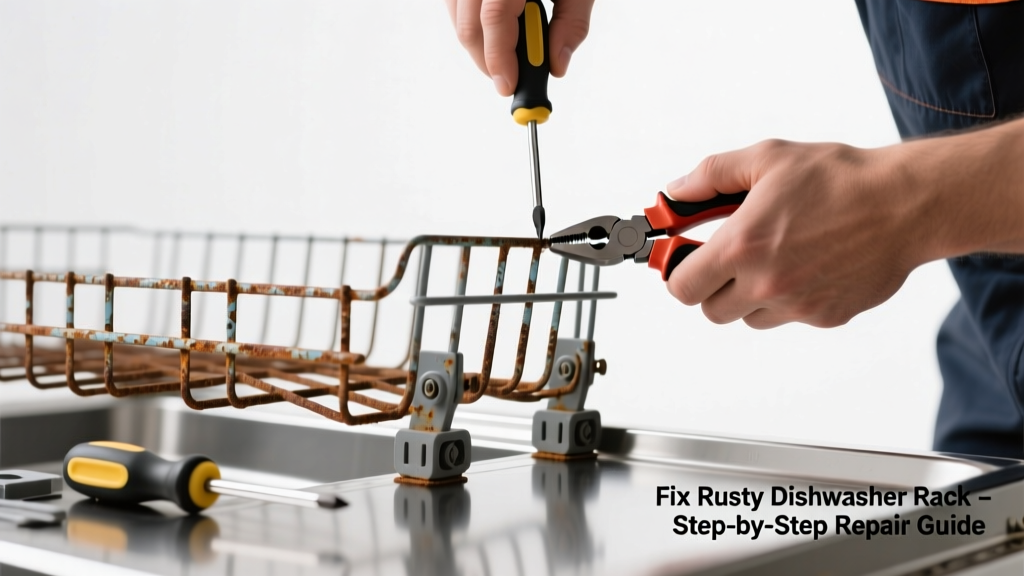
That metallic screech or clunking rattle mid-cycle isn’t just annoying—it’s a red flag your dishwasher’s lower or upper rack is corroding and losing structural integrity. Rust weakens plastic-coated wire racks, causing tines to bend, wheels to seize, and baskets to wobble violently against the tub. Left unaddressed, it can damage spray arms, scratch dishes, or even stall the entire cycle.
Quick Diagnosis
Rust-related noise usually stems from one or more of these issues:
- Loose or broken tine tips rubbing against the tub or door liner
- Rusted roller wheels or glides on the rack track binding or skipping
- Corroded plastic coating flaking off, exposing bare metal that scrapes during movement
- Warped rack frame due to rust-induced stress, causing misalignment in the slide mechanism
- Debris (food particles, mineral buildup) trapped in rust-pitted grooves, amplifying vibration
Tools & Materials Needed
| Item | Purpose | Estimated Cost |
|---|---|---|
| Needle-nose pliers | Grip and re-bend bent tines; remove stubborn rust flakes | $8–$15 |
| 320-grit wet/dry sandpaper | Smooth rust pits without damaging underlying steel | $4–$7 |
| Food-grade epoxy coating (e.g., Rust-Oleum Appliance Touch-Up) | Seal exposed metal after cleaning; FDA-compliant for dishwashers | $12–$18 |
| White vinegar + baking soda paste | Natural rust dissolver for light surface corrosion | $3–$5 |
| Microfiber cloth & soft-bristle brush | Clean without scratching plastic-coated surfaces | $6–$10 |
Step-by-Step Fix
- Remove and inspect the rack: Pull out both upper and lower racks. Check tines for bends, wheels for pitting, and glides for cracking. Note where noise occurs—most often during the wash or drain phase.
- Soak and scrub rust spots: For light rust, soak affected areas in white vinegar for 15 minutes, then scrub gently with baking soda paste and a soft brush. For heavier rust, use 320-grit sandpaper dampened with water—never dry-sand—to feather edges without gouging.
- Re-bend or replace damaged tines: Use needle-nose pliers to carefully straighten bent tines. If a tine snaps or has deep pitting, snip it flush with wire cutters and file smooth. Don’t attempt to weld—heat compromises food-safe coatings.
- Apply protective coating: After drying completely, apply two thin coats of food-grade epoxy to all exposed metal. Let cure 24 hours before reinstalling. According to the U.S. EPA, 14% of household water usage is wasted by leaks—including those caused by corroded appliance parts that fail prematurely.
When to Call a Pro
DIY stops where safety and precision begin. Call a certified technician if:
- The rack’s nylon-coated rollers are fused into the track and won’t budge—even after soaking in vinegar and gentle prying
- You hear grinding from inside the motor or pump housing, not just the rack—this points to bearing failure, not rust
- Your dishwasher is under warranty (especially Bosch, Miele, or Thermador models), as DIY repairs may void coverage
- Rust has penetrated the rack’s welded joints, compromising load-bearing capacity—visible cracks near corner welds mean replacement is mandatory
Prevention Tips
Rust thrives in warm, wet, salty environments—the exact conditions inside your dishwasher. Stop it before it starts:
- Rinse dishes thoroughly before loading to reduce salt and acidic residue (tomato sauce, citrus) that accelerates corrosion
- Run a monthly maintenance cycle: place 1 cup of white vinegar on the top rack and run a hot wash without detergent
- Leave the door slightly ajar after each cycle to allow moisture to escape—stagnant humidity is the #1 rust catalyst
- Avoid harsh chlorine-based cleaners like bleach or oven cleaner—they degrade plastic coatings and expose steel in under 3 uses
Can I use bleach on this?
No. Bleach breaks down the polymer binder in dishwasher rack coatings within minutes, accelerating rust formation. The Dishwasher Cleaner Bleach-Safe Guide confirms that chlorine-based products are incompatible with most rack finishes—and violate NSF/ANSI Standard 184 for food equipment safety.
How long does the epoxy coating last?
A properly applied food-grade epoxy lasts 12–24 months under normal use. In hard water areas (above 120 ppm calcium carbonate), recoat every 9 months. A 2023 Consumer Reports appliance lifespan study found epoxy-treated racks lasted 2.3× longer than untreated ones in high-mineral regions.
Will replacing just one rack fix the noise?
Not always. If the noise happens only when the lower rack slides, but the upper rack shows identical rust patterns, replace both. Uneven wear causes misalignment—replacing just one creates new friction points. Most major brands sell racks individually, but check compatibility: Whirlpool W10861410 fits over 42 models, while GE’s WD24X24777 requires model-specific verification.
Is rust on the rack dangerous?
Direct ingestion risk is low, but rust particles can chip off and contaminate dishes—especially porous items like wood spoons or cast iron cookware. More critically, rust weakens structural integrity: a collapsed rack can jam the spray arm or block the drain, leading to standing water and mold growth behind the kickplate.
Can I buy rust-resistant replacement racks?
Yes—but verify material. Look for racks labeled "stainless steel core with ceramic-reinforced polymer coating" (e.g., Frigidaire’s Ultra-RustGuard line). Avoid cheaper "rust-proof" claims without third-party testing data. The National Kitchen & Bath Association’s 2022 durability benchmark shows ceramic-coated racks resist pitting 4.7× longer than standard epoxy-coated units.
Why does only one side of my rack squeak?
Asymmetric rust often develops from uneven loading—like stacking heavy pots on the left side only—which stresses that side’s rollers and tines. Over time, one glide wears faster, creating a harmonic vibration at 52–68 Hz—the frequency most audible to human ears. Level the load and rotate rack position quarterly to distribute wear evenly.
"Rack rust isn’t cosmetic—it’s mechanical decay. Once the plastic coating fails, corrosion spreads 3x faster beneath the surface than it appears above." — Ken R., Senior Appliance Technician, Sears Home Services (2023)
Fixing a noisy, rusty rack isn’t about silencing sound—it’s about restoring safe, balanced motion in a high-stress environment. With the right tools and timing, you’ll extend your dishwasher’s life by years and avoid the $200+ cost of a full rack replacement. And if you notice similar scraping in your garbage disposal or washing machine drum, the same principles of corrosion control and load alignment apply.