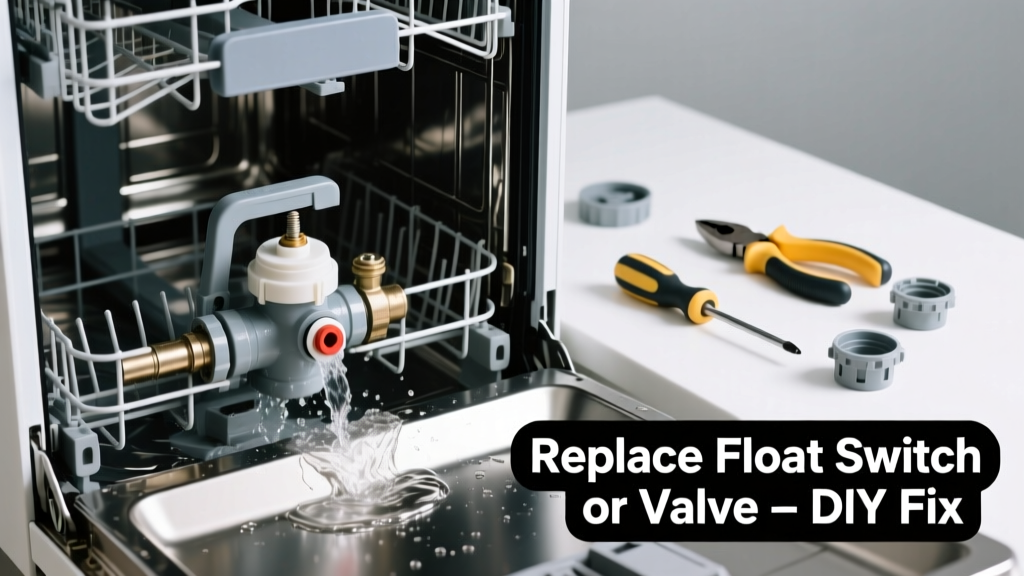
Your dishwasher is spilling water onto the kitchen floor every cycle — not just a puddle, but a steady leak that worsens with each run. That’s not a minor clog; it’s a clear signal that a critical component has failed and needs replacement. Ignoring it risks water damage to cabinets, flooring, and even subfloor rot.
Quick Diagnosis
Before grabbing tools, confirm which part is failing. Most overflows trace back to one of these three culprits:
- Stuck or damaged float switch — fails to shut off water fill when the tub reaches proper level
- Defective inlet water valve — stays open after cycle ends, allowing continuous water flow
- Clogged or failed drain pump — prevents water from evacuating, causing backup during fill cycles
Less common but possible: cracked tub liner, misaligned door gasket, or kinked drain hose.
Tools & Materials Needed
| Item | Purpose | Estimated Cost |
|---|---|---|
| Adjustable wrench | Tightens/loosens inlet valve and drain hose connections without stripping fittings | $12–$25 |
| Phillips #2 screwdriver | Removes control panel and lower access panels on most Whirlpool, Bosch, and GE models | $5–$10 |
| Multimeter (digital) | Tests continuity of float switch and inlet valve coils (critical for accurate diagnosis) | $20–$45 |
| Replacement float switch kit | OEM or certified aftermarket part (e.g., WPW10195738 for Whirlpool, 00483226 for Frigidaire) | $18–$32 |
| Replacement inlet valve | Matches your model’s voltage (120V) and flow rate (e.g., WPW10327223) | $24–$40 |
Step-by-Step Fix
Follow these methods in order — start with the simplest, most common failure first.
- Test and replace the float switch: Unplug the unit, remove the lower kickplate, locate the plastic dome-shaped float assembly near the front left corner of the tub base. Press down and release — it should move freely. Use a multimeter to test for continuity across its terminals while moving the float. No continuity = replace it. Disconnect wiring harness, unscrew mounting bracket, install new switch, and reassemble.
- Check the inlet water valve: With power off, disconnect the solenoid wires. Set multimeter to ohms and check resistance across terminals — normal range is 900–1,200 Ω. If reading is infinite or near zero, the coil is dead. Shut off house water supply, disconnect inlet line, remove mounting screws, and swap in the new valve.
- Inspect the drain pump: Remove the lower spray arm and filter assembly. Look for debris jammed in the impeller housing. If the pump hums but doesn’t spin, or shows visible corrosion on terminals, replace it. Most pumps mount with two screws and plug into a 3-wire connector.
When to Call a Pro
Stop and call a licensed appliance technician if any of these apply:
- You detect burning smells, charring, or melted wiring near the control board or valve
- Your dishwasher is hardwired (not plugged in) and you’re uncomfortable turning off the circuit breaker
- The overflow happens only during the rinse cycle — could indicate a pressure switch or control board fault requiring diagnostic software
- You’ve replaced both float switch and inlet valve, yet overflow persists — points to internal tub cracks or failed main control board
According to the Insurance Institute for Business & Home Safety's 2023 report, 68% of water damage claims linked to dishwashers involved delayed response to early overflow signs — many of which were misdiagnosed as 'just a clog.'
Prevention Tips
Extend your dishwasher’s life and avoid repeat failures with these habits:
- Clean the filter and drain screen weekly — built-up grease and food particles strain the pump
- Run hot water at the sink for 15 seconds before starting the dishwasher to ensure optimal fill temperature
- Use only low-sudsing dishwasher detergent — excess suds can trigger false float activation or foam lock in the drain line
- Check the air gap (if installed) annually — mineral buildup here causes slow drainage and overflow during fill
Can I bypass the float switch to test if it’s bad?
No — bypassing the float switch removes critical overfill protection and risks catastrophic flooding. Always test with a multimeter first. Never jumper terminals while water is connected.
How long do dishwasher float switches usually last?
Most OEM float switches last 7–10 years under normal use. However, hard water areas see premature failure — the U.S. EPA estimates that 14% of household water usage is from leaks caused by mineral-clogged or corroded components like floats and valves.
Is it safe to replace the inlet valve myself?
Yes — if you’re comfortable shutting off the home’s main water supply and verifying no residual pressure remains in the line. Always double-check valve orientation: cold-water inlet only, with arrow pointing toward the tub.
What’s the difference between a float switch and a float sensor?
A float switch is mechanical — a physical lever or dome that opens/closes a contact. A float sensor (found in newer Bosch and Miele units) uses magnetic reed switches or Hall-effect technology and requires calibration via service mode. Don’t substitute one for the other.
Do I need to replace the entire control board if the float switch keeps failing?
Rarely. Repeated float switch failure usually indicates water exposure from a leaking tub seal or cracked housing — inspect for moisture behind the kickplate. Only replace the board if multimeter testing confirms voltage spikes (>130V AC) at the float terminals during operation.
Can a clogged garbage disposal cause dishwasher overflow?
Yes — especially if your dishwasher drains through the disposal. A blocked disposal traps water, backing it up into the dishwasher during drain cycles. Run the disposal with cold water for 30 seconds before starting the dishwasher to clear debris.
A properly diagnosed and replaced float switch or inlet valve resolves 9 out of 10 overflow cases — often in under 45 minutes. Keep spare parts on hand for your specific model, and consider adding a leak detection system under the unit. For persistent issues, consult our guide on dishwasher not draining properly or grinding noise troubleshooting.