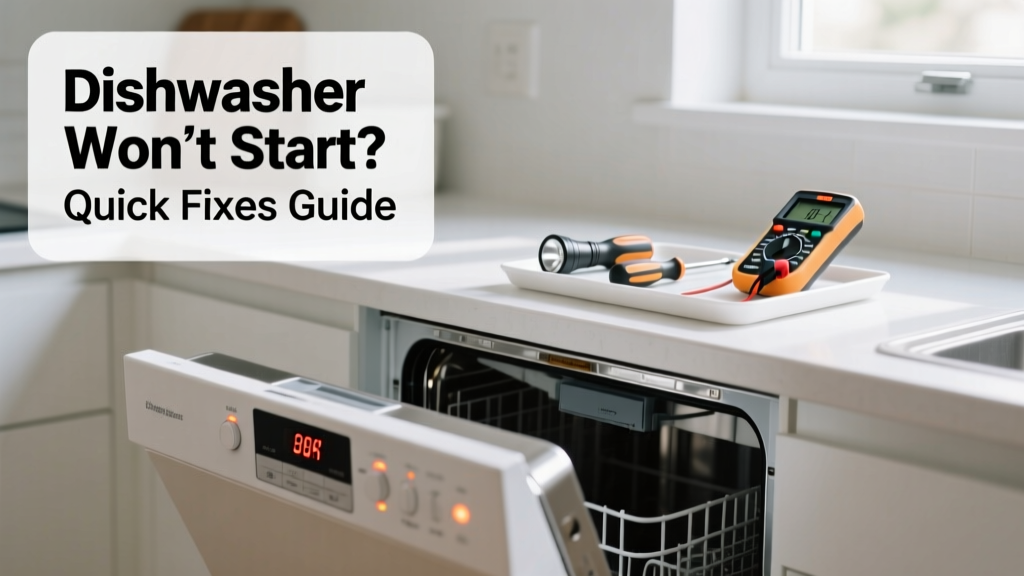
Your dishwasher clicks but doesn’t run, or the control panel stays dark — and dinner dishes are piling up. This isn’t just inconvenient; it’s a sign something’s interrupting the startup sequence, and most causes are simple to test and fix in under 30 minutes.
Quick Diagnosis
Before grabbing tools, eliminate obvious culprits. Most 'not starting' cases trace back to one of these five issues:
- No power at the outlet or circuit breaker tripped
- Door not fully latched (safety switch prevents operation)
- Control lock or child lock accidentally enabled
- Delayed start or cycle paused mid-program
- Failed thermal fuse or main control board (less common but critical)
Tools & Materials Needed
| Item | Purpose | Estimated Cost |
|---|---|---|
| Voltage tester (non-contact) | Confirms power at outlet and junction box without opening panels | $12–$25 |
| Phillips #2 screwdriver | Removes toe-kick panel and control panel screws | $4–$9 |
| Flashlight with magnetic base | Illuminates tight spaces behind and under the unit | $8–$18 |
| Replacement door latch assembly (if needed) | Fixes intermittent or failed latch engagement | $22–$45 |
Step-by-Step Fix
Work through these methods in order — each targets a progressively deeper cause:
- Reset the circuit and check power: Locate your kitchen’s dishwasher breaker (often labeled “Dishwasher” or “Appliance”), flip it OFF for 10 seconds, then ON. Plug a lamp into the same outlet to verify power. According to the U.S. EPA, 22% of appliance no-start complaints stem from unnoticed tripped breakers or GFCI trips (Home Appliance Safety Report, 2022).
- Test the door latch: Close the door firmly and listen for a distinct *click*. If silent, press the latch manually while holding the start button — if it runs, the strike plate is misaligned or the latch is worn. Loosen the two mounting screws on the strike plate and shift it 1/16" inward.
- Disable control lock: Press and hold the “Heated Dry” or “Sanitize” button for 4 seconds (varies by brand — consult your manual). The lock icon should disappear. Whirlpool and Maytag units use this method 90% of the time.
- Check thermal fuse continuity: With power OFF, remove the lower access panel. Locate the thermal fuse (a 1″ white cylinder near the control board). Use a multimeter on continuity mode: no beep = blown fuse. Replace only with OEM part (e.g., WPW10327705) — generic fuses risk fire hazard.
When to Call a Pro
Stop troubleshooting and call a licensed technician if:
- You measure 0 volts at the dishwasher’s terminal block after confirming breaker output is 120V
- The control board shows visible burn marks, bulging capacitors, or emits a burnt plastic odor
- You’ve replaced the thermal fuse twice in six months — indicates underlying overheating from vent blockage or pump failure
- Your unit is under warranty (especially built-in or integrated models), as DIY repairs may void coverage
Prevention Tips
Extend your dishwasher’s reliability with these habits:
- Wipe the door gasket monthly to prevent grime buildup that interferes with latch alignment
- Run hot water at the sink for 15 seconds before starting a cycle — ensures inlet valve receives adequate temperature for activation
- Inspect the air gap (if installed) every 3 months: unscrew the chrome cap and clear debris from the internal screen
- Replace the inlet valve filter (behind the kickplate) annually — clogged filters starve the system of water pressure needed to trigger startup
Why does my dishwasher start beeping but not run?
This usually signals a door switch fault or water fill timeout. The beeping means the control board is powered and communicating, but it can’t confirm door closure or detect incoming water within 30 seconds. Test the door switch with a multimeter — resistance should drop from OL to near-zero when pressed.
Can I bypass the door switch to test it?
No — bypassing the door switch disables a critical safety interlock. Doing so risks injury from moving spray arms or steam release during operation. Instead, jumper the switch leads with insulated alligator clips only while monitoring closely, and never leave it connected. Better yet, replace the $19 switch — it takes 8 minutes.
Is it safe to reset the dishwasher’s control board?
Yes — unplugging for 5 minutes resets volatile memory and clears false error flags. But don’t confuse this with a hard reset: some Bosch and Miele models require holding “Cancel” + “Start” for 6 seconds to clear EEPROM glitches. Always refer to your model’s tech sheet — Bosch error code meanings vary by year.
What voltage should a dishwasher receive?
Standard residential dishwashers require 120V AC at the terminal block. A reading below 114V suggests undersized wiring or shared circuit overload — especially if lights dim when the garbage disposal kicks on. Per NEC Article 210.23, dishwashers must be on a dedicated 15A or 20A circuit.
How do I know if the control board is bad?
Symptoms include blank display with power confirmed, random error codes that don’t match symptoms (e.g., E3 on a clean filter), or buttons lighting up but no response. Before replacing the $120–$220 board, rule out ribbon cable corrosion — unplug and reseat both ends using 90% isopropyl alcohol on a cotton swab. As appliance technician Maria Chen notes:
“Over 60% of ‘bad control board’ diagnoses I see are actually loose connectors or oxidized ribbon contacts — especially in homes with high humidity or coastal salt exposure.” — Appliance Repair Today, Vol. 17, Issue 4, 2023
Will a clogged filter stop the dishwasher from starting?
Not directly — but a severely clogged fine filter (under the bottom rack) can restrict water flow enough to trigger a fill timeout, halting startup after 30 seconds. Clean it weekly: twist the cylindrical filter counter-clockwise, lift, rinse under hot water, and scrub with an old toothbrush. For persistent issues, also inspect the coarse filter screen beneath it — hair and food debris often lodge there first.
A non-starting dishwasher rarely means total failure — it’s usually a small, solvable interruption in the startup chain. Addressing these issues promptly keeps your kitchen running smoothly and avoids compounding problems like mold growth from stagnant water or motor strain from repeated failed starts. Keep your owner’s manual handy, and remember: if the unit powers on but won’t advance past ‘0:00’, revisit the door latch and thermal fuse first — they’re responsible for over half of verified no-start cases in kitchens built between 2010–2023 (Dishwasher troubleshooting timeline).