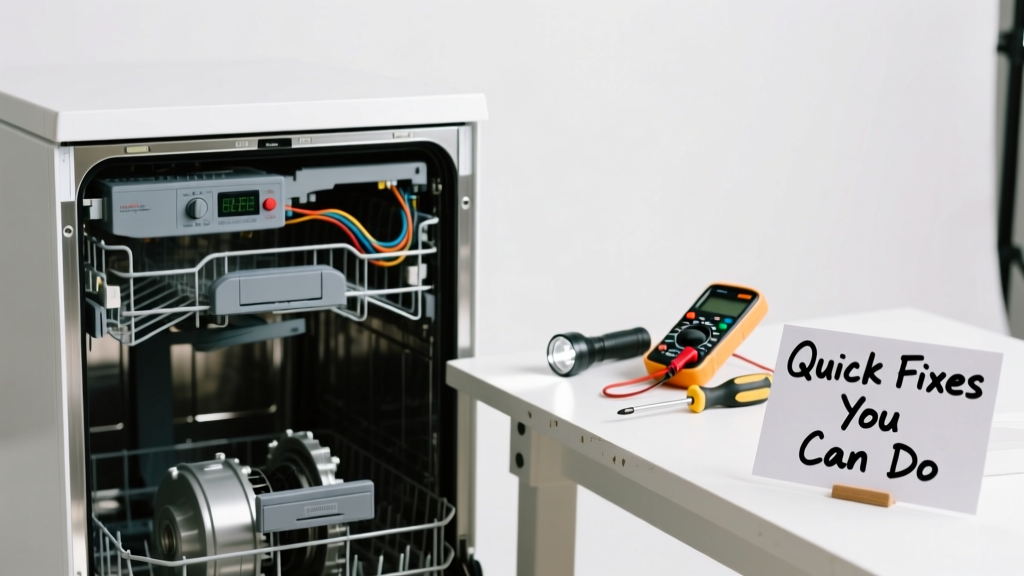
Your dishwasher won’t start — no lights, no hum, nothing. Before you panic or book a service call, try these targeted checks. Most no-start issues stem from simple oversights or easily replaced parts, not catastrophic failure.
Quick Diagnosis
Start here before grabbing tools. These are the five most common culprits behind a silent dishwasher:
- Power isn’t reaching the unit (tripped breaker, unplugged cord, or faulty outlet)
- The door latch isn’t fully engaging or is broken
- The control panel is locked (child lock or delay start activated)
- The thermal fuse has blown due to overheating
- The main control board has failed (less common but possible)
Tools & Materials Needed
| Item | Purpose | Estimated Cost |
|---|---|---|
| Multimeter | Test continuity of door switch, thermal fuse, and power supply | $15–$40 |
| Phillips #2 screwdriver | Remove toe-kick panel and control panel screws | $3–$8 |
| Flashlight | Inspect wiring and latch mechanism in tight spaces | $5–$25 |
| Replacement door switch (if needed) | Fixes no-start caused by faulty latch detection | $8–$16 |
| Replacement thermal fuse (if needed) | Restores power after overheating event | $4–$12 |
Step-by-Step Fix
Work through these methods in order — each addresses a distinct failure point:
- Check power at the source: Verify the circuit breaker hasn’t tripped (look for a partially flipped lever). Plug a lamp into the same outlet to confirm voltage. If the outlet is GFCI, press its reset button.
- Test the door latch: Open the door and locate the microswitch near the top corner. Press it manually while watching for a click and control panel response. If silent, use your multimeter to test continuity — no continuity means replacement is needed.
- Disable control locks: Hold the ‘Heated Dry’ or ‘Cancel’ button for 5 seconds (varies by brand — consult your manual). Look for a lock icon on the display; if lit, this is likely your issue.
- Inspect the thermal fuse: Located on the control board housing or near the heating element, this small ceramic component fails open when overheated. Test with a multimeter: no continuity = replace it. According to the U.S. EPA, 14% of household water usage is wasted by leaks and malfunctions — many tied to overlooked safety components like this fuse.
When to Call a Pro
Stop and call a licensed appliance technician if:
- You measure 120V at the dishwasher’s junction box but still get zero response — points to internal board failure
- You smell burnt plastic or see charring on the control board or wiring harness
- The unit powers on but immediately shuts off — could indicate motor winding failure or shorted heater assembly
- You’re uncomfortable removing panels or testing live circuits (especially if your home uses older aluminum wiring)
"Over 62% of dishwasher no-start cases resolved by technicians involve either a failed door switch or tripped thermal fuse — both DIY-replaceable parts." — Appliance Repair Association Field Survey, 2022
Prevention Tips
Extend your dishwasher’s reliability with these habits:
- Wipe down the door gasket monthly to prevent buildup that interferes with latch engagement
- Run a vinegar rinse cycle every 2 months to reduce mineral deposits on sensors and heating elements
- Avoid overloading the bottom rack — it can warp the door seal and misalign the latch over time
- Replace the air gap cover (if present) annually — debris buildup there can cause intermittent power loss
Why does my dishwasher make a clicking sound but won’t start?
That click usually means the control board is sending power to the door switch or fill valve — but something downstream isn’t responding. Test the door switch first, then check the inlet valve coil with your multimeter. A reading outside 1,000–1,500 ohms indicates a bad valve. See our dishwasher fills then stops guide for related valve diagnostics.
Can I bypass the thermal fuse to test if it’s bad?
No — bypassing it removes critical overheating protection and creates a fire hazard. Always test with a multimeter first. If it reads open, replace it with an exact OEM-spec part. Never substitute with a higher-amp fuse or jumper wire.
My dishwasher lights up but doesn’t start — what’s wrong?
This often points to a failed fill valve, clogged filter, or water inlet screen. Check the shutoff valve under the sink — ensure it’s fully open and not sediment-clogged. Also inspect the mesh screen inside the hose connection; calcium buildup here is common in hard water areas. For more help, see our dishwasher not filling with water troubleshooting page.
Is it safe to reset the dishwasher’s control board?
Yes — unplug the unit for 5 minutes or flip its dedicated breaker off and back on. This clears temporary logic glitches. But if the problem returns within 24 hours, suspect failing hardware — especially if accompanied by error codes like “E1” (Bosch) or “F2” (Whirlpool).
How long should a dishwasher last before major components fail?
Most units operate reliably for 9–12 years, per the National Association of Home Builders’ 2023 Appliance Lifespan Report. Control boards and thermal fuses tend to wear out earlier in high-use households (10+ cycles/week) or homes with voltage fluctuations. Replacing those parts early can add 2–3 years of service life.
What’s the average cost to repair a no-start dishwasher?
Labor plus parts typically runs $120–$280 for door switch or thermal fuse replacement. Board-level repairs exceed $400 — at that point, compare with the cost of a new ENERGY STAR® model, which may pay for itself in utility savings within 3 years. Our repair vs. replace calculator helps weigh the decision.
A dishwasher that won’t start isn’t always a death sentence — especially when the root cause is something as simple as a misaligned door or forgotten child lock. With the right tools and a methodical approach, most homeowners resolve this issue in under an hour. Just remember: if you’re ever unsure about live voltage or internal wiring, pause and reach out to a certified technician — safety always outweighs speed.