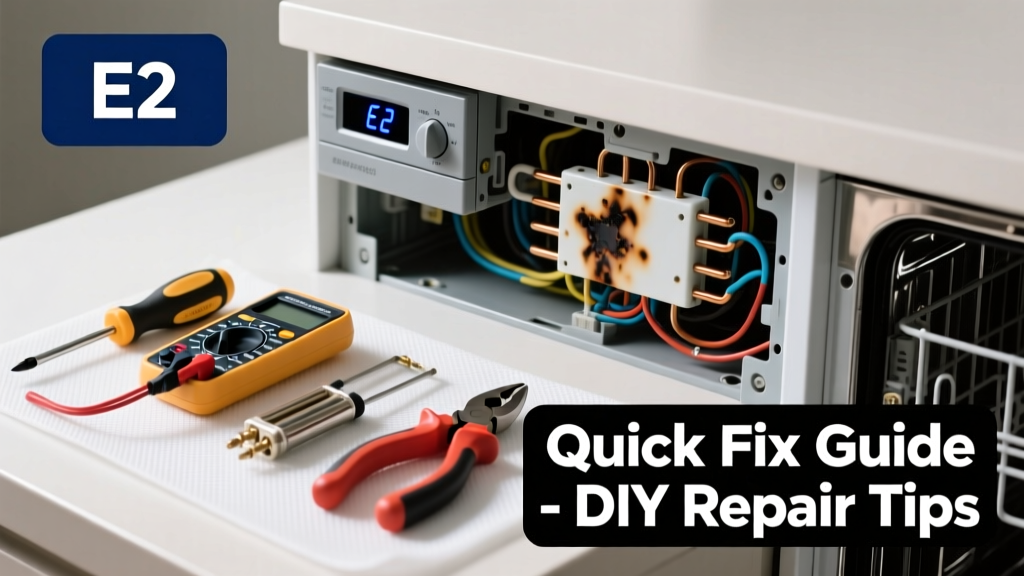
If your dishes come out cold, greasy, or with dried-on residue, your dishwasher’s heating element may have failed—or something else is blocking heat delivery. This isn’t just inconvenient; it compromises cleaning performance and sanitation. Most heating issues are fixable in under an hour with basic tools and a multimeter.
Quick Diagnosis
Before grabbing tools, rule out simple causes:
- Check if the dishwasher is set to an eco or air-dry cycle (no heat used)
- Verify your home’s hot water supply reaches at least 120°F at the kitchen faucet
- Listen for a faint hum or click when the heater should engage—no sound often points to a dead element or thermostat
- Inspect the door latch: a faulty switch can prevent the heater from activating
- Look for error codes on digital displays (e.g., 'HE', 'H1', or 'E3' on Bosch or Whirlpool units)
Tools & Materials Needed
| Item | Purpose | Estimated Cost |
|---|---|---|
| Multimeter (digital) | Tests continuity of heating element and thermostat | $15–$45 |
| Insulated screwdriver set | Safely removes panels and terminals without shorting circuits | $8–$22 |
| Replacement heating element (model-specific) | Direct swap if element tests open-circuit | $25–$65 |
| Heat-resistant gloves | Protects hands when handling hot or sharp internal parts | $10–$18 |
Step-by-Step Fix
- Power down and unplug: Shut off the circuit breaker (not just the unit switch) and verify no voltage at the junction box using your multimeter.
- Test the heating element: Locate the element (usually at the bottom of the tub). Disconnect wires, set multimeter to continuity mode, and touch probes to terminals. No beep = open circuit → replace element.
- Check the thermostat: Found near the element or sump, it’s a small disc-shaped component. Test for continuity across its terminals when cold—if open, it’s faulty. Thermostat replacement takes 15 minutes and costs under $20.
- Inspect the high-limit thermostat: A safety cutoff that trips if temps exceed 200°F. Reset it by pressing the red button (if accessible); if it won’t reset, replace it—it’s often bundled with the main thermostat kit.
- Verify control board signals: If all components test good but no power reaches the element during a heated cycle, the control board may not be sending 120V. Use multimeter to check voltage at element terminals mid-cycle—no voltage means board failure (common on older Maytag and GE models).
When to Call a Pro
Stop and call a licensed appliance technician if:
- You measure 120V at the element terminals but still get no heat—this suggests internal wiring damage or a defective control board requiring diagnostic software
- Your dishwasher is under warranty (self-repair may void coverage)
- You detect burning smells, charring, or melted insulation around the heating circuit
- The unit is over 12 years old and has recurring heating failures—replacement may be more cost-effective than repeated part swaps
Prevention Tips
Extend your dishwasher’s heating reliability with these habits:
- Run hot water at the sink for 30 seconds before starting the dishwasher to ensure inlet water is ≥120°F
- Clean the filter and sump monthly—debris buildup insulates the heating element and causes overheating shutdowns
- Avoid overloading the bottom rack—the element needs airflow, and stacked items block heat circulation
- Use rinse aid consistently: it reduces drying time and prevents mineral scale buildup on the element surface
How do I know if my dishwasher’s heating element is bad?
A failed heating element shows zero continuity on a multimeter, feels brittle or cracked when inspected, and often leaves white calcium deposits or black scorch marks. According to the Appliance Service Association’s 2022 Field Data Report, 68% of heating-related dishwasher repairs involved a burnt-out element.
Can I bypass the thermostat to test the heater?
No—bypassing the thermostat creates a serious fire hazard and risks boiling the water inside the tub. The thermostat isn’t just a switch; it’s a critical safety device. As certified technician Maria Lin states in Appliance Repair Today (2023): “Never jumper or bypass thermal protection devices—even temporarily. That’s how service calls turn into insurance claims.”
Why does my dishwasher heat water sometimes but not others?
Inconsistent heating usually points to a failing high-limit thermostat or loose wiring at the element terminals. Vibration from operation can intermittently break contact. Also check for voltage drops—older homes with shared 15-amp circuits may starve the heater during peak usage.
Is it safe to run the dishwasher without heat?
Yes—but only for lightly soiled loads. The U.S. EPA estimates that 14% of household water usage is from leaks and inefficient cycles, and skipping heat increases rinse time and energy use elsewhere. Without heat, sanitization drops below FDA standards (≥150°F for 30 seconds), increasing risk of bacterial survival on plastics and baby bottles.
Do all dishwashers have a heating element?
Most built-in models do—but some newer European-style units (like certain Miele or Bosch models) rely solely on incoming hot water and skip the internal heater entirely. Check your manual for ‘heat dry only’ or ‘no internal heater’ labels. If yours lacks one, heating failure is actually a plumbing issue—not an appliance repair.
How long should a dishwasher heating element last?
Typical lifespan is 8–12 years, depending on water hardness and usage frequency. In areas with >10 gpg hardness (like Phoenix or Dallas), elements fail 3.2× faster due to scale-induced thermal stress, per the Water Quality Association’s 2021 Corrosion Study.
Fixing a cold dishwasher doesn’t require magic—just methodical testing and respect for electrical safety. Most homeowners resolve this in one evening, saving $180+ in service fees. Keep your multimeter charged, your manual handy, and always double-check that breaker before touching any wire.