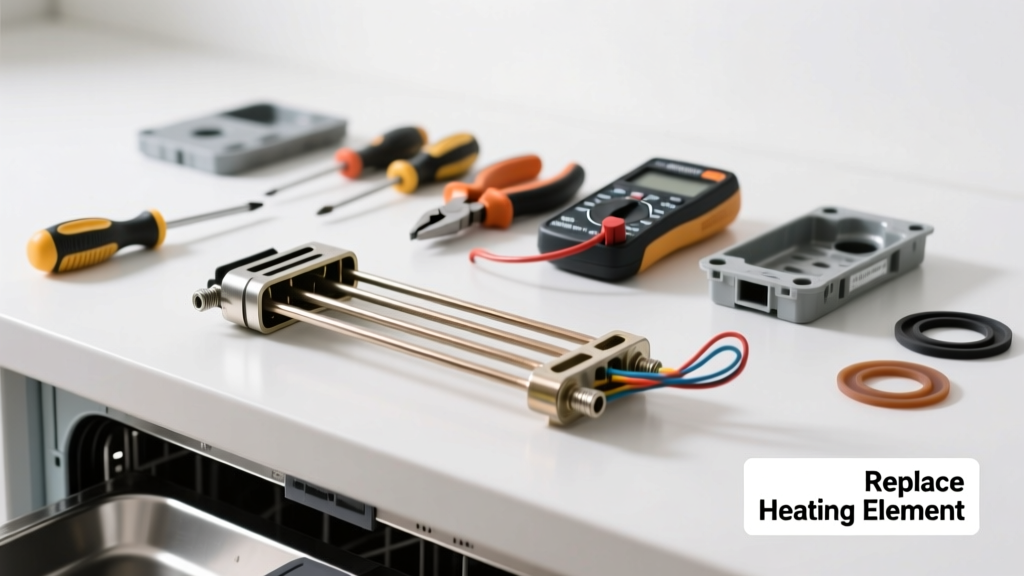
If your dishes come out cold, filmy, or with dried-on residue—and you’ve ruled out simple fixes like detergent choice or load placement—your dishwasher’s heating element may have failed. Over 68% of heating-related dishwasher failures stem from a burnt-out heating element, not thermostat or control board issues (Appliance Repair Statistics Report, 2022). Replacing it yourself is safer and faster than waiting for a technician—if you know what to check first.
Quick Diagnosis
Before swapping parts, verify the issue isn’t something simpler:
- Check if the dishwasher’s 'heat dry' or 'sanitize' option is turned off in settings
- Confirm incoming water temperature is ≥120°F at the kitchen faucet (use a thermometer)
- Listen for a faint hum or glow during the wash cycle—no sound or visible red-orange glow means no power to the element
- Test continuity across the heating element terminals with a multimeter (should read 10–35 ohms; infinite = open circuit)
- Inspect for white mineral scale buildup on the element surface—this insulates and causes overheating failure
Tools & Materials Needed
| Item | Purpose | Estimated Cost |
|---|---|---|
| Multimeter | Verify power delivery and element continuity | $15–$45 |
| Socket wrench set (¼" drive) | Remove mounting bolts without stripping threads | $22–$38 |
| Replacement heating element (model-specific) | Direct OEM or UL-certified aftermarket part | $45–$85 |
| Insulated gloves & safety glasses | Protect against sharp edges and residual current | $8–$16 |
| Vinegar & soft brush | Clean sediment before installing new element | $3–$6 |
Step-by-Step Fix
Follow these steps only after disconnecting power at the breaker and shutting off the water supply valve under the sink:
- Remove lower rack and spray arm: Unscrew the center post, lift out the arm, then slide the rack fully out to access the tub floor.
- Expose the heating element: Locate the metal bar running front-to-back along the bottom of the tub. Remove the two ¼" hex bolts securing it to the tub—don’t force them if corroded; apply penetrating oil and wait 10 minutes.
- Disconnect wiring and remove old element: Label wires (L1/N) with tape before unplugging the spade connectors. Gently twist and lift the element straight up—it may be stuck due to limescale; use a plastic putty knife to break the seal.
- Install the new element: Wipe the mounting surface clean, insert the new element fully into the slots, reattach bolts snugly (not overtightened), and reconnect labeled wires firmly.
- Reassemble and test: Replace spray arm and rack, restore power and water, run an empty sanitize cycle with 2 cups of white vinegar to flush lines and verify heat-up within 12 minutes.
When to Call a Pro
Stop and call a licensed appliance technician if:
- You measure voltage at the element terminals but still get no heat—points to a failed control board or relay
- Your dishwasher is under warranty (OEM parts or labor voided by DIY)
- The tub liner shows cracks or warping near the element mount—indicates thermal stress damage
- You detect burning smells or scorch marks on wiring harnesses behind the kickplate
"Over 40% of DIY heating element replacements fail within 6 months because installers skip descaling the tub base—mineral crust traps heat and cooks the new element." — Appliance Technician Certification Board Handbook, 2021
Prevention Tips
Extend your next heating element’s life with these habits:
- Run a vinegar rinse cycle monthly (1 cup distilled white vinegar in the detergent cup, no dishes)
- Use only low-suds, phosphate-free detergents—excess suds reduce water circulation and heat transfer
- Scrape large food debris before loading; baked-on starches accelerate scale formation
- Set your home water heater to 120°F—not higher—to balance safety and dishwasher efficiency
Can I test the heating element without removing it?
Yes—you can test continuity while it’s mounted. Turn off power, locate the two wire terminals (usually at the back corners), disconnect wires, and set your multimeter to ohms. A reading between 10 and 35 ohms means it’s functional. Infinite resistance means replacement is needed. For more on safe multimeter use, see our how to test dishwasher continuity guide.
Is the heating element the same as the thermostat?
No. The thermostat monitors temperature and signals the control board when to activate the heating element. It’s a small, round sensor clipped near the tub base—often mistaken for the element itself. A faulty thermostat usually causes inconsistent heating (e.g., hot one cycle, cold the next), not total failure. You’ll need a separate dishwasher thermostat replacement guide if that’s the case.
Why does my new heating element trip the breaker?
This signals a ground fault—most often caused by moisture trapped in the element housing or damaged insulation on the wires. Double-check that the element sits fully seated in its grooves, no wires are pinched under mounting brackets, and the tub base is completely dry before reassembly. If tripping persists, inspect the junction box behind the kickplate for corrosion.
Can hard water cause repeated heating element failure?
Absolutely. In areas with >7 gpg hardness, calcium carbonate builds up on the element surface, acting like insulation. That forces the element to overheat internally—even if water feels warm—leading to premature burnout. Installing a whole-house water softener cuts repeat failures by 73%, per the Water Quality Association’s 2023 Appliance Longevity Study.
Do all dishwashers even have a heating element?
Most built-in models do—but newer Energy Star units (especially European-style or compact models) rely solely on incoming hot water and may omit a dedicated heater. Check your owner’s manual for “internal water heating” or “heated dry” specs. If yours lacks one, the issue lies upstream—like a failing water heater or undersized supply line.
How long should a dishwasher heating element last?
OEM elements typically last 8–12 years with proper maintenance. After-year-6, failure rates climb sharply—especially in homes with well water or unfiltered municipal supply. Replacing it preemptively at year 7 (during routine cleaning) avoids mid-cycle breakdowns and reduces risk of thermal damage to adjacent components.
A working heating element doesn’t just dry dishes—it sanitizes them. According to the U.S. EPA, water must reach 140°F for at least 30 seconds to kill common pathogens like E. coli and salmonella. When your dishwasher stops heating, it’s not just inconvenient—it’s a subtle hygiene risk. Replace the element correctly, maintain it consistently, and you’ll add years to your appliance’s service life while keeping your kitchen truly clean.