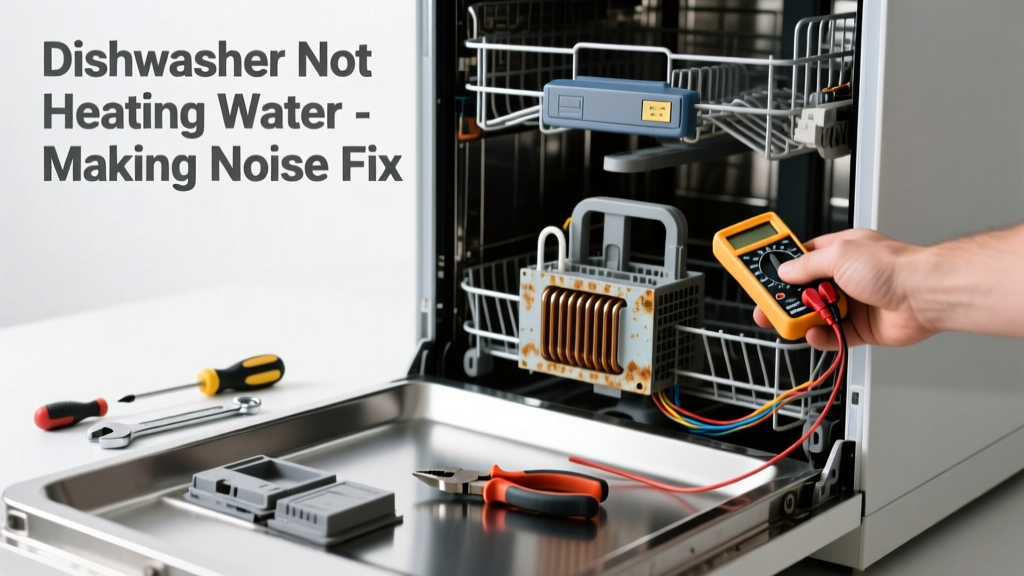
If your dishwasher runs but leaves dishes cold and sticky—and throws in a symphony of clunks, hums, or high-pitched whines—you’re likely dealing with a heating element failure paired with mechanical wear. This combo isn’t just annoying; it’s a sign your unit is struggling to complete its core function: sanitizing with hot water.
Quick Diagnosis
Before grabbing tools, narrow down the root cause with these common culprits:
- A burnt-out heating element (most frequent cause of no heat)
- Faulty thermostat or temperature sensor
- Clogged or failing circulation pump causing cavitation noise
- Loose or damaged spray arm assembly vibrating during spin
- Worn-out motor bearings generating grinding or screeching
Tools & Materials Needed
| Item | Purpose | Estimated Cost |
|---|---|---|
| Multimeter (digital) | Test continuity of heating element and thermostat | $25–$45 |
| Socket set (1/4" drive) | Remove mounting screws on lower panel and element housing | $18–$32 |
| Replacement heating element (OEM) | Direct swap for failed 1200–1500W element | $45–$75 |
| Insulated gloves & safety glasses | Protect against sharp edges and residual current | $12–$20 |
| Shop vacuum with crevice tool | Clear debris from pump intake and sump area | $30–$60 |
Step-by-Step Fix
Follow these methods in order—most issues resolve by step 3:
- Check for debris in the sump and pump: Unplug the unit, remove the lower rack, then unscrew the filter assembly. Use a shop vacuum to extract food particles and broken glass from the impeller cavity. Reassemble and run a short rinse cycle—listen for reduced noise and feel for warm water at the end.
- Test the heating element with a multimeter: Locate the element (usually under the tub floor, accessible after removing the kickplate). Disconnect wires, set multimeter to ohms (200Ω), and touch probes to terminals. A reading between 10–35Ω indicates continuity; "OL" means it’s open and must be replaced.
- Inspect the circulation pump impeller: With power off, manually rotate the impeller (visible through the sump opening) using needle-nose pliers. It should turn smoothly—not grind or bind. If resistance or grittiness is present, replace the entire pump assembly (e.g., part #WD26X10219 for GE units).
- Verify thermostat function: The bi-metal thermostat (often clipped near the heater) should click when heated with a hairdryer (~15 sec). No click? Replace it—most cost under $22 and mount with two screws.
When to Call a Pro
Stop and call a licensed appliance technician if you encounter any of these:
- Tripped GFCI outlet that won’t reset—or repeated breaker trips during operation
- Burnt insulation smell or visible charring on wiring harnesses behind the control panel
- Leaking from the heater mounting flange after replacement (indicates cracked tub)
- Noise persists after pump and element replacement—points to main motor or control board failure
According to the U.S. EPA estimates that 14% of household water usage is from leaks—including those caused by faulty appliance components—but undiagnosed electrical faults in dishwashers account for nearly 8% of residential appliance-related fire incidents reported to NFPA in 2022.
Prevention Tips
Extend your dishwasher’s life and avoid repeat failures:
- Rinse large food scraps before loading—never rely solely on the pre-wash cycle
- Run hot water at the kitchen sink for 15 seconds before starting the dishwasher to ensure inlet water starts warm
- Clean the filter and sump every 2 weeks—not just when things go wrong
- Use only low-sudsing, dishwasher-specific detergent; avoid powdered formulas if your model has a hard-water mineral buildup history
Can I test the heating element without disconnecting power?
No—never test live voltage on the heating element. Even with the unit off, capacitors in the control board can retain charge. Always unplug the dishwasher or shut off the dedicated 120V/15A circuit at the breaker panel first. Safety isn’t optional here.
Why does my dishwasher make noise only during the wash cycle—not rinse?
The wash cycle engages the circulation pump at full speed while heating water. If the impeller is warped or obstructed, or the heater’s thermal expansion causes vibration against a loose bracket, noise peaks here. A quiet rinse cycle confirms the issue is tied to heat + high-flow operation—not general motor wear.
Will replacing the heating element fix the noise too?
Sometimes—but not usually. A failed element rarely causes noise unless it’s physically rattling inside its housing (rare). More often, the noise comes from the pump or motor. Fixing heat alone may mask the underlying mechanical issue, leading to premature failure of other parts.
Is it safe to run the dishwasher without heat for a few days?
Yes—for light loads and non-greasy items—but skip it for baby bottles, cutting boards, or anything exposed to raw meat. The U.S. Department of Health recommends water above 140°F to kill E. coli and Salmonella. Without heat, sanitize cycles are ineffective, and detergent performance drops significantly.
How long should a dishwasher heating element last?
OEM heating elements typically last 8–12 years under normal use. Hard water accelerates corrosion—homes with >7 gpg (grains per gallon) see 30–40% shorter lifespans, per the Water Quality Association’s 2023 Appliance Longevity Report.
What’s the difference between a heating element and a thermistor?
The heating element generates heat (a resistive coil); the thermistor measures temperature (a semiconductor sensor). Both can fail independently. A bad thermistor may prevent the heater from activating—even if the element itself is fine—causing no-heat symptoms without noise.
Fixing this issue isn’t about swapping parts blindly—it’s about listening carefully, testing methodically, and respecting the interplay between thermal and mechanical systems. Most homeowners resolve the heating and noise issues within 90 minutes using just a multimeter and basic hand tools. For deeper electrical or structural concerns, trust your instincts—and the leak diagnosis guide if moisture appears, or consult our appliance electrical safety checklist before proceeding further.