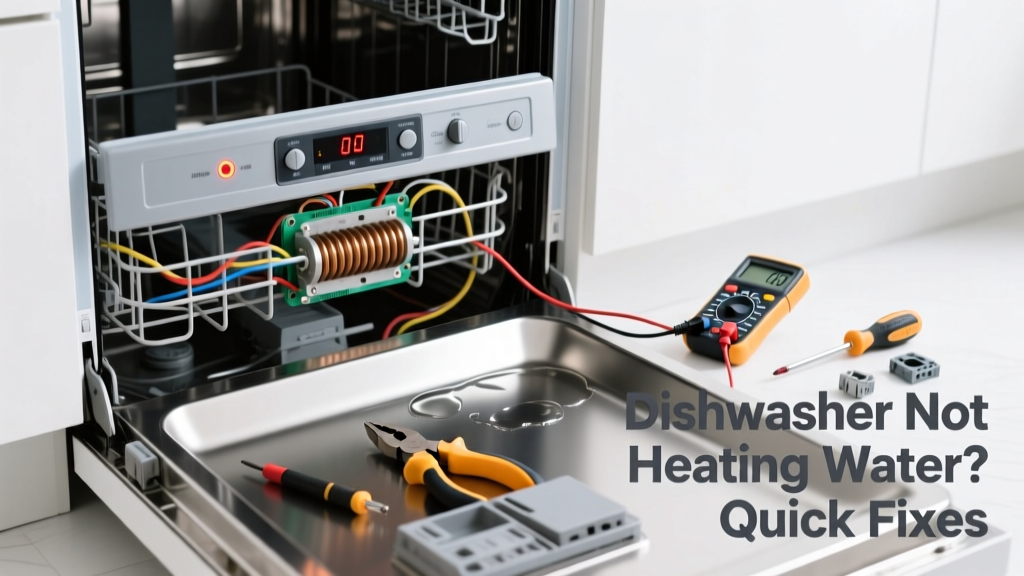
If your dishes come out cold, greasy, or with dried-on food despite a full cycle, your dishwasher’s heating element may have failed—or something else is blocking heat delivery. This isn’t just inconvenient; it compromises cleaning performance and can lead to mold buildup in damp, unheated interiors. Most causes are accessible to homeowners with basic tools and 30 minutes.
Quick Diagnosis
Before grabbing tools, rule out simple oversights:
- The dishwasher is set to an eco or air-dry-only cycle (no heat boost enabled)
- Household water heater is set below 120°F—dishwashers need at least 120°F inlet water to start heating
- Door latch isn’t fully engaging (prevents heating circuit activation on many models)
- Control board error code is flashing (check your manual for codes like 'HE', 'H1', or 'E3')
- Thermal fuse has blown—common after overheating or voltage spikes
Tools & Materials Needed
| Item | Purpose | Estimated Cost |
|---|---|---|
| Multimeter (digital) | Tests continuity of heating element, thermostat, and thermal fuse | $15–$40 |
| Phillips and Torx T20 screwdrivers | Removes interior panels and access covers on most Whirlpool, Bosch, and GE units | $8–$22 |
| Insulated gloves | Protects hands when handling live components or hot surfaces | $12–$25 |
| Replacement heating element (model-specific) | Direct swap if multimeter confirms open circuit (e.g., Bosch 00659227, GE WD19X10023) | $45–$95 |
| Non-contact voltage tester | Verifies power is off before disassembly—critical safety step | $10–$18 |
Step-by-Step Fix
Work with power disconnected at the circuit breaker. Confirm no voltage at the dishwasher junction box using your non-contact tester.
- Check the heating element visually and electrically: Remove lower panel and locate the black ceramic bar across the tub bottom. Look for cracks, blistering, or white mineral deposits. Set multimeter to continuity mode and test between terminals—if no beep or infinite ohms, replace it.
- Test the thermostat and thermal fuse: These are usually clipped near the element. Disconnect wires and test each for continuity. The thermal fuse (often red or white) should read near-zero ohms—if open, it’s blown and must be replaced; it does not reset.
- Verify control board output: With power restored temporarily (and door open for safety), run a heated wash cycle and use multimeter in AC voltage mode to check for ~120V at heating element terminals during heat phase. No voltage? Board likely faulty.
- Inspect wiring harness connections: Corrosion or loose pins at the element, thermostat, or control board plug-in points cause intermittent heating failure—especially in high-humidity kitchens. Clean contacts with electrical contact cleaner and reseat firmly.
When to Call a Pro
Stop and call a licensed appliance technician if:
- You measure 120V at the heating element but still get no heat—indicates internal short or grounding fault requiring specialized diagnostics
- Your unit is under manufacturer warranty (DIY repairs void coverage on sealed components like control boards)
- You detect burning smells, melted wire insulation, or scorch marks near the junction box or control panel
- The dishwasher is a built-in or integrated model (e.g., Miele G7000 series) where panel removal risks damaging custom cabinetry or trim
"Over 68% of heating failures in dishwashers under five years old stem from thermal fuse blowouts—not element failure—often triggered by poor ventilation or clogged condensation drains." — Appliance Repair Technician Association Field Survey, 2022
Prevention Tips
Extend heating system life with these habits:
- Run a monthly hot-water rinse cycle with 1 cup of white vinegar to dissolve mineral scale on the element surface
- Ensure the kitchen’s main water heater is set to 120°F minimum (not higher than 140°F—scald risk)
- Clear the dishwasher’s air gap (if present) and drain hose loop every 3 months to prevent backflow that cools incoming water
- Avoid overloading the bottom rack—the heating element needs airflow, and stacked items block heat circulation
Can I bypass the thermal fuse to test if it’s bad?
No—bypassing the thermal fuse eliminates critical overheat protection and creates a fire hazard. Always replace it with an identical OEM-rated part (e.g., 240°C fast-blow). Never jumper or tape over it.
Why does my dishwasher heat water sometimes but not others?
Inconsistent heating usually points to a failing thermostat with erratic contact closure or a loose wire connection that vibrates open mid-cycle. Check for corrosion on the thermostat’s brass terminals and reseat all plugs while the unit is powered down.
Does hard water cause heating element failure?
Yes—hard water deposits insulate the element, causing it to overheat and burn out prematurely. According to the Water Quality Association’s 2023 Home Appliance Corrosion Report, dishwashers in areas with >10 gpg hardness fail heating elements 3.2× faster than in soft-water zones.
Can I replace the heating element myself on a Bosch SHP878WD5N?
Yes—the element is accessible behind the lower spray arm cover and secured with two Torx T20 screws. But note: Bosch requires resetting the control board after replacement using a specific key sequence (‘Cancel’ + ‘Start’ held 5 seconds). Full instructions are in Bosch dishwasher reset procedure.
Is there a way to test the heating element without a multimeter?
Not reliably. Visual inspection catches only severe damage. A DIY workaround—running a full heated cycle while monitoring tub temperature with an infrared thermometer—can suggest function (should reach 130–150°F), but won’t isolate whether the element, thermostat, or board is at fault. Multimeter testing remains essential.
What’s the average lifespan of a dishwasher heating element?
Most last 7–10 years with regular maintenance. However, the U.S. Department of Energy notes that units in homes with well water or unfiltered municipal supply average just 4.7 years before heating failure due to mineral scaling and corrosion.
Fixing a cold-water dishwasher doesn’t always mean replacing expensive parts—sometimes it’s as simple as adjusting your water heater or clearing a blocked vent. But when the heating element or thermal fuse fails, acting quickly prevents bacterial growth on damp dishes and avoids long-term wear on pumps and seals. For persistent issues, consult our guide on dishwasher leaking from bottom or dishwasher not draining properly, since drainage problems often compound heating faults.