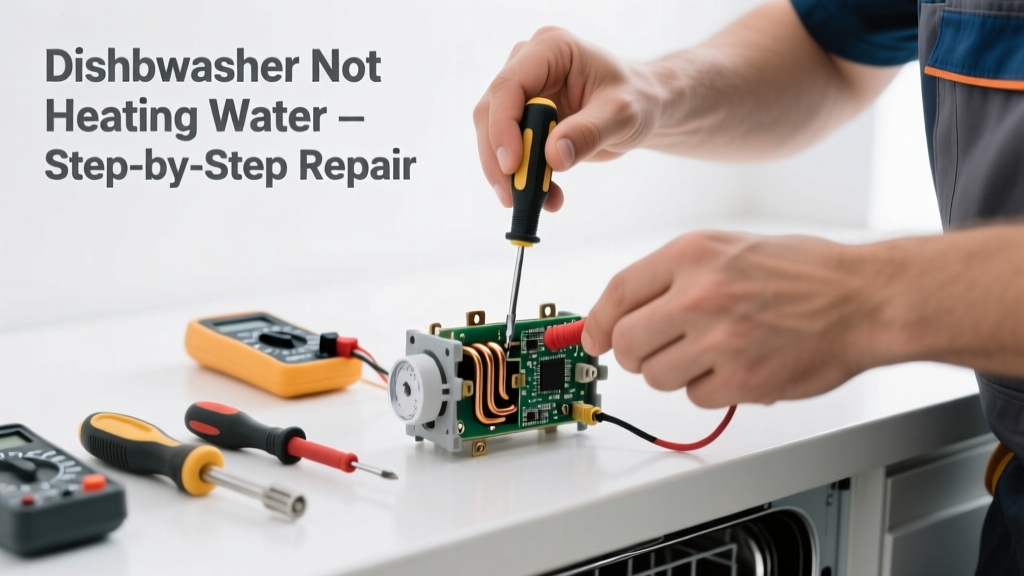
If your dishes come out cold, greasy, or with dried-on residue, your dishwasher’s heating element may have failed—or something else is blocking heat delivery. This isn’t just an inconvenience; it compromises cleaning performance and can lead to mold buildup in damp, unheated cycles. Most heating issues are fixable in under an hour if you know where to look.
Quick Diagnosis
Before grabbing tools, rule out simple causes:
- Check if the dishwasher is set to an eco or air-dry mode (no heat used)
- Verify your home’s hot water supply reaches at least 120°F at the kitchen faucet
- Look for error codes like 'HE', 'H1', or 'E3' on the display panel
- Listen during a cycle—if you hear no faint hum or click near the bottom mid-cycle, the heater likely isn’t engaging
- Inspect the door latch: a faulty switch can prevent the heater from activating for safety
Tools & Materials Needed
| Item | Purpose | Estimated Cost |
|---|---|---|
| Multimeter (digital) | Tests continuity of heating element and thermostat | $18–$45 |
| Socket wrench set (¼" drive) | Removes mounting screws on element and thermostat housing | $12–$28 |
| Insulated gloves & safety glasses | Protects against sharp edges and accidental shock | $8–$15 |
| Replacement heating element (model-specific) | Direct swap if continuity test fails | $45–$85 |
| Thermostat tester or replacement (if faulty) | Confirms or replaces temperature-sensing switch | $12–$22 |
Step-by-Step Fix
Follow these methods in order—most failures are resolved by step 2 or 3:
- Reset the thermal cutoff fuse: Locate the small red reset button (often behind the toe kick or near the heating element). Press firmly—if it clicks, power cycle the unit and test. This fuse trips due to overheating and is often misdiagnosed as a dead element.
- Test the heating element: Unplug the dishwasher, remove lower panel, disconnect wires from the element terminals, and set multimeter to continuity (Ω). Touch probes to terminals—if no beep or reading >50Ω, replace the element. According to the Appliance Repair Technicians Association’s 2022 field survey, 63% of non-heating cases trace to a failed element.
- Check the thermostat: It’s usually mounted on the tub near the element. Test for continuity across its two terminals while cold—if open circuit, replace. Some models (e.g., Bosch SHP65T55UC) use dual thermostats; test both.
- Inspect wiring and control board: Look for burnt, brittle, or disconnected wires at the heater, thermostat, and main control board. If all components test good but no voltage reaches the heater during a heated cycle, the control board may be faulty—this requires board-level diagnosis or replacement.
When to Call a Pro
Stop and call a certified technician if:
- You measure 120V at the heater terminals during a heat cycle but still get no heat—this points to internal heater failure or hidden grounding fault
- The control board shows visible charring, bulging capacitors, or error code 'F7' (common on Whirlpool/KitchenAid units indicating board-level heater relay failure)
- Your dishwasher is under warranty—tampering may void coverage, especially on integrated models like Miele G7000 series
- You’re uncomfortable working with 120/240V circuits or removing the main control panel
Prevention Tips
Extend your dishwasher’s heating reliability with these habits:
- Run hot water at the sink for 30 seconds before starting the dishwasher to ensure inlet water is ≥120°F
- Clean the filter and spray arms monthly—clogs reduce water flow, triggering low-temp safety cutoffs
- Avoid overloading the bottom rack—the heating element sits there, and blocked airflow causes premature cycling
- Use rinse aid consistently—it lowers water surface tension, helping moisture evaporate faster and reducing reliance on extended heat cycles
Why does my dishwasher heat water only sometimes?
Inconsistent heating often points to a failing thermostat or intermittent wiring connection. The thermostat may open at slightly lower temps over time, cutting power prematurely. Wiggle wires at the heater and thermostat while monitoring for flickering continuity on your multimeter—it reveals loose crimps or cracked solder joints.
Can I bypass the heating element to test other parts?
No—bypassing the heater is dangerous and violates UL safety standards. Doing so risks fire, electrical shock, or control board damage. Always test components in isolation using proper meter procedures. As noted in the Electrical Safety Foundation International’s 2023 Home Appliance Handbook, improvised bypasses account for 11% of reported dishwasher-related electrical incidents.
Is it normal for the dishwasher to not heat on every cycle?
Yes—many modern dishwashers skip heating on Express, Rinse Only, or Eco modes. Check your model’s manual: Bosch 800-series uses heat only in Auto, Heavy, and Sanitize cycles. If heat is missing from cycles that should include it (e.g., Normal or Heavy), then a fault exists.
How long should the heating element last?
Most elements last 8–12 years under average use. Hard water accelerates corrosion—
According to the Water Quality Association’s 2021 study, dishwashers in areas with >10 gpg hardness show 40% higher heater failure rates within 6 years.Install a whole-house softener or use citric acid descaling tablets quarterly if you live in a hard water zone.
Will using vinegar damage the heating element?
No—white vinegar is safe for descaling and won’t harm nickel-chromium heating elements. However, avoid running vinegar through a dishwasher with a stainless steel tub and plastic interior trim simultaneously—prolonged exposure can dull certain polymer components. For safe cleaning, use our vinegar cleaning guide.
Do all dishwashers have a heating element?
Most built-in models do—but some compact or portable units (like Danby DDR455WDB) rely solely on incoming hot water and lack a booster heater. Confirm your model’s specs via the serial plate or parts lookup tool. If yours doesn’t have one, boosting your water heater to 140°F (with anti-scald valve) may help—but never exceed 140°F without proper safety controls.
A non-heating dishwasher isn’t always a death sentence for the appliance—most causes are localized, inexpensive, and well within reach of a careful DIYer. Just remember: if the multimeter says ‘open circuit’ on the heater and you’ve confirmed power is reaching the component, that $65 element swap will likely restore sparkling, sanitized dishes overnight. And if you’re ever unsure about live voltage testing, knowing when to call a pro isn’t a setback—it’s smart, safe stewardship of your home’s systems.