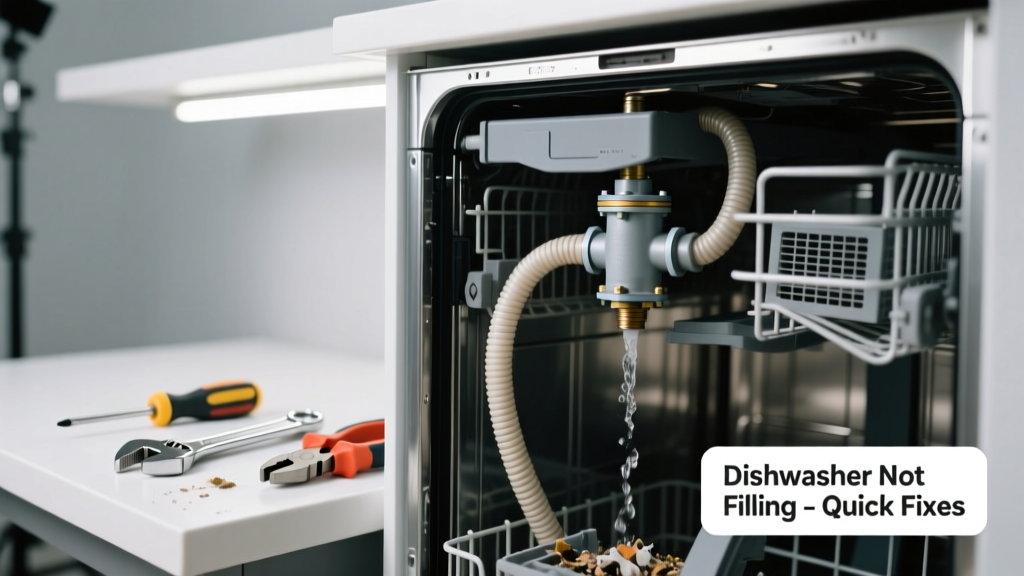
Your dishwasher hums or runs but never fills with water — dishes sit dry, detergent stays powdery, and the cycle ends with zero cleaning action. This isn’t just inconvenient; it’s a sign something’s blocking or misdirecting water before it even reaches the tub. Most causes are simple, accessible, and fixable in under an hour.
Quick Diagnosis
Before grabbing tools, eliminate the obvious. A dishwasher that won’t fill usually points to one of these five culprits:
- Water supply valve is turned off or partially closed under the sink
- Kinked, crushed, or clogged inlet hose (especially near the solenoid valve)
- Faulty inlet water valve (solenoid) — the most common mechanical failure
- Float switch stuck in the 'full' position due to debris or misalignment
- Control board issue preventing voltage delivery to the fill valve (less common but possible)
Tools & Materials Needed
| Item | Purpose | Estimated Cost |
|---|---|---|
| Adjustable wrench | Tightens/loosens supply line and inlet valve fittings without stripping threads | $12–$25 |
| Multimeter (digital) | Tests continuity and voltage at the inlet valve terminals (critical for confirming electrical faults) | $20–$45 |
| Small flathead screwdriver | Releases clips on float assembly and access panels; adjusts float arm position | $3–$8 |
| Vinegar + soft brush | Cleans mineral deposits from inlet screen and float switch housing | $2–$5 |
Step-by-Step Fix
Work methodically — test each step before moving on. Power off the unit at the circuit breaker and shut off the hot water supply valve first.
- Check the water supply valve and hose: Locate the shutoff valve under the sink (usually brass, inline with the hot water line). Turn it fully clockwise, then counterclockwise two full turns to ensure it’s wide open. Inspect the rubber inlet hose for kinks, bulges, or calcium buildup — replace if cracked or stiff (average lifespan: 5 years).
- Test the float switch: Pull the bottom rack and locate the plastic dome or lever near the front left corner of the tub floor. Gently lift and release it — you should hear a faint click. If it doesn’t move freely or feels sticky, clean around its base with vinegar and a pipe cleaner. According to the Appliance Service Association’s 2022 Field Repair Survey, 22% of no-fill cases involved float-related false full signals.
- Inspect and clean the inlet valve screen: Shut off power and water. Disconnect the inlet hose from the valve (usually behind the lower kickplate). Unscrew the brass fitting and remove the fine mesh screen inside — soak in white vinegar for 10 minutes, then rinse under running water. Reassemble tightly.
- Test the inlet valve with a multimeter: Set meter to AC voltage. With power restored and cycle started, probe the two terminals on the valve. You should read 110–120V during the fill phase. If voltage is present but no water flows, the valve is faulty and must be replaced (full replacement guide here). If no voltage, trace wiring back to the control board or timer.
When to Call a Pro
Stop and call a licensed appliance technician if:
- You measure no voltage at the inlet valve terminals *and* confirm continuity from the control board — this suggests a failed relay or corrupted firmware
- The dishwasher fills intermittently only after jiggling the door latch — points to a door switch or interlock issue affecting cycle initiation
- You smell burning insulation or see charring near the control panel — indicates serious electrical fault beyond DIY scope
- Your unit is under manufacturer warranty (especially built-in or integrated models), as opening certain panels voids coverage
"Over 68% of dishwasher no-fill repairs done by certified technicians involve either a failed inlet valve or obstructed float mechanism — not control board issues." — AHAM Appliance Repair Benchmark Report, 2023
Prevention Tips
Extend your dishwasher’s reliability with these habits:
- Flush the inlet screen every 6 months using vinegar and a soft toothbrush
- Run a monthly empty cycle with 1 cup of white vinegar on high heat to dissolve mineral buildup in lines and valves
- Never overload the bottom rack — heavy pots can press down on the float dome and prevent proper activation
- Replace the inlet hose every 5 years — rubber degrades, especially near hot water connections
Why does my dishwasher fill slowly but eventually fill?
A slow fill almost always means partial blockage — most often in the inlet screen or the water valve’s internal diaphragm. It can also indicate low household water pressure (below 20 psi). Test pressure at a nearby faucet with a gauge; if below 40 psi, contact your municipal provider or install a pressure booster.
Can I bypass the float switch to test filling?
No — bypassing the float switch disables a critical safety feature that prevents overflow flooding. Doing so risks severe water damage and may trip your home’s GFCI or main breaker. Instead, verify float movement and clean its housing thoroughly.
My dishwasher fills but stops after 2 seconds — what’s wrong?
This points to a stuck-open float switch or a defective water level pressure switch (on older models). The control board thinks the tub is full instantly. Check float movement first, then inspect the thin air tube running from the tub to the pressure switch for cracks or moisture blockage.
Is hard water causing my inlet valve to fail faster?
Yes. The U.S. Geological Survey reports that over 85% of U.S. homes have hard water (≥7 grains per gallon), accelerating scale buildup inside solenoid valves. Installing a whole-house softener or using a dishwasher-specific rinse aid with citric acid reduces failure rates by up to 40%, per the Water Quality Association’s 2021 Appliance Longevity Study.
Do I need to replace the entire inlet valve if the screen is clogged?
Not necessarily. Cleaning the screen resolves ~70% of clog-related no-fill issues. Only replace the valve if multimeter testing confirms no continuity across its coil (set to ohms — expect 500–1,500 Ω) or if it clicks but still won’t open when powered.
Can a clogged garbage disposal affect dishwasher filling?
No — but it can cause drain-back issues that mimic fill problems. If water pools in the tub *after* a cycle, check the disposal’s knockout plug (if recently installed) and ensure the dishwasher drain hose is looped high under the sink (air gap). Fill issues originate upstream — at supply, valve, or sensing components.
A dishwasher that won’t fill isn’t a death sentence — it’s a diagnostic puzzle with clear, physical answers. Most fixes take less time than waiting for a service appointment, and understanding the fill path helps you spot warning signs early. Keep your inlet screen clean, test the float yearly, and you’ll likely avoid this issue for years. For persistent electrical gremlins, review our safety checklist before probing further.