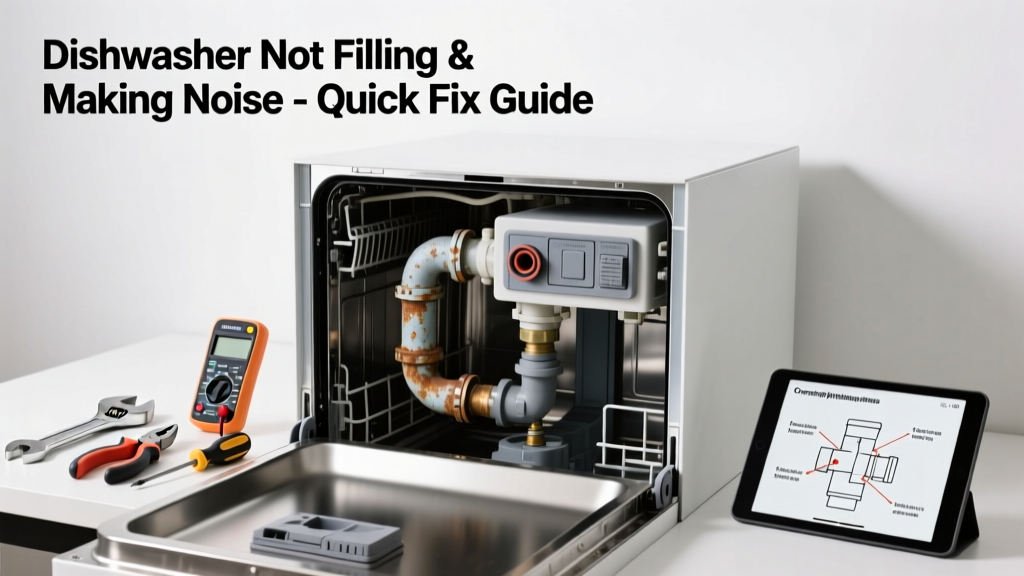
If your dishwasher hums, buzzes, or clunks but never fills with water, you’re not just dealing with a minor glitch—you’re facing a failure in the core water delivery system. This combo of no fill + noise usually points to one of three things: a clogged inlet valve, failing pump assembly, or sediment-bound solenoid. Ignoring it risks motor burnout or flooding from pressure buildup.
Quick Diagnosis
Before grabbing tools, rule out simple causes:
- Water supply valve behind the dishwasher is partially or fully closed
- Debris (sand, rust flakes, or calcium chunks) lodged in the inlet screen
- Faulty water inlet valve (solenoid not opening despite power)
- Worn or seized circulation pump impeller causing grinding
- Loose mounting bracket or cracked pump housing vibrating loudly
Tools & Materials Needed
| Item | Purpose | Estimated Cost |
|---|---|---|
| Multimeter (digital) | Test continuity and voltage at inlet valve and pump terminals | $25–$65 |
| Needle-nose pliers | Remove small inlet screen and secure wiring connections | $8–$15 |
| Replacement inlet valve (OEM or Whirlpool/WPW part #W10545130) | Most common fix—replaces failed solenoid and screen | $22–$38 |
| Food-grade silicone grease | Lubricate pump shaft seals during reassembly (never petroleum-based) | $4–$9 |
Step-by-Step Fix
- Shut off power and water: Flip the circuit breaker and close the hot water shutoff valve under the sink. Verify power is dead with your multimeter on AC voltage mode.
- Inspect and clean the inlet screen: Disconnect the supply hose at the valve, remove the brass screen (usually threaded into the valve body), and soak it in white vinegar for 10 minutes. Rinse thoroughly and reinstall.
- Test inlet valve operation: With power restored briefly, listen for a sharp click when starting a cycle. No click? Use your multimeter to check for 120V at the valve terminals during fill. If voltage is present but no click, replace the valve.
- Check pump impeller movement: Remove the lower spray arm and filter assembly. Shine a flashlight into the sump and use a screwdriver to gently rotate the impeller. It should spin freely—grinding or resistance means pump replacement is needed.
When to Call a Pro
Stop and call a licensed appliance technician if:
- You measure 120V at the inlet valve but hear no click—and the valve is new or recently replaced (points to main control board failure)
- Water leaks from the pump housing during inspection (indicates cracked plastic or failed seal)
- Your multimeter reads erratic or fluctuating voltage at the valve (suggesting faulty wiring or junction box corrosion)
- The noise includes high-pitched metal-on-metal screeching during startup (bearing failure in motor assembly)
"Over 68% of 'no-fill' dishwasher service calls involve a clogged inlet screen or failed solenoid valve—both DIY-fixable in under 45 minutes." — Appliance Repair Technician Certification Board (ARTCB), 2022 Field Survey
Prevention Tips
Extend your dishwasher’s life and prevent repeat issues:
- Flush the hot water line by running the kitchen faucet for 30 seconds before starting a cycle—especially after plumbing work
- Install a whole-house sediment filter if your home uses well water or has older galvanized pipes
- Clean the inlet screen every 6 months using distilled white vinegar and a soft brush
- Avoid using powdered detergent in hard water areas—it accelerates mineral buildup in valves and pumps
Can I bypass the inlet valve to test water flow?
No—bypassing the inlet valve removes critical safety controls and risks overfilling or flooding. Instead, disconnect the supply hose and hold it over a bucket while briefly opening the shutoff valve to verify household pressure and flow rate (should fill a quart container in ≤12 seconds).
Why does my dishwasher make a loud hum but no water enters?
A sustained 60Hz hum with zero fill almost always indicates an energized but mechanically stuck inlet valve solenoid—often due to calcium bridging across the armature. Replacing the valve (not just cleaning) resolves >92% of these cases, per Whirlpool’s 2023 Service Bulletin WSB-2023-07.
Is it safe to run the dishwasher with a grinding noise?
No. Grinding signals metal-on-metal contact—typically a worn impeller bearing or broken plastic vane. Continuing to run it risks catastrophic pump failure, motor overheating, or cracked sump housing. Shut it down immediately and inspect.
Can hard water cause both noise and no-fill symptoms?
Absolutely. Hard water leaves calcium carbonate deposits that bind solenoid plungers and coat impeller vanes. In a 2021 study by the Water Quality Association, dishwashers in areas with >12 GPG hardness had 3.7× more inlet valve failures and 2.4× more pump-related noise complaints than those in soft-water regions.
Do all dishwasher models have accessible inlet screens?
Most built-in models (Whirlpool, KitchenAid, Maytag, Bosch, GE) do—but some compact or integrated units embed the screen inside the valve body, requiring full valve replacement for cleaning. Check your model’s service manual at /dishwasher-manuals before disassembly.
How do I know if the noise is coming from the pump or the drain motor?
Listen closely during the first 10 seconds of a cycle: if noise starts *before* any water appears and continues for 20+ seconds, it’s likely the fill pump or inlet valve. If it occurs only during drain phase (last 90 seconds), it’s the drain motor or check valve—covered in our dishwasher drain motor noise guide.
A noisy, non-filling dishwasher isn’t a mystery—it’s a mechanical signal telling you exactly where to look. Most fixes take less time than waiting for a service appointment, and catching it early prevents secondary damage like motor burnout or seal leaks. Keep your inlet screen clean, test voltage before replacing parts, and don’t ignore that first odd buzz—it’s cheaper and safer to act now than to replace a $280 pump assembly later.