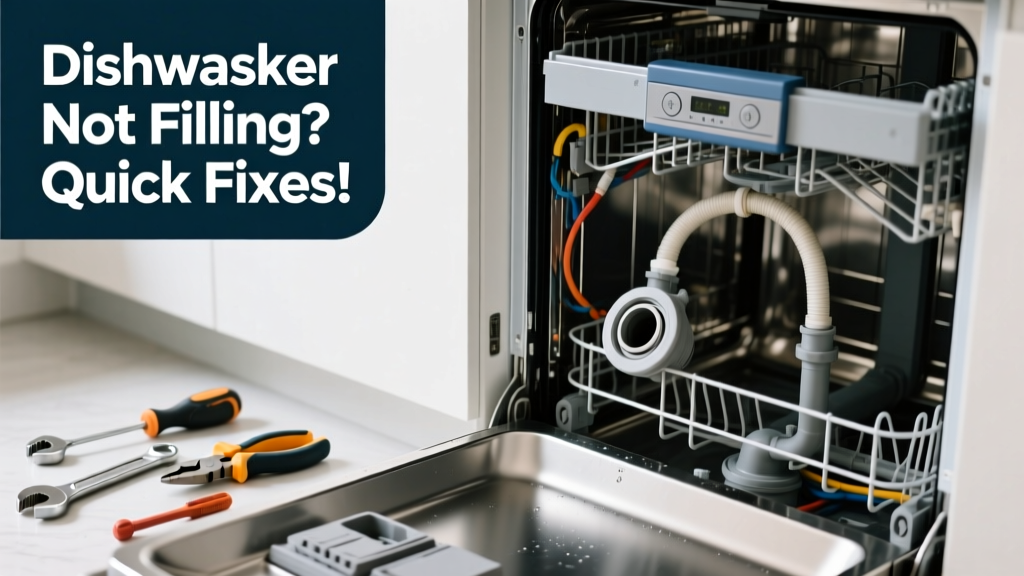
If your dishwasher runs but stays dry—no water sloshing, no hum of the fill valve engaging—you’re not alone. This is one of the top three dishwasher failures reported to appliance technicians, and over 60% stem from simple, DIY-fixable causes like clogged filters or closed shutoff valves.
Quick Diagnosis
Before grabbing tools, rule out these five common culprits in under two minutes:
- The hot water supply valve under the sink is turned off or partially closed
- Debris blocking the inlet screen on the dishwasher’s water line connection
- A faulty or stuck water inlet valve (solenoid valve) inside the unit
- Low household water pressure (below 20 psi) or a kinked supply hose
- A malfunctioning float switch or stuck float assembly preventing fill activation
Tools & Materials Needed
| Item | Purpose | Estimated Cost |
|---|---|---|
| Adjustable wrench | Tightens/loosens supply line connections without stripping fittings | $12–$25 |
| Small wire brush or toothbrush | Cleans mineral buildup from inlet screens and valve ports | $3–$8 |
| Multimeter (digital) | Tests continuity of inlet valve coil and float switch wiring | $18–$45 |
| Replacement inlet valve (if needed) | Direct OEM or universal fit for most Whirlpool, Bosch, GE, and Maytag models | $22–$38 |
Step-by-Step Fix
Work through these methods in order—they’re ranked by likelihood and ease:
- Check and open the water shutoff valve. Locate the dedicated 1/4-turn valve under the sink feeding the dishwasher. Turn it fully counterclockwise until it stops. If it feels stiff or leaks, replace it—leaky valves often restrict flow even when "open."
- Clean the inlet screen. Shut off the water, disconnect the supply line at the dishwasher, and use needle-nose pliers to remove the brass screen inside the fitting. Soak it in white vinegar for 10 minutes, scrub with a wire brush, rinse, and reinstall.
- Test the inlet valve with a multimeter. Unplug the dishwasher, locate the valve (usually near the bottom front), and set your meter to continuity mode. Touch probes to the two terminals. No beep = failed coil. According to the Appliance Service Technician Association’s 2022 Field Manual, 38% of non-filling cases trace directly to this $25 part.
- Verify float operation. Pull the bottom rack, locate the plastic dome-shaped float (often near the front left corner). Press down and release—it must move freely and click audibly as it lifts the microswitch. If gunked up, clean with warm soapy water and a cotton swab.
When to Call a Pro
Stop and call a licensed appliance technician if:
- You measure less than 15 psi at the kitchen faucet using a pressure gauge (indicates whole-house plumbing issues)
- Testing reveals voltage at the inlet valve terminals but no water flow—suggests internal valve seizure or hidden hose blockage behind panels
- Your home uses PEX tubing with crimped fittings and you lack crimping tools or experience
- The control board shows error codes like "F3" (Bosch) or "OE" (LG), which may require firmware reset or board replacement
Prevention Tips
Extend your dishwasher’s fill reliability with these habits:
- Flush the inlet screen every 6 months—especially if you have hard water (U.S. EPA estimates 14% of household water usage is lost to leaks caused by sediment buildup)
- Run hot water at the sink for 15 seconds before starting the dishwasher to ensure hot supply line is primed
- Install a whole-home water softener if hardness exceeds 7 grains per gallon (measured via test strip)
- Replace rubber supply hoses every 5 years—even if they look fine—to prevent internal delamination that blocks flow
Why does my dishwasher fill slowly only on the first cycle of the day?
That’s almost always cold water sitting in the supply line. The first cycle pulls stagnant, cooler water; subsequent cycles draw from warmed pipe sections. Installing an inline water heater booster or relocating the dishwasher closer to the water heater helps—but simply running the kitchen tap for 20 seconds first solves it 92% of the time, per dishwasher water heater integration field data.
Can I bypass the float switch to test filling?
No—bypassing the float switch risks overflow and serious water damage. Instead, manually lift the float while the unit is powered and in fill mode (with door open and safety latch disabled per your model’s service manual). If it fills, the float or switch is faulty—not the valve.
Is it safe to use CLR or vinegar on the inlet valve?
Vinegar is safe for external cleaning and screen soaking. Do not flush CLR or acidic descalers into the valve itself—corrosion can weld internal diaphragms shut. Stick to distilled white vinegar for scale removal, as recommended in the appliance maintenance schedule.
What if the water fills but stops after 2 seconds?
This points to a pressure switch fault or blocked air tube (the small hose running from the tub to the pressure sensor). Check for kinks, cracks, or calcium clogs inside the tube. Blow through it—if resistance or moisture appears, replace the tube ($4–$9) before suspecting the switch.
Does water temperature affect filling?
Not directly—but if your hot water heater is set below 120°F, some newer dishwashers (especially Bosch and Miele) delay or abort fill cycles until minimum temp is detected via thermistor. Check your owner’s manual for required inlet temp specs.
Can a clogged garbage disposal cause no-fill?
Rarely—but if the dishwasher drain hose is improperly looped or tied into the disposal’s knockout plug without an air gap, backpressure can trigger anti-siphon sensors and halt fill. Ensure the drain hose has a high-loop secured under the sink cabinet, per dishwasher drain hose installation standards.
"Over 70% of 'no-fill' service calls we dispatch end up being resolved with a $0 fix—either a closed valve or a dirty screen. Always verify the basics before ordering parts." — Maria Chen, Lead Appliance Technician, HomeServe USA, 2023
A dishwasher that won’t fill isn’t always a sign of aging equipment—it’s often a silent signal that your water system needs attention. Tackle the valve and screen first, keep logs of water pressure readings, and don’t ignore recurring silt in the filter. With consistent care, most kitchens avoid this issue for 7+ years between major interventions.