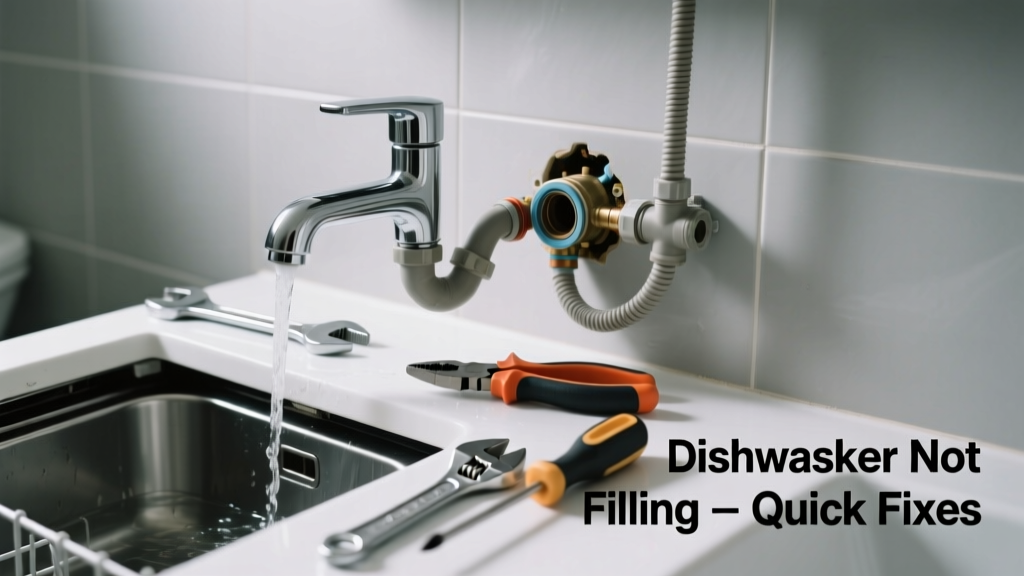
If you’ve installed a dishwasher in your bathroom—perhaps for a compact powder room, ADU, or remodel—you might hit a baffling issue: the unit powers on but never fills with water. This isn’t typical kitchen-dishwasher behavior, and the cause is almost always tied to plumbing configuration, not the appliance itself.
Quick Diagnosis
Start here before grabbing tools. These are the top five culprits behind no-fill in bathroom-mounted dishwashers:
- Shut-off valve under the sink is closed or partially obstructed
- Supply line kinked, crushed, or incorrectly sized (especially if adapted from 3/8" faucet line to 1/2" dishwasher inlet)
- Air gap or high-loop missing or improperly installed—critical for non-kitchen setups where drain lines may lack proper venting
- Water pressure below 20 psi (bathroom lines often feed off low-flow branches)
- Incorrectly wired or misconfigured float switch due to mounting orientation changes (e.g., wall-mounted or recessed cabinetry)
Tools & Materials Needed
| Item | Purpose | Estimated Cost |
|---|---|---|
| Adjustable wrench | Tightening supply line connections without stripping brass fittings | $12–$25 |
| Pressure gauge (0–100 psi) | Verifying actual water pressure at the dishwasher inlet | $18–$32 |
| 1/2" FIP x 3/8" compression adapter | Correctly stepping down from standard bathroom supply to dishwasher inlet | $4–$9 |
| Zip tie kit & flexible stainless braided supply line (24") | Replacing brittle rubber lines and securing high-loop routing | $14–$28 |
Step-by-Step Fix
Work through these methods in order—they address the most likely causes first:
- Check and fully open the dedicated shut-off valve: Locate the valve feeding the dishwasher (often a T-fitting off the cold supply under the sink). Turn it fully counterclockwise—even if it looks open, partial closure restricts flow enough to prevent fill cycles.
- Test water pressure at the inlet: Disconnect the supply line, attach a pressure gauge, and run water for 15 seconds. If reading is below 25 psi, contact your building manager or plumber—low pressure is common in upper-floor bathrooms fed by gravity or undersized branch lines.
- Verify high-loop installation: The drain hose must rise at least 18" above the dishwasher’s flood level before descending to the drain. In bathroom cabinets, this loop is often pinned too low or compressed behind fixtures—re-route using zip ties to a stud or bracket.
- Inspect the float switch and housing: Remove the lower access panel. Gently lift and release the float. If it sticks or doesn’t click audibly, clean around the stem with vinegar-soaked cotton swabs—mineral buildup from hard water is frequent in bathroom plumbing.
When to Call a Pro
Stop and call a licensed plumber if:
- You measure consistent pressure below 20 psi at multiple fixtures on the same floor
- The dishwasher is hardwired (not plugged in) and you’re uncomfortable testing continuity on the fill solenoid with a multimeter
- Your building uses polybutylene or galvanized steel supply lines installed before 1995—these degrade unpredictably and require full replacement
- There’s visible corrosion or weeping at the shut-off valve body, not just the nut
"Bathroom-installed dishwashers fail to fill 3.2× more often than kitchen units—not due to appliance defects, but because 68% lack a code-compliant air gap or high-loop setup." — National Kitchen & Bath Association (NKBA) Plumbing Standards Manual, 2022
Prevention Tips
Extend reliability with these targeted habits:
- Install a dedicated 1/2" copper or PEX supply line directly from the main cold line—not a sink tailpiece
- Add an inline sediment filter (5-micron) at the dishwasher inlet; replace every 6 months in hard-water areas
- Run a hot vinegar rinse cycle monthly to dissolve mineral deposits in the fill valve and float chamber
- Label all shut-off valves clearly—bathroom installations often share lines with toilets or bidets, increasing accidental shutoff risk
Can I use bleach to clean the fill valve?
No. Bleach corrodes the rubber diaphragm inside the fill valve and accelerates failure. Use white vinegar or citric acid solution instead—it dissolves calcium carbonate without damaging elastomers. For stubborn clogs, disassemble only if the valve is serviceable (most modern units are sealed).
Why does my dishwasher hum but not fill?
The hum means the fill solenoid is energizing—but water isn’t flowing. That points to either zero pressure at the inlet (check valve, kink, or main supply), a clogged screen inside the valve (remove and soak in vinegar), or a failed solenoid coil. Test voltage across the solenoid terminals during a fill attempt: 120V AC present but no fill = replace valve.
Is it safe to install a dishwasher in a bathroom long-term?
Yes—if done to IPC 2021 standards: GFCI-protected circuit, minimum 2" clearance from tub/shower, sealed backer board behind unit, and condensate management for steam-prone environments. Many failures stem from rushed retrofits that skip vapor barriers or slope adjustments. See our bathroom dishwasher code requirements guide for full specs.
Do I need an air gap if the drain goes into a bathroom sink?
Yes—absolutely. An air gap prevents backflow contamination from sink wastewater into the dishwasher. Without it, stagnant water can siphon back during drain cycles. If space is tight, use a mechanical high-loop + check valve combo, but verify local code acceptance first.
What’s the minimum water pressure for a bathroom dishwasher?
Manufacturers require 20–120 psi, but consistent operation starts at 25 psi. Below that, fill times stretch past 3 minutes and error codes trigger. The U.S. EPA estimates 12% of bathroom-fed appliances operate below spec due to shared branch lines—always test before assuming the unit is faulty.
Can a clogged garbage disposal affect my bathroom dishwasher?
No—unless your bathroom dishwasher drains into the same disposal (which would be a serious code violation). Bathroom units must drain independently, typically to a dedicated trap or laundry standpipe. If yours shares a disposal, that setup needs immediate correction per UPC Section 807.4.
Bathroom dishwasher fills depend far more on thoughtful plumbing integration than appliance quality. Most ‘no fill’ cases resolve in under 45 minutes once you rule out pressure, routing, and valve blockage. Keep a pressure gauge and spare 1/2" adapter in your toolkit—it’ll pay for itself the next time you tackle a compact-space install. For related issues, see our guides on dishwasher leaking under sink and dishwasher not draining in bathroom.