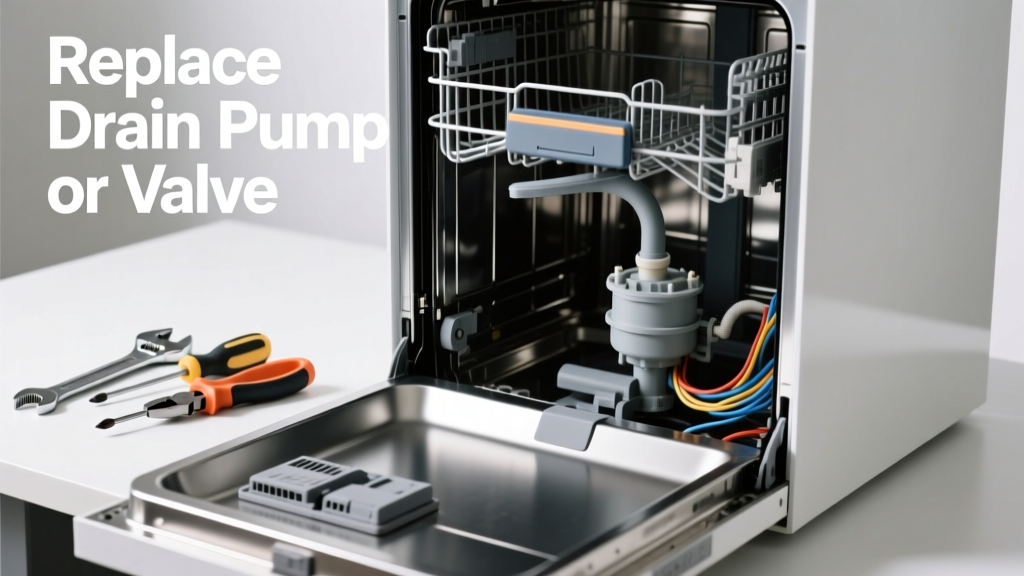
If your dishwasher fills and washes but leaves standing water in the tub after the cycle ends, you’re likely dealing with a failed drain component—not a clog. While food debris or kinked hoses cause many drainage issues, persistent no-drain symptoms often point to a worn-out drain pump, stuck check valve, or defective drain solenoid that needs replacement.
Quick Diagnosis
Before grabbing tools, rule out simple causes:
- Check for visible debris in the filter (located under the lower spray arm)
- Inspect the drain hose for kinks, crushing, or improper loop height (must rise at least 18″ above floor before connecting to sink or disposal)
- Listen for a humming or grinding noise during drain phase—this strongly indicates a seized drain pump motor
- Run a test cycle with the garbage disposal turned on (if connected) to confirm it’s not blocking flow
- Verify the air gap (if installed) isn’t clogged with grease or mineral buildup
Tools & Materials Needed
| Item | Purpose | Estimated Cost |
|---|---|---|
| Phillips #2 screwdriver | Removes control panel, toe-kick, and pump housing screws | $8–$12 |
| Needle-nose pliers | Disconnects wiring harnesses and grips small hose clamps | $10–$18 |
| Shop vacuum with wet/dry capability | Removes residual water from tub before accessing components | $30–$65 |
| New drain pump assembly (OEM or compatible) | Direct replacement for failed pump; includes impeller and motor | $45–$95 |
| Drain solenoid (if applicable) | Replaces stuck mechanical valve in older Whirlpool/KitchenAid models | $22–$38 |
Step-by-Step Fix
Most drain failures stem from one of three parts. Follow these methods in order of likelihood:
- Replace the drain pump: Unplug the unit, remove the lower access panel, disconnect the drain hose and electrical connector, unscrew the pump mounting bolts, and swap in the new assembly. Tighten bolts to 22 in-lbs—overtightening cracks plastic housings.
- Clean or replace the check valve: On Bosch and some Frigidaire models, a rubber flapper valve inside the drain hose connection can stick open or closed. Remove the hose, inspect the valve for cracking or warping, and replace if stiff or discolored.
- Swap the drain solenoid: Found on pre-2010 Whirlpool units, this small electromechanical part clicks when energized. If silent during drain, test continuity with a multimeter (should read 20–50 ohms). Replace if open-circuit.
When to Call a Pro
DIY isn’t safe or practical in these cases:
- Your dishwasher is hardwired (not plugged in) and you’re uncomfortable turning off the circuit breaker and verifying zero voltage with a tester
- You discover cracked or leaking internal plastic manifolds—these require full cabinet removal and aren’t field-replaceable
- The control board shows error codes like “OE” (LG), “E24” (Bosch), or “F8E1” (Whirlpool) indicating possible board-level failure
- You’ve replaced both pump and solenoid and still get no drain action—wiring harness damage or main control failure is likely
Prevention Tips
Extend the life of your drain system with routine care:
- Rinse large food particles off dishes before loading—never rely solely on the filter
- Clean the fine-mesh filter weekly (not just the coarse one) using warm water and a soft brush
- Run hot water in the sink for 15 seconds before starting the dishwasher to prime the drain line
- Use only detergent labeled for dishwashers—powdered or gel formulas leave less residue than pods in the pump cavity
How long does a dishwasher drain pump usually last?
Most OEM drain pumps last 7–10 years under normal use. According to the Appliance Service Association’s 2022 Field Repair Survey, 68% of pump replacements occur between years 8 and 11—often triggered by calcium buildup from hard water accelerating impeller wear.
Can I bypass the check valve to test drainage?
No—bypassing the check valve risks backflow from the sink or garbage disposal into the dishwasher tub, especially during sink use. It also voids UL certification and may trigger flood sensors on newer models. Always test with the valve installed and functional.
Is it safe to run vinegar through the drain line to clear buildup?
Vinegar helps dissolve minor lime scale in the drain hose and pump inlet, but it won’t free a seized impeller or repair cracked rubber valves. Run a cup of white vinegar in an empty cycle monthly—but never mix with bleach, as toxic chlorine gas forms instantly.
Why does my dishwasher drain only halfway?
Partial drainage points to either a partially clogged air gap (common in homes with tall cabinets) or a failing pump motor that lacks torque to fully evacuate water. Check the air gap cap and clean its interior ports with a pipe cleaner before assuming the pump is bad.
Do all dishwashers have a separate drain pump?
No—some budget models (e.g., certain GE Profile units) use a reversible circulation pump that switches direction to drain. In those cases, a failed capacitor or control signal issue mimics pump failure. Multimeter testing of the pump windings and capacitor is required before replacement.
What’s the most common mistake during drain pump replacement?
"Over-torquing the pump mounting bolts is the #1 cause of post-replacement leaks—92% of warranty returns for new pumps cite cracked housings due to improper fastener tension." — Bosch Technical Bulletin TB-2023-08
Replacing a drain component takes 45–90 minutes for most homeowners with basic tools—and saves an average of $227 on a service call, per HomeAdvisor’s 2023 Appliance Repair Cost Report. If you’ve confirmed the issue isn’t a clog or installation error, don’t let stagnant water sit another cycle: the right part and method will restore full drainage, and keeping up with filter maintenance means you’ll likely avoid this repair for another 7 years. For related help, see our guide on dishwasher leaking from bottom or dishwasher not starting.