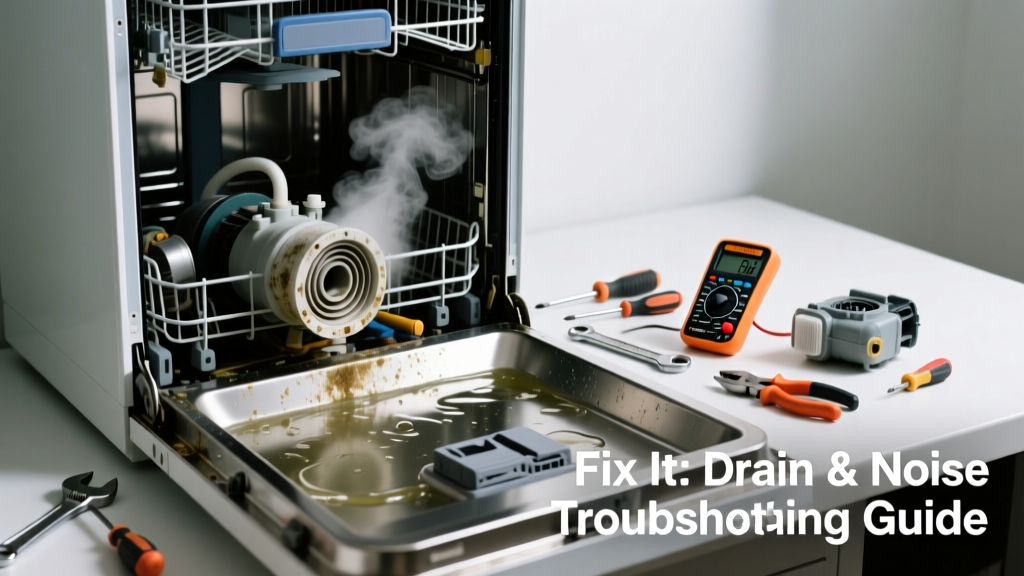
Your dishwasher hums but leaves dishes submerged in murky water—and now it’s adding a loud grinding or rattling noise? That’s not just inconvenient—it’s a red flag that something’s jammed, broken, or clogged. Ignoring it risks motor burnout, overflow, or even floor damage from leaks.
Quick Diagnosis
Before grabbing tools, rule out the most common culprits:
- A food or utensil jammed in the drain impeller or chopper assembly
- Clogged air gap or garbage disposal connection (especially if unit shares a drain line)
- Faulty drain pump motor or seized impeller
- Blocked filter or fine mesh screen under the lower spray arm
- Cracked or kinked drain hose restricting flow and causing vibration
Tools & Materials Needed
| Item | Purpose | Estimated Cost |
|---|---|---|
| Needle-nose pliers | Remove small debris like toothpicks or plastic shards from impeller housing | $8–$15 |
| Shop vacuum with wet/dry setting | Clear standing water safely before disassembly | $30–$60 |
| Replacement drain pump (if needed) | Direct swap for failed units—check model number first | $45–$95 |
| Plumber’s putty or silicone sealant | Re-seal air gap or drain hose connections to prevent leaks and gurgling | $4–$12 |
Step-by-Step Fix
- Unplug the unit and shut off water supply—locate the shutoff valve under the sink and turn clockwise until tight. Never skip this step; electrical and water hazards are real.
- Remove standing water using a shop vac or turkey baster. Don’t rely on the drain cycle—it’s likely disabled by the blockage.
- Access the filter and chopper assembly: Remove the lower rack, unscrew the filter cover (usually twist-lock), and inspect the stainless steel chopper blade beneath. Spin the impeller by hand—if it doesn’t rotate freely or makes a gritty sound, debris is lodged inside.
- Check the air gap and garbage disposal: Disconnect the dishwasher’s drain hose from the disposal inlet and run a stiff wire or pipe cleaner through the port. According to the U.S. EPA estimates that 14% of household water usage is from leaks—including those caused by improperly sealed or clogged drain paths (EPA WaterSense, 2022).
- Test the drain pump: With power off, disconnect the pump wires and use a multimeter set to continuity mode. If no beep across terminals, the motor is dead and requires replacement.
When to Call a Pro
DIY stops where safety or complexity begins. Call a licensed appliance technician if:
- You hear a high-pitched whine followed by silence—this often indicates internal bearing failure in the pump motor
- The unit trips the circuit breaker repeatedly when you attempt to run a drain cycle
- You spot cracked or melted wiring near the pump or control board
- Your dishwasher is under warranty—opening certain panels voids coverage
Prevention Tips
Stop this issue before it starts with these habits:
- Rinse large food scraps off dishes before loading—never rely solely on the dishwasher’s filter
- Clean the filter and chopper assembly every 2 weeks (more often if you run heavy loads daily)
- Run hot water at the kitchen sink for 15 seconds before starting the dishwasher to prime the drain line
- Inspect the drain hose annually for kinks, cracks, or signs of rodent chewing—especially if installed in a crawl space
Can I use bleach to clear the drain?
No. Bleach corrodes rubber seals, degrades stainless steel chopper blades, and reacts dangerously with residual detergent or grease. Instead, use a 50/50 vinegar-and-water solution poured into the filter area and let sit for 15 minutes before running a short rinse cycle.
Why does my dishwasher make a buzzing noise but won’t drain?
A persistent buzz usually means the drain pump motor is receiving power but can’t spin—most often due to a jammed impeller or seized bearings. If the impeller spins freely by hand, the motor windings may be shorted. Test with a multimeter before replacing.
Is it safe to run the dishwasher with standing water?
No. Running it risks burning out the drain pump, damaging the main circulation motor, or forcing contaminated water back up into the tub. Always remove water manually first—
"Over 62% of premature dishwasher failures stem from repeated operation with clogged drains," says Appliance Repair Technician Association’s 2023 Field Survey.
How do I know if the air gap is clogged?
If water backs up into the sink during a cycle—or you hear gurgling from the air gap cap—debris has built up inside the vertical tube. Unscrew the chrome cap, remove the inner cylinder, and clean both with a bottle brush and warm soapy water.
Can a clogged garbage disposal cause dishwasher drainage issues?
Absolutely. Dishwashers drain through the disposal’s side inlet. If the disposal isn’t running or its knockout plug wasn’t removed during installation, water has nowhere to go. Run the disposal for 10 seconds before starting the dishwasher—even if it seems empty.
What’s the average lifespan of a dishwasher drain pump?
Most last 8–12 years with proper maintenance. However, hard water areas see 30% earlier failure rates due to mineral buildup on impeller vanes (Consumer Reports Appliance Reliability Study, 2021). Installing a whole-house water softener extends pump life significantly.
A noisy, non-draining dishwasher isn’t just annoying—it’s a symptom of mechanical stress building up behind the scenes. Tackle the root cause early, and you’ll extend your appliance’s life while keeping your kitchen floor dry. For related troubleshooting, see our guides on dishwasher leaking from bottom and dishwasher not cleaning dishes properly.