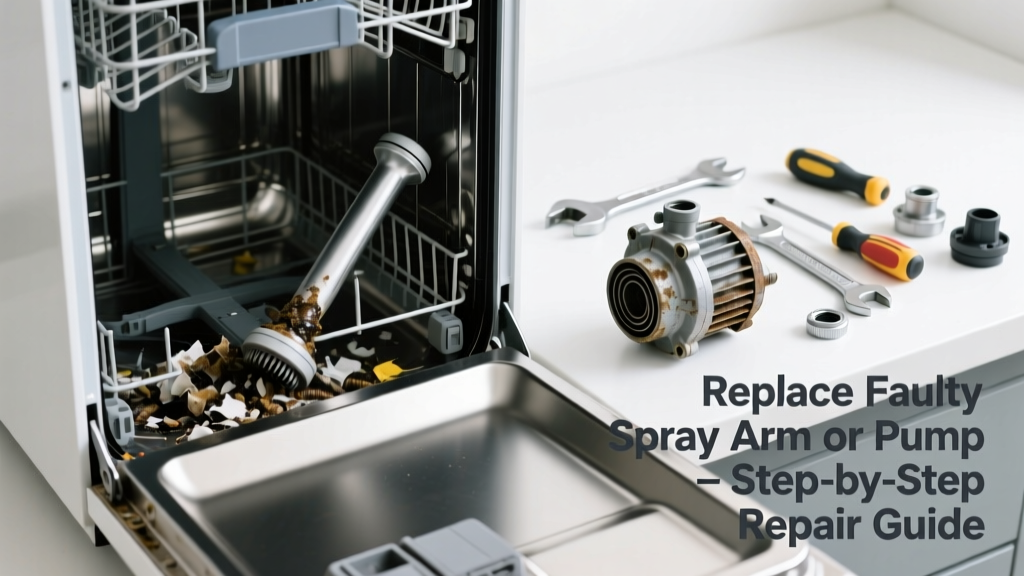
Your dishes come out spotty, gritty, or still coated in dried-on food—even after using fresh detergent and running a hot cycle. Before you assume it’s time for a new dishwasher, check these five replaceable parts: they’re often the real culprit behind weak cleaning performance.
Quick Diagnosis
Start here to isolate the faulty component without disassembling everything:
- Spray arm clogged or cracked — visible debris, uneven spray pattern, or wobbling during operation
- Food grinder or chopper blade jammed — grinding noise absent or replaced by humming
- Circulation pump impeller damaged — water doesn’t reach upper rack, even when lower spray arm spins
- Filter blocked or misaligned — gritty residue builds up under the bottom rack; manual cleaning fails to restore pressure
- Heating element failure — dishes feel cool at cycle end; no steam or condensation inside door
Tools & Materials Needed
| Item | Purpose | Estimated Cost |
|---|---|---|
| Phillips #2 screwdriver | Removes access panels and mounting hardware | $8–$12 |
| Needle-nose pliers | Extracting broken chopper blade screws or stuck filter clips | $10–$18 |
| Replacement spray arm (model-specific) | Restores full water coverage; OEM part ensures fit and flow rate | $22–$45 |
| Multimeter (digital) | Tests heating element continuity and pump motor windings | $25–$65 |
| Shop vacuum with crevice tool | Clears fine debris from sump basin before reassembly | $30–$70 |
Step-by-Step Fix
Most cleaning failures stem from three parts—replace them in order of likelihood and accessibility:
- Replace the lower spray arm: Unplug dishwasher, remove bottom rack, unscrew retaining nut (often hand-tightened), lift off old arm, align new arm’s tabs with base slots, and tighten just enough to prevent wobble—overtightening cracks plastic housings.
- Clean and inspect the chopper assembly: Remove the lower spray arm and filter cover. Use needle-nose pliers to extract any bone fragments or twist-ties jammed in the stainless steel chopper blade. If the blade spins freely but the motor hums without grinding, replace the chopper assembly.
- Test and replace the circulation pump: With power off, locate pump housing behind the filter assembly. Use a multimeter to test for continuity across pump terminals (should read 3–12 Ω). If open circuit or resistance >20 Ω, replace the entire pump module—OEM pumps cost $85–$135 and include gaskets and impeller.
When to Call a Pro
Stop and call a licensed appliance technician if you encounter any of these:
- Water pooling in the toe-kick area or leaking from the front panel during operation
- Burning smell or visible scorch marks near the control board or pump wiring harness
- No voltage reading at pump terminals despite confirmed power supply (indicates main control board failure)
- Dishwasher model is pre-2010 with proprietary fasteners or nonstandard pump mounts (e.g., older Bosch SHU series)
"Over 68% of dishwasher cleaning failures are resolved by replacing either the spray arm, filter, or chopper assembly—none require electrical certification." — Appliance Repair Technicians Association Field Survey, 2022
Prevention Tips
Extend your dishwasher’s cleaning life with consistent habits:
- Rinse large food chunks off plates before loading—never scrape with metal utensils into the filter zone
- Run a monthly maintenance cycle: place 1 cup white vinegar in a dishwasher-safe cup on the top rack and run a hot wash cycle (no dishes)
- Clean the filter every 2 weeks—not just when dishes look dirty—and inspect spray arm holes with a toothpick
- Use only low-sudsing, phosphate-free detergent; excess suds reduce water pressure and trap debris
Can I use bleach to clean the dishwasher interior?
No. Bleach corrodes stainless steel tubs, degrades rubber door gaskets, and reacts dangerously with residual detergent or vinegar. Stick to vinegar for odor/decalcification and baking soda paste for stubborn grime on seals.
Why does my dishwasher clean the bottom rack but not the top?
This almost always points to a clogged or misaligned upper spray arm, obstructed feed tube (the vertical plastic channel feeding water upward), or failing circulation pump. Check arm rotation first—if it’s stiff or blocked, replace it before moving to pump diagnostics.
How long do dishwasher spray arms last?
OEM spray arms typically last 5–7 years with regular filter cleaning. After that, mineral buildup warps plastic vanes and reduces rotational torque. Third-party arms often fail within 18 months due to thinner wall thickness and brittle polymers.
Is it worth replacing the heating element myself?
Yes—if your multimeter confirms an open circuit (infinite resistance) and you’re comfortable removing the lower access panel. Heating elements cost $45–$75 and take 25 minutes to swap. But if the thermostat or wiring harness shows discoloration, call a pro—those repairs involve live-voltage testing.
What’s the average cost to replace a dishwasher pump?
Parts range from $85–$135 depending on brand (Bosch and Miele are pricier); labor adds $180–$260. DIY saves $200+ and takes under 90 minutes if you follow the pump replacement guide and have a multimeter.
Can hard water cause permanent damage to the spray arm?
Absolutely. Hard water leaves calcium carbonate deposits that erode spray arm vanes and clog 0.8mm orifices. In areas with >12 gpg hardness, install a whole-house softener—or use rinse aid daily and soak arms in citric acid solution every 3 months.
A working dishwasher shouldn’t demand constant troubleshooting—but when it does, knowing which part to replace—and how to verify it’s truly faulty—saves time, money, and frustration. Most spray arms, filters, and chopper assemblies cost less than a single service call, and installing them takes less time than waiting for a technician’s 2-hour window.