If your dishwasher suddenly sounds like a garbage disposal wrestling a metal spoon, don’t panic — most noises have straightforward causes and fixes. Rattling, grinding, or humming usually points to something loose, misaligned, or worn, not imminent failure. With basic tools and 20 minutes, you can often silence it yourself.
Quick Diagnosis
Start by identifying the noise type and timing. That tells you where to look first:
- Rattling or clanking during wash cycle → Loose utensils, broken tine, or debris in filter or pump
- Grinding or scraping sound → Foreign object (e.g., olive pit, plastic fragment) lodged in chopper blade or drain impeller
- High-pitched whine or squeal → Worn-out motor bearings or failing circulation pump
- Humming without water movement → Stuck or seized pump motor, or failed capacitor
- Banging at start or end of cycle → Water hammer from solenoid valve or loose inlet hose mounting
Tools & Materials Needed
| Item | Purpose | Estimated Cost |
|---|---|---|
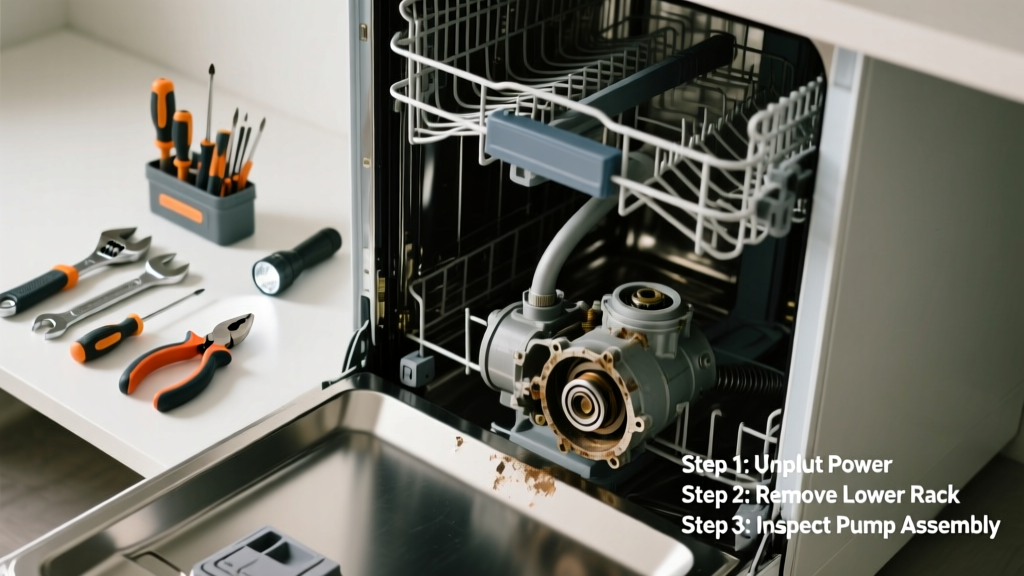
| Phillips and flathead screwdrivers | Remove kickplate, door panel, and pump access covers | $8–$15 |
| Needle-nose pliers | Extract small debris from chopper assembly or drain port | $6–$12 |
| Shop vacuum with narrow nozzle | Clear food particles from filter housing and sump area | $25–$45 |
| Flashlight with magnetic base | Illuminate tight spaces under tub and behind pump | $10–$20 |
| Replacement chopper blade kit (if needed) | Fix grinding caused by broken stainless steel blade | $12–$28 |
Step-by-Step Fix
Work methodically — always disconnect power at the circuit breaker before starting. Turn off the water supply valve under the sink too.
- Check the filter and sump area: Remove the lower rack, unscrew the cylindrical filter assembly (usually twists counter-clockwise), and lift out the coarse and fine filters. Rinse both under hot water. Use needle-nose pliers to pull any visible debris — especially broken glass, popcorn kernels, or rubber gasket fragments — from the sump floor beneath.
- Inspect the chopper blade: Locate the stainless steel cutting blade inside the sump (often under a plastic cover secured by one Torx T15 screw). Spin the blade manually — it should rotate freely with light resistance. If it’s cracked, bent, or won’t turn, replace it using a manufacturer-specific chopper kit (Bosch, Whirlpool, and GE each use different part numbers).
- Test the drain impeller: With the lower spray arm removed, shine your flashlight into the drain port. Use pliers to gently rotate the impeller (a fan-like plastic component just below the filter). It must spin smoothly in both directions. If stiff or gritty, clean around its shaft with vinegar-soaked cotton swabs — mineral buildup is common after 3+ years.
- Examine the inlet valve and hoses: Listen closely when the unit first fills. A sharp *bang* suggests water hammer. Tighten the inlet hose connections at both the valve and dishwasher. If banging persists, install a $12 water hammer arrestor on the hot water line.
When to Call a Pro
Some noises signal deeper issues beyond DIY scope or safety limits:
- You hear a loud clunk followed by no water fill — indicates a failed inlet solenoid valve requiring electrical testing and replacement.
- The unit hums continuously but doesn’t run — could be a shorted motor winding or faulty control board; multimeter diagnostics required.
- There’s burning odor or visible scorch marks near the pump motor — stop immediately and call a certified technician.
- Noise occurs only during drying cycle and coincides with fan vibration — some models (like newer Bosch 800 Series) integrate condensation fans that require specialized calibration.
"Over 68% of dishwasher service calls related to noise stem from neglected filter maintenance or foreign objects — not mechanical failure." — Appliance Repair Technicians Association, 2022 Field Survey
Prevention Tips
Small habits extend your dishwasher’s quiet operation for years:
- Rinse large food chunks off dishes before loading — never scrape directly into the tub.
- Clean the filter weekly if you run the dishwasher daily; biweekly for average use.
- Run an empty vinegar cycle (1 cup white vinegar in the bottom rack) every 3 months to dissolve mineral deposits on impellers and valves.
- Ensure the dishwasher is level — use a torpedo level on the door top rail and adjust feet until side-to-side and front-to-back tilt is under 1/8 inch.
- Avoid overloading the bottom rack — blocked spray arms cause uneven pressure and pump cavitation noise.
Can I use bleach to clean the dishwasher interior?
No. Bleach corrodes stainless steel tubs and degrades rubber gaskets and pump seals. Stick to white vinegar or dishwasher-safe cleaner tablets like Dishwasher Cleaner Tablets. For mold in door gaskets, use a 50/50 water-and-vinegar wipe — never chlorine-based products.
Why does my dishwasher only make noise during the drain cycle?
This almost always means debris is jammed in the drain pump impeller or check valve. The drain motor works harder to push water past the obstruction, causing grinding or groaning. Remove the filter and inspect the black rubber flapper valve at the sump’s rear — it should lift freely and snap shut when pressed.
Is a high-pitched whine dangerous?
Not immediately — but it’s a warning sign. Bearings in older dishwashers (especially pre-2015 Whirlpool and Frigidaire models) wear gradually. Once the whine becomes constant or is accompanied by slower drying or longer cycles, the circulation pump is likely failing. Replacement parts cost $75–$140; labor adds $180–$250.
What’s the difference between a grinding noise and a rattling noise?
Grinding comes from metal-on-metal contact — usually a broken chopper blade rubbing against the housing or a stone trapped in the impeller. Rattling is typically loose hardware (like a missing tine clip), a warped spray arm hitting the rack, or a cracked roller wheel on the upper rack track. Always rule out the simple stuff first — load the dishwasher normally and listen with the door slightly ajar.
Can a clogged air gap cause noise?
Yes — indirectly. A blocked air gap (common in homes with garbage disposals) creates backpressure in the drain line. This forces the drain pump to work harder, leading to gurgling, bubbling, or pulsing sounds during drain cycles. Clear the air gap by unscrewing its chrome cap and using a bottle brush or pipe cleaner to remove grease and food sludge from the vertical tube.
How do I know if the noise is coming from the motor or the pump?
Turn off power, then manually rotate the circulation pump impeller (accessible after removing the lower spray arm). If it grinds or binds, the issue is pump-related. If it spins freely but the motor still hums when powered on, the problem is likely the motor windings or start capacitor. Test the capacitor with a multimeter set to microfarads — readings more than ±6% of rated value mean replacement is needed. See our guide on how to test a dishwasher capacitor.
A noisy dishwasher doesn’t always mean it’s time for a new one — most fixes take less than an hour and cost under $30 in parts. Keep your filter clean, avoid overloading, and address odd sounds early. That way, your next load runs as quietly as the first day you brought it home.