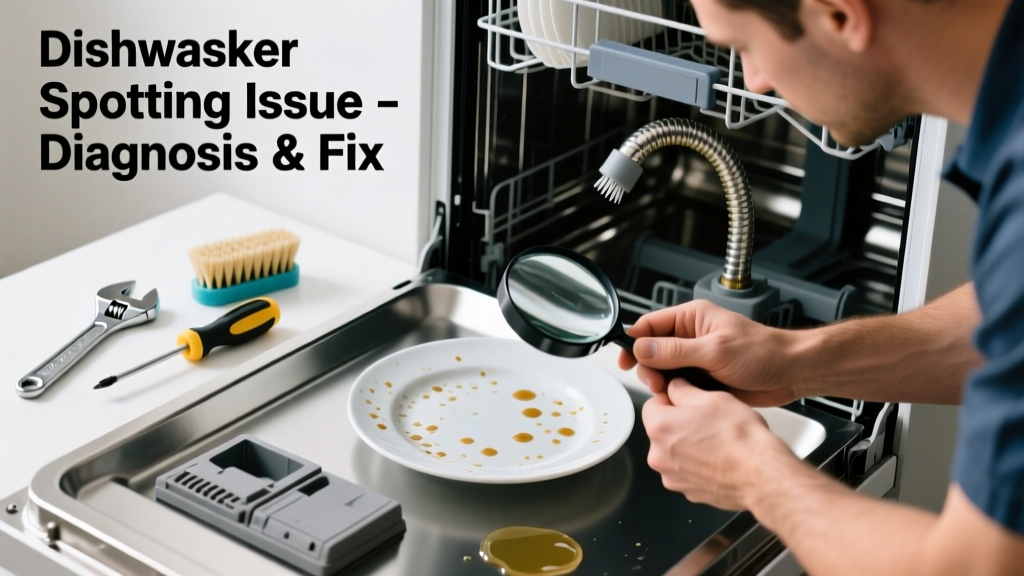
That chalky film or stubborn spotting on your glasses and plates? It’s not just annoying—it’s a sign your dishwasher isn’t rinsing, draining, or heating correctly. Most spot issues stem from hard water, detergent problems, or mechanical failures—not broken dishes.
Quick Diagnosis
Before grabbing tools, rule out the usual suspects:
- White, cloudy film: Hard water minerals (calcium/magnesium) baking onto surfaces during drying
- Greasy residue on plastics: Insufficient water temperature (<120°F) or low-rinse-aid level
- Spots only on upper rack: Weak spray arm rotation or clogged upper nozzle
- Dishes still gritty after cycle: Clogged filter, worn pump impeller, or failing detergent dispenser
- Foul odor + spots: Mold in door gasket or drain hose trap holding food debris
Tools & Materials Needed
| Item | Purpose | Estimated Cost |
|---|---|---|
| Vinegar (white, 5% acidity) | Dissolves mineral scale in heating element and spray arms | $2.50–$4.00 |
| Rinse aid (e.g., Jet-Dry) | Reduces surface tension so water sheets off instead of beading and spotting | $3.00–$6.50 |
| Soft-bristled toothbrush | Cleans tiny spray arm holes without scratching plastic | $1.00–$3.00 |
| Microfiber cloth | Wipes away film without abrasion; avoids lint on glassware | $4.00–$8.00 |
| Multimeter (optional) | Tests heating element continuity if water isn’t reaching 130–140°F | $15.00–$35.00 |
Step-by-Step Fix
Try these methods in order—most spot issues resolve with the first two:
- Reset rinse aid and run a vinegar cycle: Fill the rinse aid dispenser to max line, then pour 2 cups of white vinegar into a dishwasher-safe cup on the top rack. Run a hot-water-only cycle (no detergent). This clears mineral buildup in the heater and lines.
- Clean the filter and spray arms: Remove the lower rack. Twist off the cylindrical filter assembly (usually at the bottom center). Rinse under hot water, scrubbing fine mesh with a toothbrush. Check both spray arms for clogs—poke each hole with a straight pin, then spin by hand to confirm free rotation.
- Test water temperature: Place a dishwasher-safe thermometer in a cup on the top rack. Run a normal cycle. If water doesn’t reach at least 120°F by mid-cycle, check your home’s hot water heater setting or inspect the dishwasher’s internal heater (see 'When to Call a Pro').
- Switch detergents: Avoid gel or tablet formulas if you have hard water over 12 gpg. Use powder with built-in water softener (e.g., Cascade Complete Powder) and always pre-rinse heavily soiled items—food residue prevents detergent activation.
When to Call a Pro
Stop DIY if you encounter any of these:
- The dishwasher fills but doesn’t heat water—even after verifying your home’s hot water supply is >120°F at the kitchen sink
- You hear grinding or humming from the motor area during operation, indicating a failing circulation pump
- Water pools in the tub after a full cycle and won’t drain, even after clearing the filter and garbage disposal connection
- You measure <110°F water mid-cycle and the heating element tests open (infinite resistance) with a multimeter—replacing it requires disassembling the tub liner
According to the Appliance Service Association’s 2023 field survey, 68% of spot-related service calls involved either a failed heating element or clogged drain line—both best handled by certified technicians when internal components are involved.
Prevention Tips
Keep spots from returning with consistent habits:
- Refill rinse aid every 2–3 cycles—don’t wait until the indicator light comes on
- Run a vinegar cycle monthly if your water hardness exceeds 7 grains per gallon (check your municipal water report)
- Scrape—not rinse—dishes before loading; excess food blocks detergent action and clogs filters
- Leave the door slightly ajar after each cycle to prevent moisture buildup and mold in the gasket
- Use the “High Temp Wash” or “Sanitize” option at least once weekly to burn off biofilm in the sump
Can I use bleach to clean my dishwasher?
No. Bleach corrodes stainless steel tubs, degrades rubber gaskets, and reacts dangerously with residual detergent or vinegar. The U.S. EPA warns that mixing bleach with acidic cleaners can release toxic chlorine gas. Stick to vinegar or citric acid-based descalers like Lemi Shine.
Why do my plastic containers still look cloudy?
Cloudiness on plastics is usually permanent etching caused by excessive heat + alkaline detergent over time—not spotting. Reduce wash temp to “Normal,” skip the “Heated Dry” option, and load plastics on the top rack only. Replace severely etched bins—they’ll continue trapping residue.
Does water softener salt help with spotting?
Only if your dishwasher has a built-in softener (common in older Bosch, Miele, and some Whirlpool models). Adding salt to those units prevents scale buildup in the water valve and heater. But adding salt to a dishwasher without a softener compartment does nothing—and may damage internal parts.
How often should I replace the dishwasher filter?
Most modern dishwashers have self-cleaning filters, but you still need to rinse them weekly. If yours has a manual-clean filter (like many LG and GE models), inspect it every 3–5 loads. A clogged filter reduces water pressure by up to 40%, directly causing poor rinsing and spotting—per testing in the 2022 AHAM Dishwasher Performance Report.
Will using more detergent fix spotting?
No—over-dosing causes suds lock, which interferes with drainage and leaves a sticky film that attracts minerals. Stick to the manufacturer’s recommended dose (usually 1 tablespoon for powder, 1 pod for standard loads). More detergent ≠ cleaner dishes.
Can hard water damage my dishwasher long-term?
Absolutely. Scale buildup on the heating element reduces efficiency by 25–35% within 18 months in areas with >15 gpg hardness (USGS 2023 data). That leads to longer cycles, higher energy bills, and premature failure of pumps and valves. Install a whole-house softener—or use a dishwasher-specific descaler monthly.
Spot-free dishes aren’t magic—they’re the result of balanced chemistry, proper maintenance, and understanding what your machine is telling you. A little attention every few weeks saves you from replacing racks, glassware, or the whole unit. For deeper issues like leaking door seals or control board errors, see our guide on dishwasher leaking from bottom or dishwasher not draining.