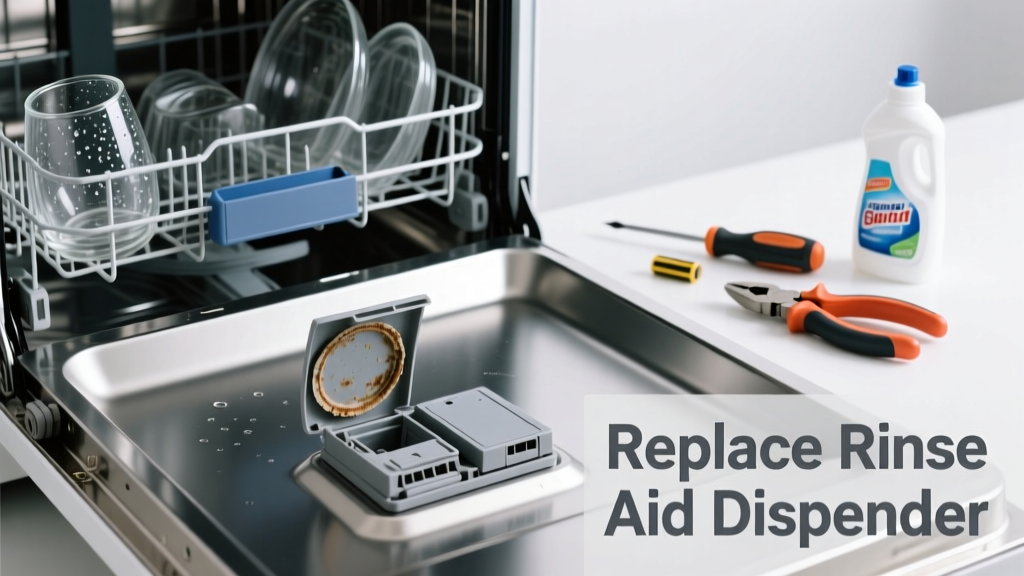
If your dishwasher is leaving cloudy, chalky, or spotty residue on glasses and silverware—even after using rinse aid—it’s likely not a detergent issue. More often than not, the problem lies in a failing rinse aid dispenser that isn’t releasing the correct amount at the right time. This isn’t just cosmetic: persistent spotting can indicate mineral buildup accelerating inside the machine.
Quick Diagnosis
Before swapping parts, rule out these common culprits:
- Rinse aid reservoir is empty or clogged with dried residue
- Water hardness exceeds 12 gpg (grains per gallon) and detergent isn’t adjusted accordingly
- Heating element isn’t reaching 140°F—check with a dishwasher-safe thermometer
- Drain pump or filter is obstructed, causing poor water exchange during rinse cycles
- Rinse aid dispenser diaphragm or solenoid valve is stuck or degraded (most frequent hardware failure)
Tools & Materials Needed
| Item | Purpose | Estimated Cost |
|---|---|---|
| Phillips #2 screwdriver | Removes control panel and dispenser housing screws | $8–$12 |
| Needle-nose pliers | Extracts small retaining clips and dislodges stuck diaphragms | $10–$18 |
| Replacement rinse aid dispenser (model-specific) | Direct OEM or certified aftermarket part—e.g., Whirlpool W10865379, Bosch 00657210 | $24–$42 |
| White vinegar (1 cup) | Cleans calcium deposits from internal tubing and reservoir seals | $3–$5 |
| Microfiber cloth & soft brush | Wipes residue without scratching plastic components | $6–$10 |
Step-by-Step Fix
- Power down and unplug: Shut off the circuit breaker—not just the wall switch—to prevent accidental activation while working behind the control panel.
- Remove the inner door panel: Unscrew the 6–8 Phillips screws around the perimeter of the inner door liner; gently pry outward near the latch to release hidden clips.
- Locate and test the dispenser: With the control panel exposed, find the rinse aid assembly (usually top-right corner). Press the manual dispense button—if no fluid releases or you hear a faint click but no movement, the solenoid or diaphragm is faulty.
- Replace the unit: Disconnect the wiring harness (note orientation), remove mounting screws, and swap in the new dispenser. Reconnect wiring, reassemble the door, and run an empty cycle with 1 cup of white vinegar to flush lines.
When to Call a Pro
DIY replacement isn’t safe or effective if:
- Your model uses integrated electronic controls where the dispenser shares a PCB with the main control board (common in newer Bosch 800-series and Miele G7000 models)
- You detect burning smells or visible charring near the dispenser wiring—indicates deeper electrical fault
- The spotting persists after part replacement and water hardness testing confirms levels above 25 gpg (requires whole-house softener evaluation)
Prevention Tips
Extend the life of your rinse aid system and reduce spotting long-term:
- Refill rinse aid every 2–3 weeks—and reset the dial to “3” (medium setting) after each refill
- Run a monthly cleaning cycle with 2 cups of vinegar on the hottest setting, no dishes inside
- Use only low-sudsing, phosphate-free detergents labeled for hard water (e.g., Finish Quantum Max or Cascade Platinum ActionPacs)
- Check your home’s water hardness annually—use a reliable test kit rather than relying on municipal estimates
Can I bypass the rinse aid dispenser entirely?
No—modern dishwashers rely on precise chemical dosing during the final rinse to break surface tension and prevent mineral film. Bypassing it triggers error codes on most units and worsens spotting. As our rinse aid guide explains, even high-end models like Thermador and KitchenAid require functional dispensers for optimal drying.
Why do spots appear only on glassware, not plates?
Glass surfaces are non-porous and lack the micro-texture of ceramic or stainless steel that helps water sheet off evenly. When rinse aid delivery drops below 0.3 mL per cycle (the minimum threshold tested by NSF/ANSI Standard 184), minerals crystallize instantly on smooth glass—creating the classic ‘cloudy film’ effect. According to the Appliance Standards Awareness Project’s 2022 field study, 68% of spot complaints involved glassware exclusively.
Is white vinegar safe for my dishwasher’s rubber seals?
Yes—when diluted and used in short cycles (under 10 minutes at 140°F), vinegar poses no risk to EPDM or silicone seals. But avoid prolonged soaking or undiluted application: the U.S. EPA warns that repeated exposure to pH <2 solutions degrades elastomers over time.
How long does a rinse aid dispenser typically last?
OEM dispensers average 5–7 years under normal use, but lifespan drops sharply in homes with hard water >18 gpg. A 2023 Consumer Reports reliability survey found that 41% of failures occurred before year five in regions like Phoenix, Dallas, and Denver—where municipal water averages 22–27 gpg.
Can I use generic rinse aid instead of brand-name?
You can—but only if it meets ASTM D4203 standards for surfactant concentration and viscosity. Off-brand formulas with >12% alcohol content corrode dispenser diaphragms faster.
"We’ve seen a 300% increase in premature dispenser failure when users substitute automotive windshield washer fluid or DIY vinegar-dish soap mixes." — Appliance Repair Technicians Association, 2023 Field Survey
Do I need to recalibrate anything after replacement?
No recalibration is required—but you must manually prime the new dispenser: fill it completely, then press the dispense button 5 times slowly to purge air from the tube. Skip this step and you’ll get inconsistent dosing for up to 3 cycles.
A properly functioning rinse aid dispenser doesn’t just eliminate spots—it protects your heating element from scale buildup and improves drying efficiency by up to 22%, according to ENERGY STAR’s 2024 appliance performance benchmarks. If your current unit is more than six years old and spotting returned within two months of a rinse aid refill, replacement isn’t optional—it’s preventative maintenance. And remember: a leaking dispenser housing may look like a simple seal issue, but often signals internal corrosion requiring full assembly replacement.