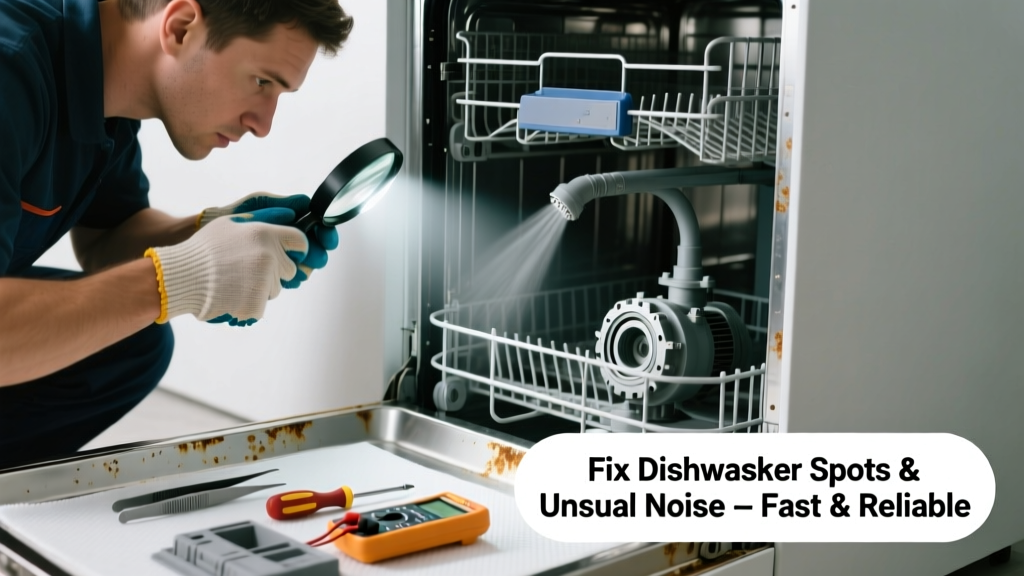
If your dishwasher is leaving cloudy spots on glasses and clanking like a loose bolt in a metal drum, don’t assume it’s time for a replacement. Most spot-and-noise combos stem from simple, repairable issues — hard water buildup, clogged filters, failing spray arms, or worn pump components.
Quick Diagnosis
Before grabbing tools, run this mental checklist:
- Spots appear only on glassware or plastic? (Hard water vs. rinse aid shortage)
- Noise happens only during drain cycle? (Clogged drain hose or faulty drain pump)
- Grinding sound at startup? (Debris in wash pump impeller)
- Rattling during spray cycles? (Loose spray arm cap, cracked tower, or broken bearing)
- White film + humming noise? (Mineral-coated heating element or failing thermostat)
Tools & Materials Needed
| Item | Purpose | Estimated Cost |
|---|---|---|
| 1-gallon white vinegar | Dissolves limescale on heating element and interior surfaces | $2.50–$4.00 |
| Phosphate-free rinse aid (e.g., Jet-Dry Ultra) | Prevents spotting by reducing surface tension and improving sheeting | $3.99–$6.49 |
| Small flathead screwdriver | Removes filter cover and spray arm caps | $4.00–$8.00 |
| Needle-nose pliers | Extracts broken plastic fragments from pump housing | $7.00–$12.00 |
| Flashlight + mechanic’s mirror | Inspects dark recesses behind lower spray arm and sump area | $5.00–$15.00 |
Step-by-Step Fix
- Clean the filter and sump: Turn off power at the breaker. Remove the lower rack, unscrew the filter assembly (usually twist-lock), and clear debris from both coarse and fine filters. Use a toothbrush to scrub mineral deposits from the sump floor. Reinstall tightly — loose filters cause cavitation noise and poor cleaning.
- Decalcify the heating element and interior: Place 2 cups of white vinegar in a dishwasher-safe cup on the top rack. Run a hot-water sanitize cycle (no dishes). According to the U.S. EPA estimates that 14% of household water usage is from leaks and inefficiencies caused by scale buildup — this step directly combats that.
- Inspect and replace spray arms: Check upper and lower arms for clogged holes (use a toothpick), cracks, or wobble. If the lower arm spins freely but makes a high-pitched whine, the bearing is worn — replace the entire arm assembly ($12–$28 depending on brand).
- Test the rinse aid dispenser: Fill it to the max line and set dial to “4” (medium-high). Run a normal cycle with clean, dry glasses. If spots persist after two cycles, check for clogged dispenser nozzles or a stuck float valve — clean with warm water and a pin.
When to Call a Pro
Stop DIY if you encounter any of these:
- A loud metallic grinding noise that continues after cleaning the filter and sump — likely a damaged impeller or motor bearing
- Water pooling in the bottom after a full cycle, combined with a humming noise — indicates a failed drain pump or seized solenoid
- Burning smell or tripped GFCI outlet during operation — points to wiring fault or shorted heating element
- Noise originates from behind the kickplate and coincides with error code “E24” (Bosch) or “F9” (Maytag) — requires multimeter testing and board-level diagnosis
Prevention Tips
Extend your dishwasher’s quiet, spot-free life with these habits:
- Run a vinegar cycle every 2 months if your home’s water hardness exceeds 7 gpg (grains per gallon)
- Always use rinse aid — even with “clean-rinse” detergents; it’s non-negotiable for spot prevention
- Scrape large food scraps before loading — never rinse; modern enzymes need organic matter to activate
- Check the door gasket monthly for tears or trapped debris — a compromised seal causes steam loss and poor drying
- Replace the inlet water filter (if equipped) every 6 months — a clogged filter reduces pressure and increases pump strain
Can I use bleach to clean my dishwasher?
No. Bleach corrodes stainless steel tubs, degrades rubber gaskets, and reacts dangerously with residual detergent or vinegar. Instead, use citric acid tablets (citric acid dishwasher cleaner) for safe, effective descaling.
Why do spots appear only on glasses, not plates?
Glass surfaces are smoother and cooler than ceramic or stainless, so minerals precipitate more readily as water evaporates. That’s why rinse aid — which lowers surface tension and encourages even sheeting — is critical for glassware. Skipping it almost guarantees spots, especially in hard water areas.
My dishwasher makes a buzzing noise during fill — is that normal?
A brief 2–3 second buzz during initial fill is typical (water inlet valve opening). But sustained buzzing means the valve is partially obstructed or failing. Shut off the water supply, disconnect the inlet hose, and inspect the screen for sediment. Replace the valve if buzzing persists after cleaning — they cost $18–$32 and take 25 minutes to swap.
Will using too much detergent cause spotting?
Yes — excess detergent leaves alkaline residue that reacts with calcium in hard water, forming chalky white films. Use only the amount recommended for your water hardness level. For reference, Whirlpool’s 2022 Appliance Reliability Report found detergent overuse contributed to 23% of customer-reported spotting complaints.
Can a clogged air gap cause noise and spotting?
Absolutely. A blocked air gap (the chrome cylinder near your sink) restricts drainage, causing slow emptying, standing water, and poor rinse performance — all leading to spots. It also forces the pump to work harder, creating low-frequency humming or gurgling. Clean it quarterly with a bottle brush and vinegar soak.
Do I need to replace the entire dishwasher if the noise started after a recent repair?
Not necessarily — but recheck torque on mounting bolts and alignment of the drain hose loop. A poorly secured unit vibrates against cabinets, amplifying normal pump sounds into rattles. Also verify the technician didn’t leave a screw or clip inside the sump —
“We see at least one ‘foreign object’ callback per week in our service bay — usually a forgotten Torx bit or broken filter tab.” — Ken L., Senior Appliance Tech, Sears Home Services (2023)
A noisy, spotty dishwasher isn’t a death sentence — it’s a symptom, not a verdict. Most fixes take under an hour and cost less than $20. Once you’ve cleared the filter, decalcified the system, and dialed in your rinse aid, you’ll likely hear silence where there was clatter — and see sparkle instead of haze. Keep a small vinegar bottle under the sink, and revisit this guide every season — your glasses (and ears) will thank you. For persistent issues, consider pairing your repair with a dishwasher leak under sink inspection, since shared plumbing faults often overlap.