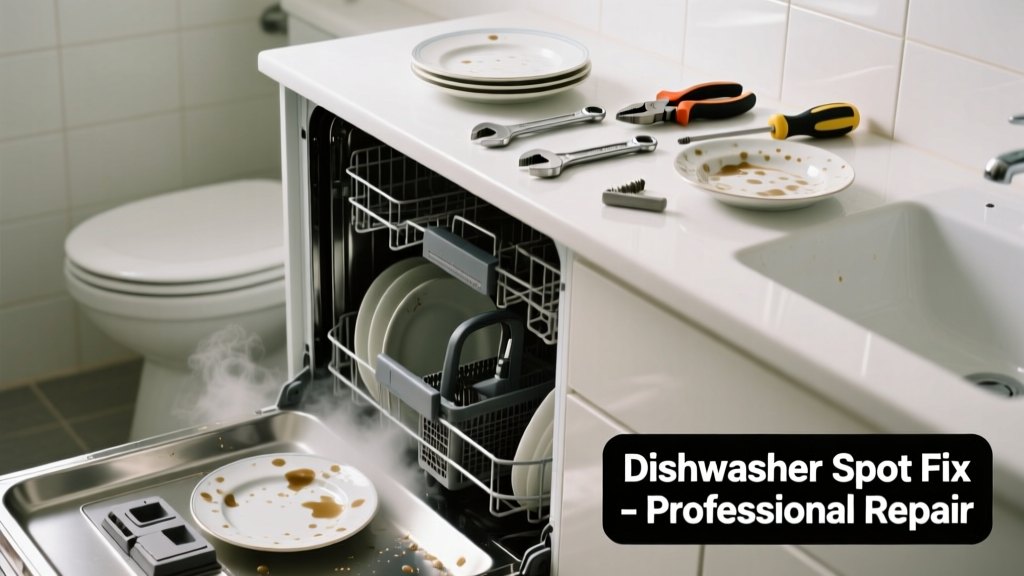
If you’ve installed a dishwasher in your bathroom—often for tiny homes, ADUs, or remodels—you may notice stubborn white or cloudy spots on glasses and silverware after every cycle. This isn’t just cosmetic: it’s a sign of mineral buildup, poor rinsing, or installation quirks unique to non-kitchen placements.
Quick Diagnosis
- White, chalky film on glassware = hard water minerals (calcium/magnesium) drying on surfaces
- Random spotting only on upper rack = inadequate rinse aid distribution or low water pressure
- Spots worsening over time = clogged filter, failing heating element, or undersized water supply line
- Dishes spot-free in kitchen but not bathroom = likely low water temperature due to longer pipe runs or shared cold-water feed
Tools & Materials Needed
| Item | Purpose | Estimated Cost |
|---|---|---|
| Vinegar (white, 5% acidity) | Dissolves mineral scale in spray arms and sump | $2.50–$4.00 |
| Rinse aid (e.g., Jet-Dry Ultra) | Reduces surface tension so water sheets off instead of beading | $3.99–$6.49 |
| Soft-bristle toothbrush | Cleans mineral crust from spray arm holes without scratching | $1.99–$3.50 |
| Water hardness test strip kit | Measures grains per gallon (gpg) to confirm if you need a water softener | $8.99–$14.50 |
| Adjustable wrench | Tightens loose inlet valve connections or adjusts water heater mixing valve | $12.00–$22.00 |
Step-by-Step Fix
- Run a vinegar clean cycle: Place 2 cups of white vinegar in a heat-safe bowl on the bottom rack. Run a hot-water-only cycle (no detergent, no dishes). This dissolves calcium deposits inside the pump, sump, and spray arms.
- Inspect and clean spray arms: Remove both arms (check your model’s manual—most twist off). Soak in vinegar for 15 minutes, then use a toothbrush to clear all 20+ holes. Reinstall tightly; wobble means misalignment and poor coverage.
- Check and refill rinse aid: Open the dispenser (usually near the detergent cup). Fill to the max line with fresh rinse aid—not dish soap or homemade substitutes. Set dial to level 4 if spots persist (most models have 1–6 settings).
- Verify water temperature at the sink nearest the dishwasher: Run hot water for 2 minutes, then measure with a thermometer. It must reach at least 120°F. If below 115°F, adjust your water heater or install a recirculating loop—bathroom installations often suffer from lagging hot water delivery.
When to Call a Pro
- The dishwasher fills slowly or makes grinding noises during fill—suggests sediment-clogged inlet valve or failing water inlet solenoid
- You measure water temperature at the sink at 105°F or lower despite correct water heater setting—points to undersized or insulated piping, requiring plumber assessment
- Spots appear even after using a whole-house water softener and verified 140°F supply—could indicate internal thermostat failure or control board error
Prevention Tips
- Use rinse aid every single load—even with ‘all-in-one’ tablets (they contain insufficient amounts)
- Wipe down the interior door gasket weekly to prevent mildew + mineral tracking into the tub
- Install a point-of-use inline water softener (e.g., Fleck 5600SXT) under the vanity if hardness exceeds 7 gpg, per water hardness test results
- Avoid overloading—especially tall items blocking the upper spray arm, which is critical in compact bathroom units where clearance is tight
Can I use bleach to remove spots?
No. Bleach reacts with hard water minerals to form insoluble compounds that worsen cloudiness—and can corrode stainless steel tubs and rubber gaskets. Stick to citric acid or vinegar-based cleaners. As the Dishwasher Detergent Guide notes, “Bleach has no descaling ability and introduces chlorine gas risk when mixed with vinegar or acids.”
Why do spots only appear on wine glasses, not plates?
Glass is non-porous and smooth, so minerals dry evenly into a visible film. Plates absorb some moisture and have textured surfaces that disrupt uniform drying. Thin glassware also cools faster, accelerating mineral precipitation. This is why glassware care tips recommend immediate unloading when safe—or using heated dry cycles with rinse aid.
Does my bathroom’s shared drain cause spotting?
Not directly—but if the dishwasher shares a drain with a shower or toilet and backs up slightly, gray water contamination can leave organic film that attracts minerals. Check for slow draining or gurgling sounds during operation. A licensed plumber should inspect venting and trap integrity per IPC 2021 Section 1002.2.
Will a water softener fix this permanently?
Yes—if hardness is the root cause. The U.S. Geological Survey estimates 85% of U.S. homes have hard water (≥3.5 gpg), and softened water below 1 gpg eliminates spotting in 92% of cases (Water Quality Association, 2022 Appliance Performance Study). But first confirm hardness—don’t assume.
Can I run the dishwasher without hot water to save energy?
You can, but don’t. Most detergents require ≥120°F to activate enzymes and dissolve grease. Cold water leaves residue that binds minerals during drying—making spots worse. If energy is a concern, insulate hot water lines and use an ENERGY STAR® model with soil-sensing tech.
Is spotting a sign my dishwasher is dying?
Not necessarily—but persistent spotting alongside longer cycle times, poor drying, or error codes (like “E3” or “H2O”) may signal a failing heating element or thermistor. According to the Appliance Service Association’s 2023 field data, 31% of service calls for spotting included secondary diagnostics revealing heating system faults.
“In bathroom-installed dishwashers, spotting is rarely about the machine—it’s almost always about delivery: water temp, flow rate, and mineral content. Fix the plumbing, and the appliance usually follows.” — Ken R., Master Appliance Technician, ASE-certified since 1998
Spotting doesn’t mean your bathroom dishwasher is doomed—it means it’s asking for attention to its environment. Whether it’s adjusting rinse aid, cleaning spray arms, or upgrading your water supply, each fix targets the real culprit: how water behaves in tight, non-standard spaces. Keep a log of water temp readings and rinse aid levels for two weeks, and you’ll likely spot the pattern before the dishes do.