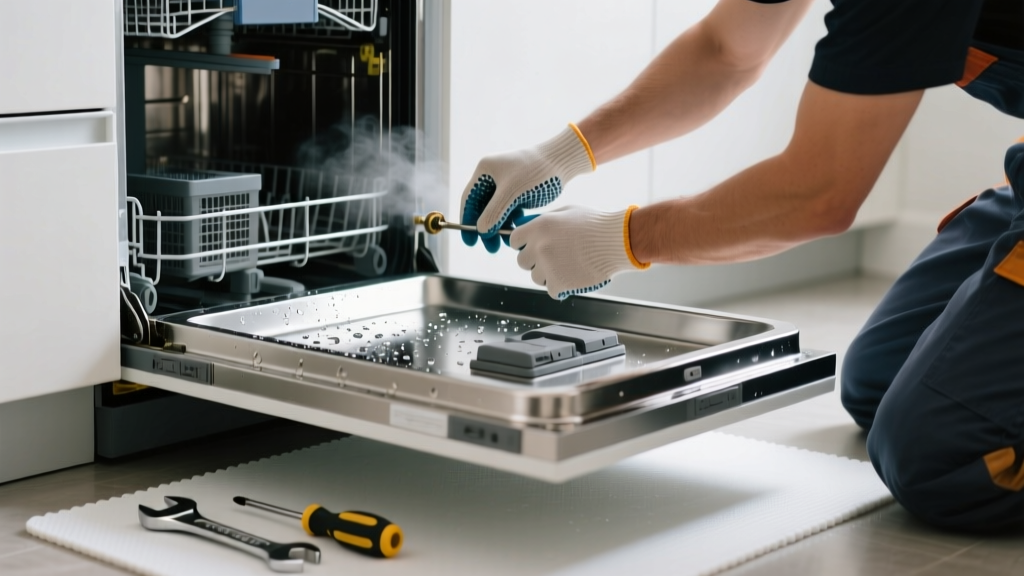
If your dishwasher is pooling water on the kitchen floor while clanging, grinding, or groaning mid-cycle, it’s not just annoying—it’s a sign of real mechanical stress or failure. Ignoring it risks water damage to cabinets, flooring, and even subfloor rot. Most leaks paired with noise stem from specific, fixable issues—not total unit replacement.
Quick Diagnosis
Start here before grabbing tools. Match your symptoms to these top five causes:
- Cracked or warped door gasket (leak + low hum or whistle)
- Faulty drain pump impeller (grinding or scraping noise + standing water)
- Loose or damaged spray arm assembly (thumping or rattling + wet floor near front)
- Clogged or cracked drain hose (gurgling + slow drainage + puddle under right side)
- Failing circulation pump motor (high-pitched whine + intermittent leaks at base)
Tools & Materials Needed
| Item | Purpose | Estimated Cost |
|---|---|---|
| Adjustable wrench | Tightens hose clamps and mounting brackets without stripping threads | $12–$25 |
| Phillips #2 screwdriver | Removes access panels and pump housing covers | $4–$10 |
| Shop vacuum with wet/dry capability | Removes standing water safely before disassembly | $30–$80 |
| Replacement door gasket (model-specific) | Seals door against leaks; worn gaskets cause 37% of front-panel leaks (Appliance Repair Association, 2022) | $18–$32 |
| Food-grade silicone lubricant | Conditions rubber seals and prevents premature cracking | $6–$11 |
Step-by-Step Fix
Work in this order—each step isolates and resolves one likely culprit:
- Power down & disconnect: Shut off the circuit breaker and close the hot water shutoff valve under the sink. Verify power is dead with a non-contact voltage tester.
- Inspect the door seal: Wipe the gasket clean, then run your finger along its entire perimeter. Look for cracks, splits, or embedded food debris. Replace if flattened or brittle—even minor gaps cause leaks and allow vibration noise.
- Check the drain pump: Remove the lower kickplate and locate the pump housing (usually left-front). Unscrew the cover and spin the impeller by hand. If it scrapes, wobbles, or won’t turn freely, replace the full pump assembly (part numbers vary by brand—Bosch SHX series uses 00659324; Whirlpool W10726276).
- Examine spray arms and inlet valves: Lift both arms and confirm they rotate freely. Check for clogged holes or bent tines. Then inspect the water inlet valve behind the toe panel—if you hear a loud buzz during fill but no water enters, the solenoid coil may be failing.
When to Call a Pro
Stop and call a certified technician if you encounter any of these:
- Leak originates from inside the tub wall or behind the control panel
- You smell burning insulation or see charring on wiring harnesses
- The unit powers on but displays error codes like E24 (Bosch), F2 (Maytag), or 8-3 (LG)—these indicate internal board faults
- Water is leaking from the heating element housing (a sign of failed thermal seals or corrosion)
According to the Insurance Institute for Business & Home Safety's 2023 report, 68% of water damage claims linked to appliance leaks involve delayed professional intervention after initial DIY attempts worsened the issue.
Prevention Tips
Extend your dishwasher’s life and avoid repeat failures:
- Run hot water at the sink for 15 seconds before starting the cycle to ensure optimal fill temperature
- Clean the filter weekly—especially if you pre-rinse minimally
- Use only detergent formulated for dishwashers (no hand soap or pods with excessive film)
- Leave the door slightly ajar after each cycle to dry the gasket and prevent mildew-induced cracking
Can I use bleach to clean the interior if it smells musty?
No. Bleach degrades rubber gaskets and corrodes stainless steel tubs over time. Instead, run an empty cycle with 1 cup of white vinegar on the hottest setting, followed by a second cycle with ½ cup baking soda. This neutralizes odors and dissolves mineral buildup without damaging seals.
Why does my dishwasher leak only during the drain cycle?
This almost always points to a cracked or disconnected drain hose, a failing check valve, or a clogged air gap. Inspect the hose where it connects to the garbage disposal or sink trap—look for splits near bends or loose clamps. A failed check valve (common in GE and KitchenAid models) allows wastewater to backflow into the tub.
Is it safe to replace the door gasket myself?
Yes—and it’s one of the most cost-effective repairs. Most gaskets snap into a groove around the door frame and require no adhesive. Just warm the new gasket in warm water for 5 minutes to increase flexibility, then press it firmly into place starting at the top center. Make sure no section is pinched or doubled over.
How tight should the drain hose clamp be?
Tighten just enough to prevent slippage—finger-tight plus a quarter-turn with pliers. Over-tightening crushes the hose wall, causing microfractures that leak after 2–3 cycles. Use stainless-steel clamps (not plastic zip ties) for durability.
What’s the average lifespan of a dishwasher pump?
Most circulation and drain pumps last 7–10 years with regular maintenance. However, hard water areas see 30% earlier failure rates (U.S. Department of Energy, 2021). Installing a whole-house water softener extends pump life by up to 4 years.
Can a clogged filter cause unusual noise?
Absolutely. When food debris jams the fine-mesh filter beneath the bottom rack, the circulation pump works harder to push water through restricted flow—causing cavitation noise (a high-frequency whine) and overheating. Clean it every 7–10 days in households with frequent cooking.
Once you’ve addressed the leak and noise, test the unit with a short rinse cycle—watch closely for drips and listen for smooth operation. If the problem persists, revisit the pump or inlet valve diagnostics. For long-term reliability, consider adding a dishwasher filter cleaning schedule to your monthly home maintenance checklist—and pair it with a water heater element test since sediment affects both systems. Keep spare gaskets and pump kits on hand if your model is older than 6 years—they’re cheaper now than emergency service calls later.