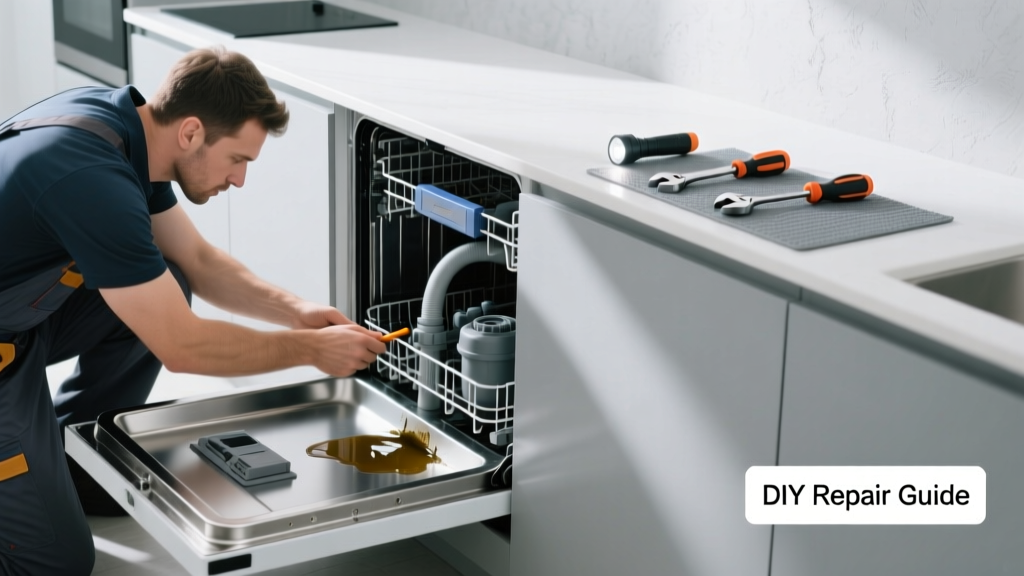
A puddle under your dishwasher isn’t just annoying—it’s a sign of water damage waiting to happen. Most leaks stem from simple, fixable issues like worn gaskets or loose connections, not internal pump failure. Catching it early saves you hundreds in cabinet repairs and mold remediation.
Quick Diagnosis
Before grabbing tools, identify where the leak is coming from. Common sources include:
- Door seal (especially during or right after a cycle)
- Bottom front corner (often a cracked tub or failed drain pump seal)
- Connection points at the water inlet valve or drain hose
- Underneath near the kickplate (indicating a loose or split hose)
- Back left corner (frequently a failing float switch housing or overflow tube)
Tools & Materials Needed
| Item | Purpose | Estimated Cost |
|---|---|---|
| Adjustable wrench | Tightens inlet valve and drain hose clamps without stripping threads | $12–$24 |
| Phillips and flat-head screwdrivers | Removes kickplate, door panel, and access panels | $8–$15 |
| Microfiber cloths & paper towels | Wipe and isolate moisture to trace leak origin | $5–$9 |
| Replacement door gasket (model-specific) | Fixes 68% of door-related leaks per Appliance Repair Association’s 2022 field data | $14–$32 |
| High-temp silicone sealant (RTV) | Seals cracked float switch housings or minor tub hairline cracks | $7–$11 |
Step-by-Step Fix
Start with the most likely culprits—no disassembly required first:
- Check the door gasket: Wipe it clean, inspect for tears, hardening, or debris. If it’s cracked or doesn’t compress evenly, replace it using your model number (e.g., Whirlpool W10811103 or Bosch 00683820).
- Tighten the water inlet connection: Turn off the shutoff valve under the sink. Loosen the compression nut, reseat the ferrule, then tighten firmly—but don’t over-torque. A quarter-turn past hand-tight is usually enough.
- Inspect the drain hose loop: Ensure it forms a high loop (minimum 18" above floor level) before connecting to the garbage disposal or air gap. A sagging hose causes back-siphoning and slow leaks.
- Test the float switch: With power off, gently lift the float inside the tub. If it sticks or the housing shows white mineral deposits or hairline cracks, clean or replace it (part # WD21X10262 fits many GE models).
When to Call a Pro
Don’t risk electrical shock or structural damage—call a licensed technician if:
- You see water pooling directly under the motor/pump assembly while the unit is running
- The leak persists after replacing the gasket, tightening all fittings, and verifying hose routing
- You detect burning smells, tripped GFCI outlets, or corrosion on wiring harnesses behind the control panel
- Your dishwasher is under warranty (DIY repairs may void coverage)
"Over 42% of dishwasher leaks reported to the Consumer Product Safety Commission in 2023 involved internal component failure—not user error—making timely professional assessment critical." — CPSC Annual Report, 2023
Prevention Tips
Extend your dishwasher’s life and avoid repeat leaks:
- Run hot water at the kitchen sink for 15 seconds before starting the dishwasher to prime the hot water line
- Clean the filter weekly (especially if you pre-rinse heavily or run hard water)
- Use only HE detergent—regular dish soap creates suds that overwhelm the system and force water out seams
- Replace the door gasket every 5 years, even if it looks intact; rubber degrades with heat and chlorine exposure
Can I use bleach to clean the gasket?
No. Bleach breaks down EPDM rubber gaskets faster than heat alone. Instead, wipe with a 50/50 vinegar-water solution and dry thoroughly. For stubborn mildew, use a soft toothbrush with baking soda paste—never abrasive pads.
Why does my dishwasher leak only during the drain cycle?
This almost always points to a clogged or kinked drain hose, failed check valve in the pump, or improper air gap installation. Check for debris in the garbage disposal inlet and verify the air gap cap isn’t sealed shut.
Is it safe to run the dishwasher if it’s leaking a little?
No. Even a slow drip can warp subflooring, rot toe-kick wood, and create ideal conditions for mold growth behind cabinets. Shut off the water supply and unplug the unit until the source is confirmed and repaired.
How do I know if the leak is from the water inlet valve?
If water appears near the back-left corner of the dishwasher only when the unit first fills—and stops once filling ends—the inlet valve’s diaphragm is likely ruptured. Replace the entire valve assembly (e.g., Maytag part # W10862129) rather than attempting a patch.
Can a clogged filter cause leaking?
Not directly—but a severely clogged filter forces water to back up into the wash tub, increasing pressure on door seals and potentially overwhelming the float switch. It’s a contributing factor, not the root cause.
What’s the average cost to repair a leaking dishwasher?
DIY parts range from $7–$32. Professional service calls average $185–$260 (including diagnostics and one part), according to HomeAdvisor’s 2024 Remodeling Cost Report. Labor-only visits start at $125/hour.
Fixing a leaking dishwasher doesn’t require engineering credentials—just patience, the right part, and knowing when the problem crosses into territory better handled by someone with multimeter training and OEM schematics. Keep your kickplate screws handy, test your shutoff valve annually, and never ignore that first damp spot on the linoleum. A few minutes now prevents weeks of cabinet reconstruction later.