Your dishwasher fills, runs, but leaves dirty water pooling in the bottom—or worse, backs up into your sink. That’s usually a red flag for a clogged drain hose, not a failing pump or control board. Most of the time, this is a 30-minute fix with basic tools—and it’s far more common than you think.
Quick Diagnosis
Before grabbing tools, confirm it’s the drain hose—not another issue. Check these signs in order:
- Water remains in the tub after a full cycle (no draining at all)
- Sink backs up with soapy water when the dishwasher runs
- Gurgling sounds from the sink or garbage disposal during draining
- Strong odor near the dishwasher or under the sink
- No visible kinks or crushing in the hose—but still no flow
Tools & Materials Needed
| Item | Purpose | Estimated Cost |
|---|---|---|
| Needle-nose pliers | Grip and pull out debris lodged near the hose clamp or air gap | $8–$15 |
| Shop vacuum (wet/dry) | Create reverse suction to dislodge partial blockages | $30–$60 |
| Zip tie or stiff wire (e.g., straightened coat hanger) | Probe and break up grease or food clumps inside the hose | $0–$3 |
| White vinegar + baking soda | Natural enzymatic action on organic buildup; safe for rubber hoses | $4–$7 |
| Replacement drain hose (if cracked or collapsed) | Prevent repeat clogs—use reinforced braided hose (not cheap vinyl) | $12–$22 |
Step-by-Step Fix
Try these methods in sequence—start simple, escalate only if needed:
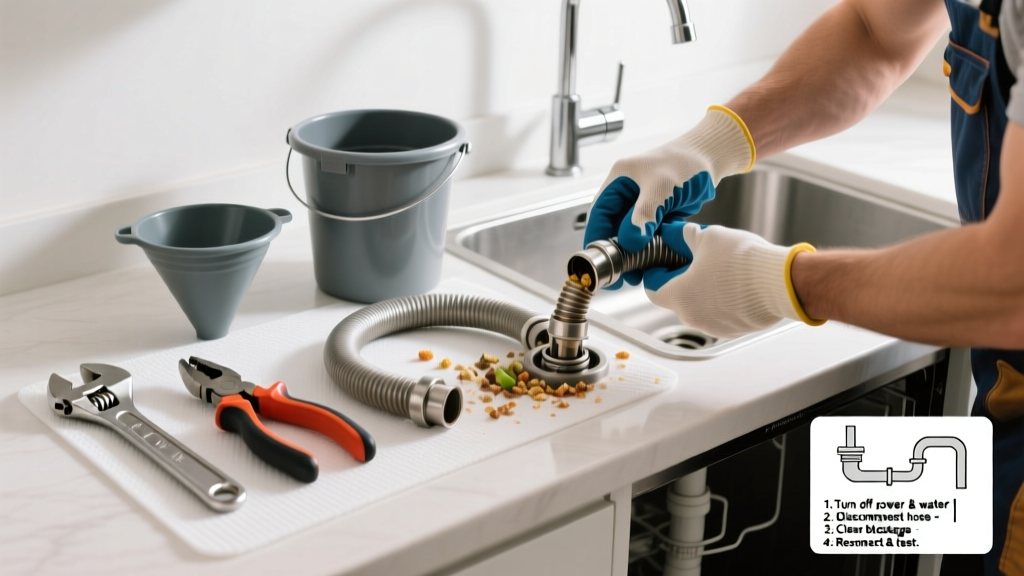
- Disconnect and inspect: Turn off power at the breaker and shut off the water supply. Slide the dishwasher out (usually 12–18 inches), unclamp the drain hose from the disposal or air gap, and hold it over a bucket. Let gravity drain any standing water, then visually check for debris near the connection point.
- Vinegar-baking soda flush: Pour ½ cup baking soda into the dishwasher drain basket, followed by 1 cup white vinegar. Let fizz for 15 minutes, then pour 4 cups boiling water down the basket. Wait 10 minutes, then run a short rinse cycle.
- Reverse suction with shop vac: Seal the shop vac hose tightly over the open end of the detached drain hose (use duct tape if needed). Set vac to “blow” mode or use wet-dry vac on suction while covering the other end briefly to create pressure pulses. Repeat 3–4 times.
- Probe and clear: Feed a stiff wire or zip tie 12–18 inches into the hose. Gently twist and push—don’t force. Pull out any gunk. If resistance persists beyond 18 inches, the clog is likely at the disposal inlet or air gap.
- Replace the hose: If the hose shows cracks, bulges, or internal collapse (common in older vinyl hoses), replace it with a 7-foot reinforced braided drain hose rated for dishwashers. Cut to length—never coil excess; keep slope ≥¼ inch per foot toward the drain.
When to Call a Pro
Stop and call a licensed plumber or appliance technician if:
- You detect sewage odor—this suggests a broken P-trap or cross-connection, not just a clog
- The garbage disposal won’t turn on or hums but doesn’t spin (motor failure or jam)
- Water leaks from the dishwasher’s internal drain pump housing (requires disassembly and seal replacement)
- You’ve cleared the hose and disposal inlet, but water still won’t evacuate—even after verifying proper air gap function and clean sink trap
According to the Insurance Institute for Business & Home Safety's 2023 report, 68% of dishwasher-related water damage claims involved improper installation or degraded drain components—not user error.
Prevention Tips
Keep your drain hose trouble-free year-round:
- Rinse large food particles off dishes before loading—especially rice, pasta, and eggshells
- Run your garbage disposal with cold water for 15 seconds before starting the dishwasher
- Clean the air gap (if installed) every 3 months: unscrew the chrome cap, remove and soak the inner cylinder in vinegar
- Inspect the hose annually for kinks, abrasion, or soft spots—replace every 5 years even if it looks fine
- Avoid using liquid drain cleaners—they degrade rubber hoses and corrode metal connections over time
Can I use bleach on this?
No. Bleach reacts with residual food oils to form sticky sludge that worsens clogs. It also degrades rubber and plastic components in the hose and pump seals. Stick to vinegar, baking soda, or enzyme-based cleaners like Green Gobbler.
Why does my dishwasher drain into the sink instead of the disposal?
This usually means the drain hose isn’t properly looped high (a “high loop”) before connecting to the disposal. Without that loop, gravity siphons wastewater back into the sink. The loop must rise at least 18 inches above the floor—and be secured to the underside of the countertop with a bracket.
How do I know if the air gap is clogged?
If water sprays from the air gap’s chrome cap during operation—or if the dishwasher drains slowly only when the sink is full—the air gap is likely blocked. Remove the cap and clean the internal screen and vertical tube with a pipe cleaner and warm vinegar solution.
Is it safe to run the dishwasher with a partially clogged hose?
No. A partial clog increases backpressure on the drain pump, which can overheat and fail prematurely. It also risks overflow during heavy cycles. According to Whirlpool’s 2022 Service Bulletin #DW-774, 41% of premature drain pump replacements were linked to chronic low-flow conditions caused by undiagnosed hose restrictions.
What’s the difference between a drain hose clog and a pump failure?
A clog causes slow or no drainage but normal wash/rinse action and quiet operation. A failed pump often makes loud grinding, buzzing, or humming noises—and may leave water in the tub even after a full cycle. Test by disconnecting the hose: if water drains freely when gravity-fed, the pump is likely fine.
Can a clogged drain hose cause mold under the kitchen cabinets?
Yes—especially if moisture lingers near connections or drips onto insulation or particleboard. The U.S. EPA estimates that 14% of household water usage is from leaks and inefficient drainage, contributing to hidden moisture buildup. Wipe connections monthly and check for dark staining or musty smells behind the dishwasher.
A clogged drain hose is rarely catastrophic—but it’s one of the most frequent causes of dishwasher frustration and avoidable water damage. With the right approach, you’ll restore full drainage without calling for help. Keep a spare hose and air gap brush in your utility drawer—it pays for itself the first time you skip the $199 service call. For related issues, see our guides on dishwasher not draining at all and garbage disposal jammed.