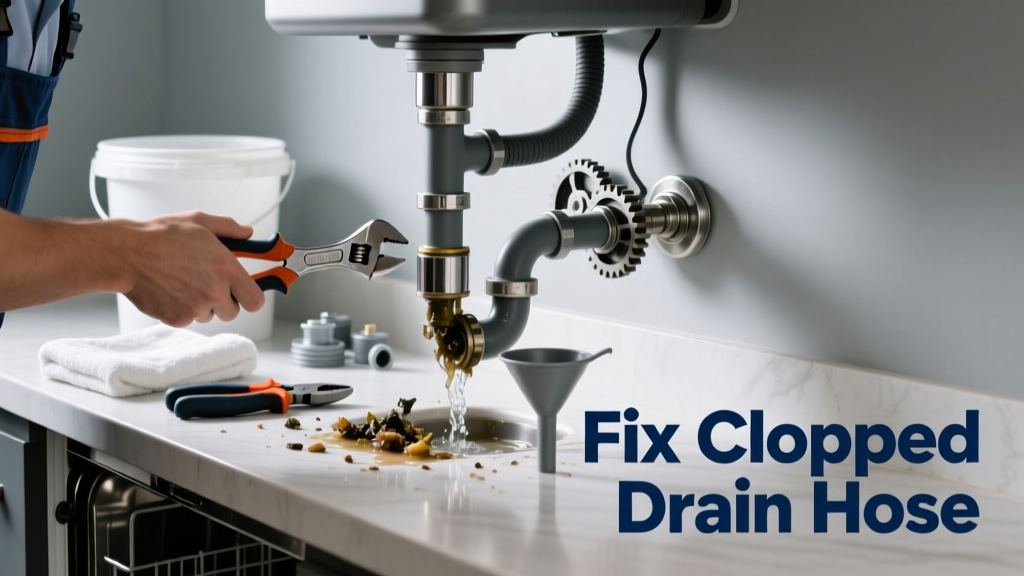
If your dishwasher suddenly starts groaning, gurgling, or humming loudly during the drain cycle—and water pools in the bottom—you’re likely dealing with a clogged drain hose. This isn’t just annoying; it can lead to standing water, mold growth, or even overflow into your kitchen cabinet.
Quick Diagnosis
Before grabbing tools, rule out these common culprits:
- A kink or sharp bend in the drain hose behind the unit
- Food debris or grease buildup at the hose’s connection to the garbage disposal or air gap
- A blocked air gap (especially if you hear sputtering or see water backing up near the sink)
- A failed check valve inside the hose—common in older Whirlpool and Maytag models
- Mineral scale buildup from hard water restricting flow over time
Tools & Materials Needed
| Item | Purpose | Estimated Cost |
|---|---|---|
| Channel-lock pliers | Grip and loosen stubborn hose clamps without damaging rubber | $12–$18 |
| 5-gallon bucket | Catch residual water when disconnecting the hose | $4–$8 |
| Vinegar + baking soda | Natural descaler for mineral deposits and mild organic clogs | $3–$5 |
| Plumber’s snake (15-ft, 1/4") | Reach past the hose elbow into the disposal or standpipe | $10–$16 |
| Replacement drain hose (if cracked or collapsed) | Prevent recurrence—use reinforced braided hose rated for dishwashers | $14–$22 |
Step-by-Step Fix
Try these methods in order—most clogs resolve at Step 2 or 3:
- Power down & disconnect: Turn off the circuit breaker and shut off the water supply. Pull the dishwasher out carefully (leave the door open for balance) and place towels underneath.
- Inspect and straighten the hose: Look for kinks, flattening, or cracks. Gently reposition—never force bends tighter than a 12-inch radius. A crushed hose causes turbulence that sounds like grinding.
- Clear the air gap or disposal inlet: Unscrew the air gap cap (usually on the sink deck) and clean the interior with a pipe cleaner. If connected to a garbage disposal, remove the discharge tube and use the plumber’s snake to clear the disposal’s dishwasher port.
- Flush with vinegar solution: Mix 1 cup white vinegar with 1 tbsp baking soda. Pour slowly into the dishwasher’s drain basket, wait 15 minutes, then run a short rinse cycle with hot water only.
- Replace the hose (if needed): If the hose is brittle, cracked, or shows internal collapse, replace it with a reinforced 7/8" ID braided hose—standard length is 6 feet, but measure yours first.
When to Call a Pro
Stop and call a licensed appliance technician if:
- You detect a sewer gas smell after opening the hose—this signals a broken P-trap or vent issue
- The noise persists after clearing the hose and you suspect a failing drain pump (a $120–$250 part with labor)
- Your home uses a graywater system or septic tank—the clog may be deeper in the branch line
- You’re uncomfortable working near electrical connections or under-floor plumbing
According to the Insurance Institute for Business & Home Safety's 2023 report, 68% of dishwasher-related water damage incidents stem from undiagnosed drain issues that worsened after DIY attempts without proper isolation.
Prevention Tips
Keep your drain hose trouble-free year-round:
- Rinse large food particles off dishes before loading—never rely solely on the filter
- Run your garbage disposal with cold water for 15 seconds before starting the dishwasher
- Clean the air gap monthly with a cotton swab dipped in vinegar
- Check hose routing every 6 months—vibrations can gradually shift its position
- Use a dishwasher-safe enzyme cleaner like Enzyme Dishwasher Cleaner quarterly to break down biofilm
Can I use bleach on this?
No. Bleach corrodes rubber hoses and degrades plastic air gaps. It also reacts dangerously with vinegar residue if used in sequence. Stick to vinegar-baking soda or enzymatic cleaners instead.
Why does my dishwasher hum but not drain?
A low, steady hum usually means the drain pump is energized but can’t move water—pointing to a full blockage downstream, often in the hose or air gap. If the hum is intermittent and accompanied by clicking, the pump itself may be failing.
Is it safe to run the dishwasher with a partially clogged hose?
No. Doing so risks overheating the drain motor, burning out the pump, or forcing water back into the tub mid-cycle. You’ll likely see error codes like “E2” (Bosch), “F9” (LG), or “Drain Error” (GE).
How tight should the hose clamp be?
Tighten just enough to prevent leaks—finger-tight plus a quarter-turn with pliers. Over-tightening cracks the hose neck or strips the clamp threads. A properly sealed clamp shouldn’t need readjustment for 3+ years.
What’s the difference between an air gap and high-loop installation?
An air gap is a physical device mounted on the sink deck that prevents backflow via an open-air break. A high-loop routes the hose up to the underside of the countertop (minimum 18" above floor level) to achieve the same anti-siphon effect. Homes built after 2010 often omit air gaps in favor of high-loops—but both require unobstructed vertical rise.
Can hard water cause this problem?
Absolutely. The U.S. EPA estimates that 85% of U.S. homes have hard water, and calcium/magnesium deposits accumulate fastest where water slows—like inside the narrow drain hose or air gap. Use a water softener or rinse aid with citric acid to reduce scaling.
A clogged drain hose doesn’t have to mean a service call or replacement unit. With the right tools and a methodical approach, most homeowners clear this issue in under 45 minutes—and avoid the $180 average service fee. Keep your hose inspected, your air gap cleaned, and your disposal running before each cycle, and you’ll rarely hear that unsettling gurgle again. For related help, see our guide on dishwasher not draining at all or leaking from the bottom.