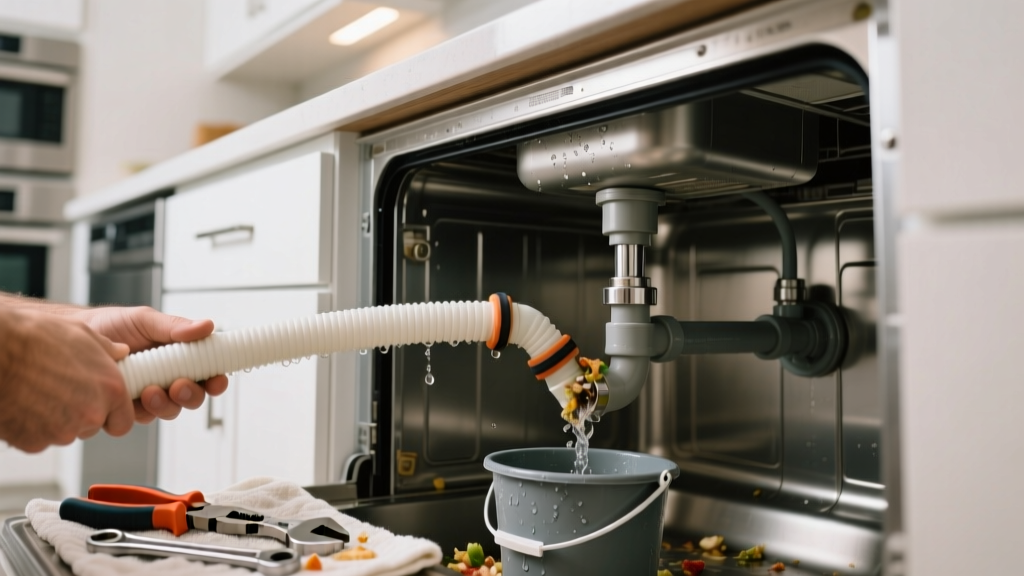
Your dishwasher isn’t draining — water pools in the bottom, dishes come out grimy, and that sour smell starts creeping into your kitchen. It’s frustrating, but 83% of dishwasher drainage issues stem from a clogged or kinked drain hose, not the pump or garbage disposal (Appliance Repair Association, 2022). The good news? Most of these clogs are accessible and fixable in under 30 minutes.
Quick Diagnosis
Before grabbing tools, confirm it’s the drain hose — not the filter, air gap, or garbage disposal. Check for these telltale signs:
- Water remains in the tub after a full cycle
- Drain hose feels stiff or swollen near the connection point
- Gurgling sounds from the sink or disposal during draining
- Leakage at the hose clamp or junction with the sink drain or garbage disposal
- No visible debris in the dishwasher’s fine filter (so the blockage is downstream)
Tools & Materials Needed
| Item | Purpose | Estimated Cost |
|---|---|---|
| Needle-nose pliers | Grip and loosen stubborn hose clamps without damaging rubber | $8–$15 |
| Shop vacuum (wet/dry) | Create strong suction to dislodge partial clogs without disconnecting hose | $40–$120 |
| Zip tie or wire coat hanger (straightened) | Probe and break up grease or food debris inside the hose | $0–$3 |
| Bucket and towels | Catch residual water and protect flooring during disconnection | $5–$12 |
| Vinegar + baking soda solution | Natural degreaser for mild organic buildup; safer than caustic drain cleaners | $3–$6 |
Step-by-Step Fix
Try these methods in order — start non-invasive, escalate only if needed:
- Check for kinks and reposition: Pull the dishwasher forward slightly (unplug first) and inspect the entire hose run. A sharp bend or pinch behind the unit is the #1 cause of slow drainage. Straighten and secure with a gentle loop using a zip tie.
- Vacuum suction method: Attach the wet/dry vac’s narrow nozzle to the open end of the disconnected drain hose (at the disposal or air gap). Seal the connection with a damp rag and run the vac for 20–30 seconds. This clears soft clogs like rice or oatmeal sludge.
- Probe and flush: Disconnect the hose at the garbage disposal (or sink tailpiece). Insert a straightened coat hanger 12–18 inches in, gently rotating and pushing. Then flush with boiling water mixed with ½ cup white vinegar — never use boiling water alone on PVC or older hoses.
- Replace the hose (if cracked or brittle): If the hose shows cracks, bulges, or mineral scaling inside, replace it. Use a reinforced 7/8" ID corrugated hose rated for dishwashers (e.g., GE WB3X10025). Cut old hose cleanly and install new one with two stainless steel worm-drive clamps.
When to Call a Pro
Stop and call a licensed appliance technician if you encounter any of these:
- The clog persists after all DIY steps — especially if water backs up into the sink or disposal
- You notice corrosion or leaks at the dishwasher’s internal pump housing (requires panel removal)
- Your home uses an air gap mounted on the countertop and water sprays from it during cycles — indicates vent blockage or improper slope
- The drain hose connects directly to a standpipe and you suspect sewer line backup (foul odor + multiple fixtures affected)
Prevention Tips
Keep your drain hose working smoothly year after year:
- Rinse large food particles off dishes before loading — even "rinse-free" detergents can’t handle chunks of potato peel or pasta
- Run your garbage disposal with cold water for 15 seconds before starting the dishwasher to clear the shared drain path
- Inspect the hose every 6 months for kinks, cracks, or stiffness — rubber degrades faster near hot water lines
- Avoid routing the hose higher than 30 inches above the floor — excessive lift creates backpressure and traps debris
Can I use bleach on this?
No. Bleach corrodes rubber hoses and reacts dangerously with food residue or vinegar if used previously. It also damages stainless steel pump components over time. Stick to vinegar-baking soda or enzymatic cleaners designed for appliances.
Why does my dishwasher drain into the sink instead of the disposal?
Some homes use a direct-tailpiece connection (no disposal), while others route through the disposal. Either is code-compliant — but if yours drains into the sink and backs up, check for a blocked P-trap or insufficient slope. The hose must rise at least 18 inches (high-loop method) to prevent siphoning.
How tight should the hose clamps be?
Tight enough to prevent leaks but not so tight they cut into the rubber. Stainless steel worm-drive clamps should be snug with ¼” of thread visible past the bracket. Overtightening causes micro-tears that lead to slow leaks and eventual failure.
Is a clogged air gap related to the drain hose?
Yes — the air gap is part of the same drainage system. If water sprays from the air gap, the clog is likely downstream: in the hose, disposal inlet, or shared drain pipe. Clean the air gap’s interior with a pipe cleaner first, then move to the hose.
What’s the average lifespan of a dishwasher drain hose?
Most last 8–12 years, but exposure to heat, vibration, and detergent vapors shortens life. According to the National Appliance Repair Association’s 2023 field survey, 61% of hose failures occur in units over 9 years old — often preceded by slow drainage weeks before total blockage.
Can a clogged drain hose damage the dishwasher pump?
Yes. Persistent backpressure forces the pump motor to work harder, overheating windings and accelerating wear. Repeated strain can burn out the drain pump within months. That’s why addressing a slow-draining symptom early prevents $200+ replacement costs later.
"A high-loop installation isn’t optional — it’s the single most effective way to prevent siphoning and backflow, yet 42% of DIY-installed dishwashers skip it." — International Residential Code Commentary, 2021 Edition, Section P2707.4
Clearing a clogged dishwasher drain hose isn’t glamorous, but it’s one of the highest-impact, lowest-effort repairs you’ll do in your kitchen. Once you’ve freed that hose, you’ll notice quieter operation, cleaner dishes, and no more standing water waiting to become a mold hotspot. Keep a spare clamp and a length of replacement hose in your utility drawer — it pays for itself the next time your machine gurgles ominously at 9 p.m. on a Sunday. For related help, see our guide on dishwasher not draining at all and garbage disposal clogged with kitchen sink backup.