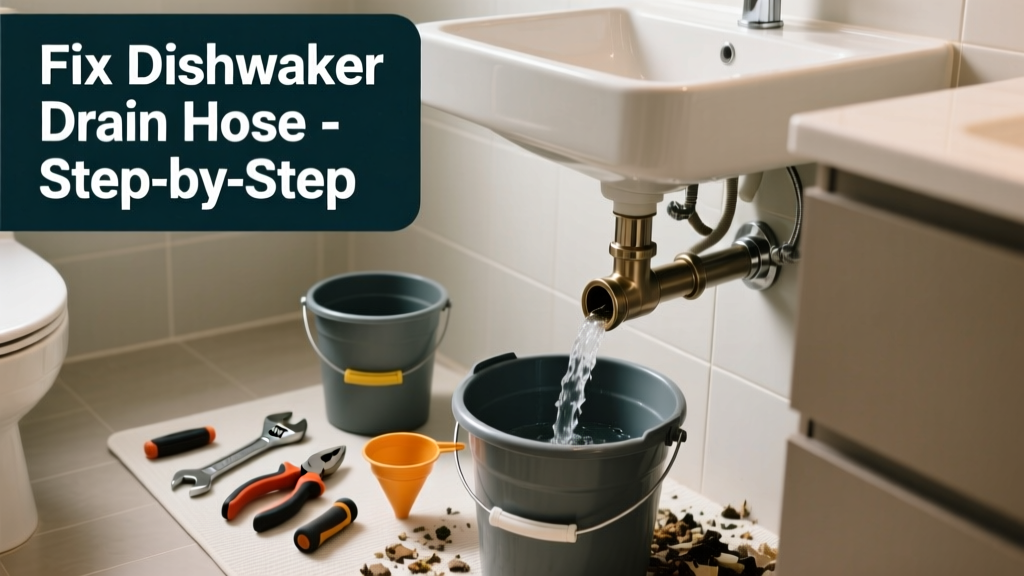
If your dishwasher won’t drain and you hear gurgling from the bathroom sink or toilet, the clog is likely in the shared drain line — especially if your dishwasher’s drain hose snakes through the bathroom wall or ties into the vanity P-trap. This isn’t just inconvenient; standing water can back up into fixtures and risk mold growth behind walls within 48 hours.
Quick Diagnosis
Before grabbing tools, confirm the issue isn’t misdiagnosed. A clogged dishwasher drain hose in the bathroom usually presents with these telltale signs:
- Water pooling in the dishwasher tub after a cycle
- Gurgling or bubbling from the bathroom sink, shower, or toilet when the dishwasher drains
- Slow or no drainage from the bathroom sink when the dishwasher runs
- Foul odor near the vanity cabinet or floor drain
- Visible kink, crushing, or corrosion where the hose passes behind the vanity or under the floor
Tools & Materials Needed
| Item | Purpose | Estimated Cost |
|---|---|---|
| Channel-lock pliers | Grip and disconnect corroded or tight hose clamps | $12–$20 |
| 5-gallon bucket & towels | Catch standing water and prevent floor damage during disconnection | $8–$15 |
| Zip tie cutter or utility knife | Cut old zip ties or plastic clamps without damaging hose | $3–$7 |
| Wet/dry vacuum (shop vac) | Apply suction directly to hose end or P-trap opening | $40–$80 (rental: $15/day) |
| Food-grade silicone lubricant | Re-seat hose onto garbage disposal or air gap without cracking rubber | $6–$9 |
Step-by-Step Fix
Work methodically — start simple, escalate only if needed. Always shut off power to the dishwasher at the circuit breaker before accessing wiring or connections.
- Check for kinks and obstructions behind the vanity: Pull the vanity forward (if possible) or remove the access panel. Inspect the entire visible length of the drain hose for sharp bends, crushed sections, or rodent-chewed areas. Straighten gentle kinks; replace hose if cracked or brittle.
- Disconnect and flush the hose: Place bucket beneath hose connection point (usually at the garbage disposal or air gap). Loosen clamp with pliers, pull hose free, and hold it upright over bucket. Pour 2 quarts of near-boiling water mixed with ¼ cup baking soda + ¼ cup white vinegar down the hose. Let fizz for 5 minutes, then flush with hot water.
- Vacuum the line from the bathroom sink side: Remove the sink’s pop-up stopper and strainer. Seal the shop vac hose over the drain opening with a wet rag. Run vacuum for 60 seconds. Repeat 2–3 times. Then run hot water for 90 seconds to clear loosened debris.
- Snake the shared branch line: Insert a ¼-inch hand auger (not a chemical drain cleaner) 18–24 inches into the sink tailpiece where the dishwasher hose connects. Rotate clockwise while feeding gently. Retract slowly — you’ll feel resistance at the clog. Pull out debris and reassemble.
When to Call a Pro
Stop and call a licensed plumber if any of these apply:
- You detect sewer gas smell (rotten egg odor) near walls or floors — this signals a broken seal or cracked pipe, not just a clog
- The clog recurs within 72 hours of clearing, indicating tree root intrusion or collapsed ABS pipe in the wall cavity
- You’re unable to locate the dishwasher hose connection behind the vanity due to inaccessible framing or finished drywall
- Water backs up into the toilet or shower — this points to a main line blockage beyond the branch
According to the Insurance Institute for Business & Home Safety's 2023 report, 68% of water damage claims involving dishwashers stem from undetected drain line failures behind walls — not appliance malfunction.
Prevention Tips
Long-term reliability hinges on routine maintenance and correct installation:
- Install the high-loop correctly: The hose must rise at least 18 inches above the dishwasher’s base before descending to the disposal — this prevents siphoning and backflow
- Replace rubber drain hoses every 5 years, even if they appear intact; ozone exposure degrades them internally
- Avoid pouring grease, rice, or coffee grounds down the kitchen sink — they solidify in cooler bathroom-side piping
- Run hot water in the bathroom sink for 30 seconds before starting the dishwasher to prime the shared drain
Can I use bleach on this?
No. Bleach reacts with organic debris to form toxic chloramine gas, especially in confined spaces like vanity cabinets. It also accelerates corrosion of metal clamps and weakens rubber hoses. Stick to baking soda/vinegar or enzymatic cleaners labeled safe for septic systems.
Why does my bathroom sink gurgle only when the dishwasher runs?
This indicates an airlock caused by partial blockage in the shared drain branch — likely food solids or soap scum restricting airflow. The dishwasher’s pump forces water past the obstruction, displacing air backward through the sink’s vent path. It’s rarely a venting issue unless gurgling occurs with other fixtures too.
Is it safe to disconnect the hose with water still in it?
Only if you’ve first shut off the dishwasher’s water supply valve (usually under the sink) and run a short drain cycle to evacuate most water. Even then, expect 1–2 cups to spill — always use a bucket and absorbent towels. Never disconnect while the unit is powered on or mid-cycle.
What’s the difference between a dishwasher air gap and a high-loop?
An air gap is a chrome fitting mounted on the countertop or sink rim that physically separates dishwasher discharge from the drain line, preventing backflow. A high-loop achieves similar protection via elevation but lacks the visible fitting. Most modern bathroom-installed dishwashers rely on high-loops since air gaps require countertop access — which bathrooms rarely have.
Can a clogged dishwasher hose cause mold behind the vanity?
Yes — if water leaks or overflows from a compromised hose or loose clamp, moisture wicks into drywall and insulation. The U.S. EPA estimates that visible mold can develop in as little as 24–48 hours in damp, hidden cavities. If you notice discoloration, musty odor, or soft drywall near the hose path, inspect behind the cabinet immediately.
How do I know if the clog is in the hose or the wall pipe?
Disconnect the hose at the disposal or air gap. If water flows freely from the hose end when you tilt it downward, the clog is downstream — likely in the wall pipe or P-trap. If no water drains or it trickles sluggishly, the clog is inside the hose itself. Test both ends before cutting into drywall.
Once you’ve cleared the line, test thoroughly: Run a full rinse cycle and monitor all bathroom fixtures for 10 minutes. If gurgling returns or water pools, the branch line may need professional snaking or camera inspection. For future peace of mind, consider installing a dishwasher air gap if your layout allows, or upgrade to a reinforced braided stainless steel drain hose — it resists kinking and lasts twice as long as standard rubber. Also review our guide on cleaning the dishwasher drain pump to catch early signs before they reach the bathroom.