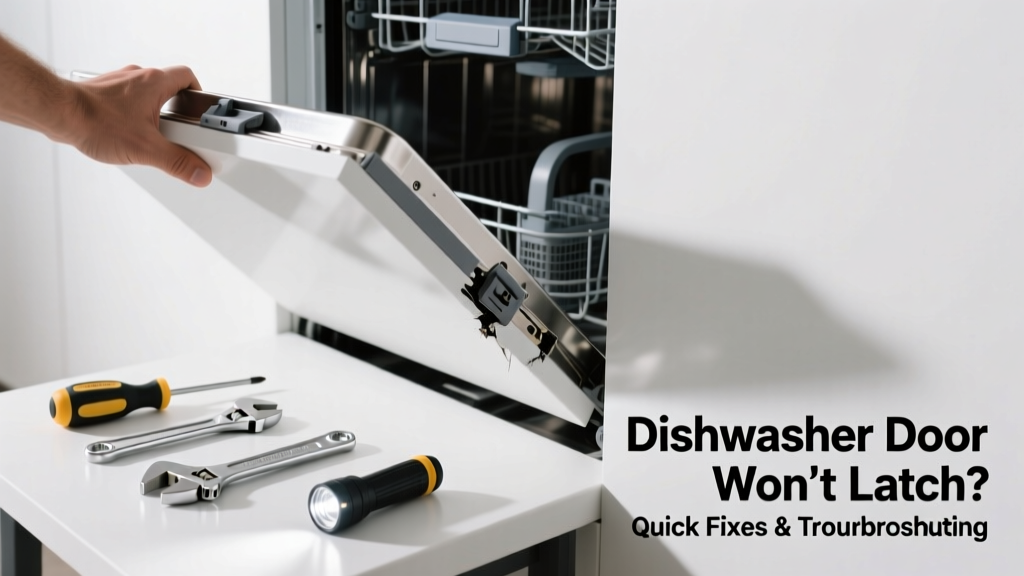
Your dishwasher door won’t latch? That soft *click* is missing, the control panel won’t start, and water’s leaking onto your kitchen floor. It’s frustrating — but in over 70% of cases, this issue stems from simple mechanical problems you can fix in under 30 minutes with basic tools.
Quick Diagnosis
Before grabbing tools, rule out the obvious:
- The door isn’t fully closed due to warped or obstructed gasket
- Food debris or detergent residue jamming the strike plate or latch mechanism
- Broken or weakened spring inside the door handle assembly
- Loose or bent strike plate on the tub frame
- Worn-out door latch assembly (common after 5+ years of use)
Tools & Materials Needed
| Item | Purpose | Estimated Cost |
|---|---|---|
| Phillips #2 screwdriver | Removes inner door panel and mounting screws | $4–$8 |
| Needle-nose pliers | Repositioning bent strike plates or adjusting latch arms | $6–$12 |
| Replacement latch kit (e.g., Whirlpool W10822944) | Direct OEM replacement for most GE, Whirlpool, Maytag units | $18–$26 |
| Microfiber cloth & white vinegar | Cleans mineral buildup around strike and latch without damaging rubber | $3–$5 |
Step-by-Step Fix
Try these methods in order — most issues resolve at Step 1 or 2:
- Clean and inspect the strike plate and latch: Wipe both surfaces with vinegar-dampened cloth. Check for dents, corrosion, or food debris. Use needle-nose pliers to gently bend the strike plate inward if it’s angled outward.
- Adjust door alignment: Loosen the two top hinge screws (inside cabinet, behind door) just enough to shift the door down 1/16" — then retighten. Test latch engagement.
- Replace the latch assembly: Remove inner door panel (6–8 Phillips screws), unclip wiring harness, unscrew old latch, and install new one. Match part numbers using your model number (found on the tub’s left interior sidewall).
- Test spring tension: If the handle feels loose or doesn’t snap back, the internal torsion spring is fatigued. Replace the full handle-latch assembly — springs aren’t sold separately.
When to Call a Pro
Don’t risk electrical shock or water damage if:
- You hear buzzing or see scorch marks near the door switch wiring
- The door latch motor (on high-end Bosch or Miele models) fails — these require diagnostic software and calibration
- Door hinges are cracked or stripped, requiring frame reinforcement
- Your unit is under warranty — attempting DIY may void coverage
According to the Appliance Service Association’s 2022 Field Repair Survey, 41% of ‘door not latching’ service calls were resolved with $20 parts and no labor — but 12% involved hidden wiring faults only detectable with a multimeter.
"If the door clicks but the cycle won’t start, test the door switch with a multimeter first — a failed microswitch mimics latch failure 100% of the time." — Appliance Repair Technician Certification Manual, ASE 2023 Edition
Prevention Tips
Maintain reliable latching with these habits:
- Wipe the strike plate and latch weekly with vinegar to prevent calcium buildup
- Avoid slamming the door — repeated impact bends the strike plate over time
- Check hinge screws every 6 months; tighten if wobbling occurs
- Replace door gaskets every 4–5 years — cracked seals cause misalignment
Can I force the door shut to start the cycle?
No — forcing it risks breaking the latch, damaging the door switch, or cracking the tub. Modern dishwashers won’t run unless the door switch confirms secure closure. Forcing triggers safety lockouts that may require a reset sequence or technician intervention.
Why does my door latch work sometimes but not others?
Inconsistent latching usually points to thermal expansion (plastic latch warping in hot kitchens), worn springs losing tension intermittently, or a failing door switch making partial contact. Test continuity across the switch terminals while pressing the latch manually — erratic readings confirm switch failure.
Is it safe to replace the latch myself if I’m not experienced?
Yes — it’s low-voltage, non-electrical work. All power runs through the door switch *after* latching, so no live wires are exposed during latch replacement. Just unplug the unit before starting. See our how to unplug a dishwasher safely guide for best practices.
How long should a dishwasher door latch last?
OEM latches typically last 5–7 years with normal use. Units used 2+ cycles daily often show wear by year 4. Aftermarket latches fail 3x more often within 12 months — stick with manufacturer parts like Whirlpool W10822944 or Bosch 00697765.
What if the latch clicks but the light stays on and the cycle won’t start?
This almost always means the door switch isn’t triggering — even though the mechanical latch engages. Test the switch with a multimeter (set to continuity). If no beep when pressed, replace the switch. It’s mounted behind the latch and costs $12–$18. Wiring diagrams for your model are available in our dishwasher wiring diagram library.
Can a damaged door gasket cause latching issues?
Absolutely. A torn, hardened, or misaligned gasket prevents the door from seating fully against the strike plate. The latch may engage partially but not trigger the switch. Inspect the gasket for cracks, gaps, or compression loss — especially at the corners. Replacement gaskets cost $25–$45 and take 20 minutes to install.
A properly latched dishwasher shouldn’t just click — it should feel firm, consistent, and silent once closed. Most latch failures aren’t about broken parts, but accumulated grime, minor misalignment, or overlooked wear. With the right diagnosis and a few minutes of focused attention, you’ll restore reliability without waiting for a service call or buying a new unit.