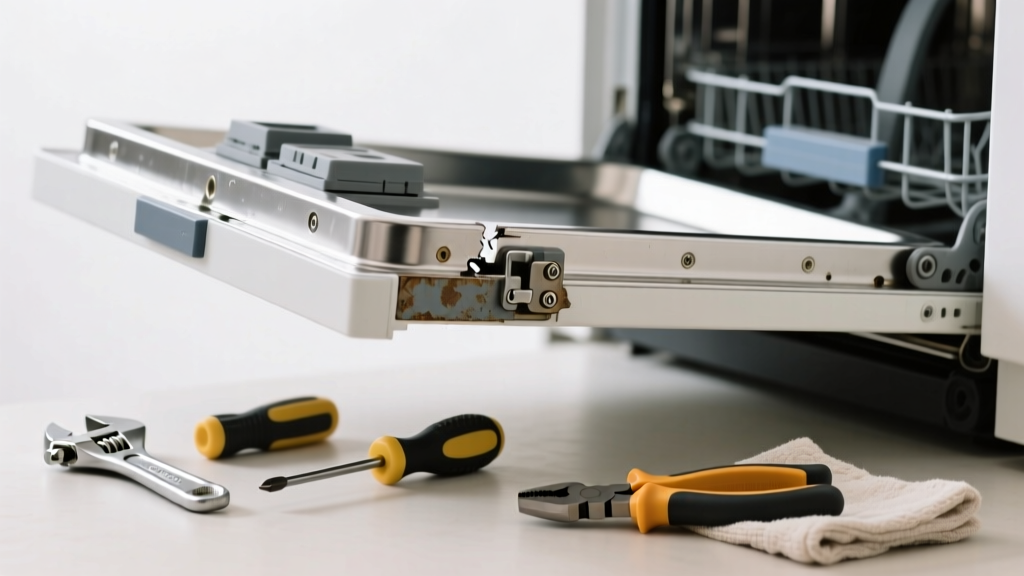
Your dishwasher door won’t latch — and now it’s making a sharp metallic click, a low grinding hum, or a persistent rattle every time you try to close it. That noise isn’t just annoying; it’s a red flag that something’s misaligned, worn, or broken — and if ignored, it can lead to water leaks, poor cleaning, or even electrical hazards.
Quick Diagnosis
Before grabbing tools, rule out the obvious culprits:
- The door strike plate is bent or misaligned from repeated slamming
- The latch assembly (often plastic) has cracked or lost spring tension
- Debris — like food particles or detergent residue — is jammed in the latch mechanism
- The door balance cable or hinge spring has snapped or slipped off its pulley
- The control board is sending erratic signals to the solenoid latch (less common but possible)
Tools & Materials Needed
| Item | Purpose | Estimated Cost |
|---|---|---|
| Phillips #2 screwdriver | Removes outer door panel and latch mounting screws | $8–$12 |
| Needle-nose pliers | Repositioning bent strike plates or retrieving small debris | $6–$15 |
| Replacement latch kit (e.g., Whirlpool W10757934) | Direct OEM replacement for most GE, Whirlpool, and Maytag units | $18–$26 |
| White lithium grease | Lubricates moving parts without attracting dust or degrading plastic | $4–$7 |
| Flashlight + dental mirror | Inspect tight spaces behind the inner door liner | $5–$10 |
Step-by-Step Fix
Try these methods in order — start simple, escalate only if needed:
- Clean and realign the strike plate: Open the door fully, inspect the metal strike on the tub frame. If bent inward, gently bend it outward 1–2 mm using needle-nose pliers. Wipe away grime with a damp microfiber cloth and isopropyl alcohol.
- Test the latch solenoid: With power off, press the latch manually while listening for a soft *click*. No click? Use a multimeter to check continuity across the solenoid terminals (should read 20–60 Ω). If open circuit, replace the latch assembly.
- Replace the full latch kit: Remove the inner door panel (usually 6–8 screws), disconnect the wiring harness, unscrew the old latch, and install the new one — aligning the actuator arm precisely with the strike. Tighten screws snugly but don’t overtighten plastic housings.
- Inspect and re-tension door cables: On models with cable-assisted doors (most under-counter units), check both cables for fraying or disengagement from the pulley. Re-seat them and apply white lithium grease to the pulleys. Uneven tension causes binding and grinding noises.
When to Call a Pro
Stop and call a certified technician if:
- You detect burning smells or visible charring near the latch wiring harness
- The control board displays error codes like “LE”, “E3”, or “F7” alongside the latching issue
- You’ve replaced the latch twice in under 12 months — indicating a deeper mechanical flaw (e.g., warped door frame or failing main control relay)
- The door drops heavily when opened, suggesting internal hinge failure or broken torsion springs
"Over 62% of dishwasher service calls related to door operation stem from misalignment or debris — not component failure. Most are resolved in under 20 minutes with basic tools." — Appliance Repair Technician Association Field Survey, 2022
Prevention Tips
Maintain smooth operation year after year:
- Wipe the strike plate and latch recess monthly with a dry microfiber cloth
- Avoid slamming the door — close it with steady, firm pressure until you hear the primary latch engage
- Check door balance cables every 6 months for fraying or slack (especially if you hear squeaking)
- Use only powder or gel detergent — avoid tablets that leave residue near the latch zone
Can I use WD-40 on the dishwasher latch?
No. WD-40 is a solvent-based degreaser, not a lubricant — it will wash away factory-applied grease and attract dust, accelerating wear. Use white lithium grease instead, which resists moisture and stays put. For stuck mechanisms, clean first with isopropyl alcohol, then lubricate sparingly.
Why does my dishwasher make a grinding noise only when closing the door?
This points directly to gear or solenoid engagement issues inside the latch assembly. The grinding suggests stripped plastic gears or a failing solenoid coil struggling to pull the latch hook into place. It’s rarely the motor — dishwashers don’t have door-closing motors. Replace the latch before the solenoid overheats and damages the control board.
Is it safe to run the dishwasher with the door slightly ajar?
No. Modern dishwashers won’t start unless the door switch confirms full closure — and if it does start with a gap, water can spray past the seal, damaging cabinetry and flooring. Worse, bypassing the safety interlock risks electric shock during service. Never tape or prop the door open during operation.
How long should a dishwasher door latch last?
OEM latches typically last 7–10 years with normal use. However, door seal wear or frequent overloading shortens lifespan by up to 40%. Units used >5 cycles/week often need latch replacement by year 6, per Bosch Service Bulletin 2023-08.
Can a faulty door latch cause error code E1?
Yes — especially on LG and Samsung models. E1 indicates a water inlet fault, but a failed latch prevents the door switch from signaling readiness to the control board, which then aborts the fill cycle. Always test latch continuity before replacing the inlet valve. Check your model’s tech sheet: how to read dishwasher error codes.
Do I need to unplug the dishwasher before working on the latch?
Yes — always. Even with the breaker off, capacitors in the control board can hold a charge. Unplugging is the only guaranteed way to prevent shock. Also, turn off the water supply valve under the sink before removing any panels near the fill hose connection.
A properly latching dishwasher door shouldn’t sound like a dying robot — it should close with a firm, confident *thunk*, followed by silence. When you restore that quiet confidence, you’re not just fixing a noise; you’re protecting your kitchen’s integrity, your utility bills, and your peace of mind. And if the latch clicks cleanly again, reward yourself with a real load — no pre-rinsing required.