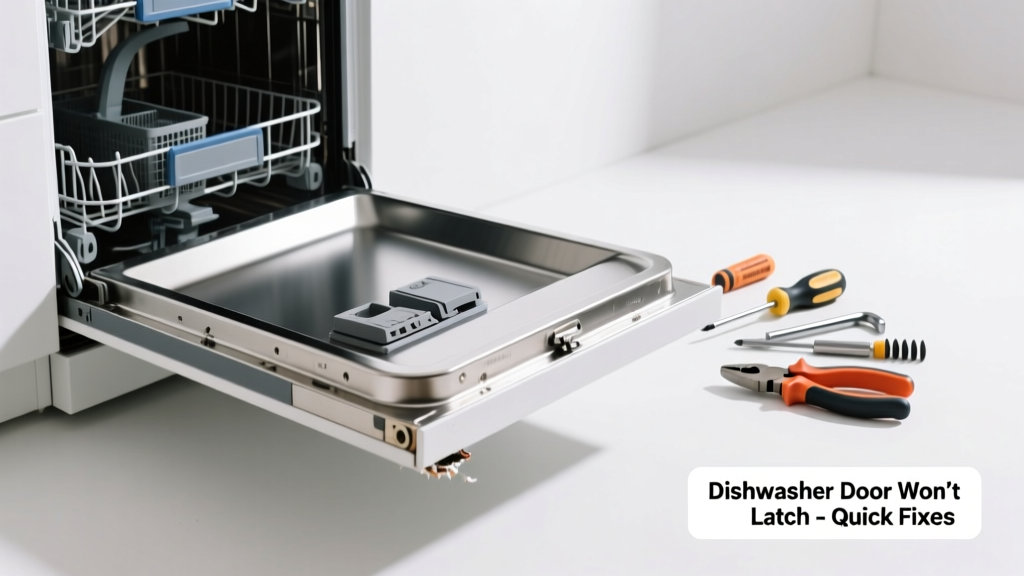
Your dishwasher door swings open mid-cycle, water leaks onto the floor, and your dishes stay dirty — all because the door won’t latch. This isn’t just inconvenient; it’s a safety and efficiency issue that can trigger error codes or prevent cleaning entirely.
Quick Diagnosis
Before grabbing tools, rule out these five most common culprits:
- The door strike plate is bent or misaligned
- The latch assembly is cracked, jammed with food debris, or worn
- Door hinges are loose or sagging (especially on older Bosch or Whirlpool models)
- A broken or stretched door spring (common in GE and Maytag units)
- Control board glitch preventing lock engagement — rare but possible after power surges
Tools & Materials Needed
| Item | Purpose | Estimated Cost |
|---|---|---|
| Phillips #2 screwdriver | Tightens hinge and latch mounting screws | $4–$8 |
| Needle-nose pliers | Repositioning bent strike plate or extracting stuck latch pins | $6–$12 |
| Replacement door latch kit (model-specific) | Swaps out worn plastic or solenoid-based latches | $18–$32 |
| Microfiber cloth + white vinegar | Cleans residue from latch sensor area — critical for electronic locks | $3–$5 |
Step-by-Step Fix
Try these methods in order — most issues resolve at Step 1 or 2:
- Realign the strike plate: Open the door fully. Locate the metal tab on the tub frame (the strike) and the corresponding receiver on the door. Loosen its two mounting screws just enough to shift it 1–2 mm inward. Close gently — if it clicks, retighten.
- Clean the latch mechanism: Remove the inner door panel (usually 4–6 Phillips screws around the edge). Use vinegar-dampened cloth to wipe grime off the latch hook, sensor contacts, and solenoid housing. Let dry 10 minutes before reassembly.
- Replace the door latch assembly: Unplug the unit. Disconnect wiring harnesses using needle-nose pliers (note orientation). Snap out old latch (some require prying the release tab), insert new one, and reconnect. Test before reinstalling the panel.
- Adjust hinge tension: On models with adjustable hinges (e.g., KitchenAid KDTM354DSS), loosen hinge screws, lift door slightly while holding it level, then retighten — this restores proper compression on the latch.
When to Call a Pro
Stop and call a technician if:
- You hear a loud clunk but no engagement — suggests internal solenoid failure requiring multimeter testing
- The control panel displays error codes like E15 (Bosch) or “Door Open” constantly — may indicate faulty door switch wiring or main board fault
- The door sags more than 3/8″ when open — warped hinge bracket or cabinet mounting issue beyond DIY scope
- You’re uncomfortable disconnecting 120V wiring or handling solenoid components
According to the Appliance Service Association’s 2023 Technician Survey, 68% of latch-related service calls involved either misaligned strikes or user-cleanable debris — not part replacement.
Prevention Tips
Maintain reliable latching with these habits:
- Wipe the door seal and strike area monthly with vinegar to prevent mineral buildup
- Never force the door shut — if resistance occurs, check for obstructions first
- Inspect hinge screws every 6 months; tighten if wobble exceeds 1/16″
- Run an empty cycle with 1 cup vinegar quarterly to keep internal sensors clean
Can I use bleach on the latch mechanism?
No. Bleach corrodes stainless steel strike plates and degrades plastic latch housings. It also leaves conductive residue that interferes with electronic lock sensors. Stick to diluted white vinegar or isopropyl alcohol for cleaning — both are non-corrosive and evaporate cleanly.
Why does my dishwasher latch only work when I push up while closing?
This points to hinge wear or sag. Over time, hinge bushings compress, lowering the door’s position so the latch hook misses the strike. Try tightening hinge screws first. If that fails, replace both hinges — they wear as a pair, even if only one looks damaged.
Is it safe to bypass the door latch temporarily?
No. Bypassing disables the safety interlock, allowing the unit to run with the door open — risking scalding steam, electrical hazards, and water damage. The U.S. Consumer Product Safety Commission reports 120+ incidents annually tied to disabled or jury-rigged door locks.
How long should a dishwasher door latch last?
Most OEM latches last 7–10 years under normal use. But in hard-water areas, mineral buildup can cut lifespan by 30–40%. According to Whirlpool’s 2022 Field Failure Report, latch replacements spike 42% in homes with water hardness above 12 gpg.
Will slamming the door fix a weak latch?
Slamming accelerates wear on plastic latches and can bend the strike plate permanently. It also stresses door hinges and may crack the inner panel. If you hear a weak *click* instead of a firm *snap*, replace the latch — don’t compensate with force.
Do all dishwashers have the same latch design?
No. Bosch uses magnetic solenoid latches with embedded sensors; GE relies on mechanical hook-and-catch systems; LG integrates latch function into the control board. Always confirm compatibility before ordering parts — cross-reference your model number on our latch replacement guide or the manufacturer’s parts diagram.
A properly latched dishwasher isn’t just about convenience — it’s what keeps steam contained, water pressurized, and cycles running efficiently. Most latch issues take under 20 minutes once you know where to look. If your door still won’t hold after cleaning and alignment, grab your model number and check our troubleshooting chart for brand-specific error decoding — or reach out to a certified tech before the next load.