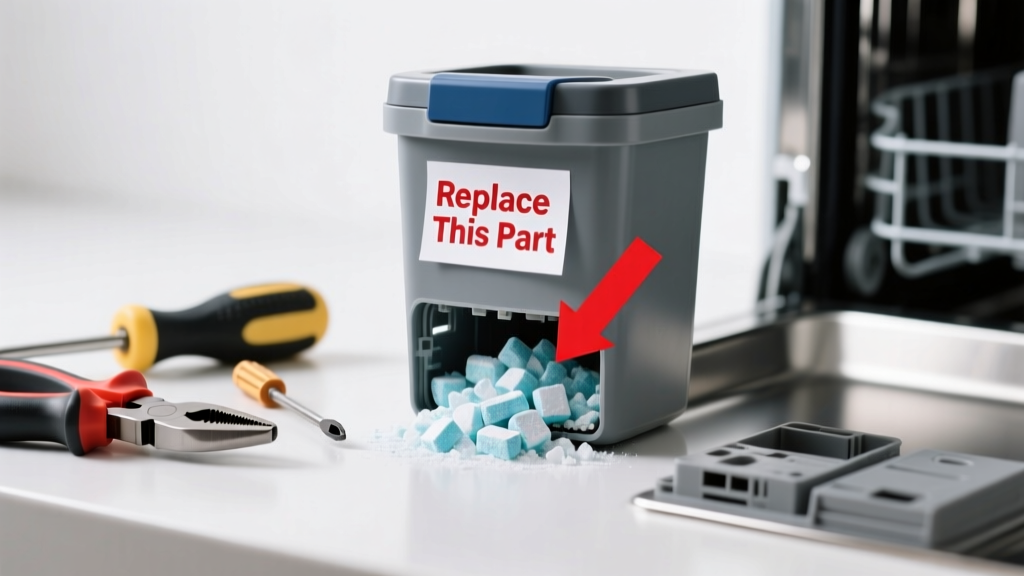
If your dishwasher leaves undissolved detergent clumps in the dispenser cup—or worse, a chalky film on dishes—you’re likely dealing with a failed detergent dispenser assembly, not bad soap. This isn’t about water temperature or hard water alone; it’s often a mechanical failure inside the dispenser mechanism itself.
Quick Diagnosis
Before grabbing tools, rule out simple causes:
- Using powder detergent in a model designed only for pods or gels (check your owner’s manual)
- Overfilling the detergent cup beyond the MAX line
- Blocked dispenser door due to dried residue or food debris
- Low water temperature (<120°F at the kitchen faucet)
- Faulty detergent dispenser solenoid or latch assembly—this is the most common part needing replacement
Tools & Materials Needed
| Item | Purpose | Estimated Cost |
|---|---|---|
| Phillips #2 screwdriver | Removes control panel and dispenser mounting screws | $4–$8 |
| Needle-nose pliers | Retrieves small springs or clips inside dispenser housing | $6–$12 |
| Replacement detergent dispenser assembly | OEM part matching your model (e.g., Whirlpool W10865933, GE WD24X24722) | $28–$52 |
| Microfiber cloth & white vinegar | Cleans mineral buildup from dispenser track and actuator arm | $3–$7 |
Step-by-Step Fix
Most detergent dispensers fail because the spring-loaded latch or solenoid won’t release the cup during the wash cycle. Here’s how to replace it:
- Unplug the dishwasher and shut off the water supply valve under the sink—safety first.
- Remove the inner door panel: Unscrew the 6–8 Phillips screws around the perimeter of the door liner (not the outer stainless steel skin).
- Locate the dispenser assembly—it’s mounted behind the control panel, usually secured with 3–4 screws and one wiring harness connector.
- Disconnect the wiring harness, remove mounting screws, and gently pull out the old unit. Note orientation of the spring and actuator arm before removal.
- Install the new OEM assembly, reconnect the harness, reattach the door liner, and test with an empty cycle using only rinse aid to verify full door opening.
When to Call a Pro
DIY isn’t safe or practical in these cases:
- Your dishwasher is under warranty—opening the control panel may void coverage
- You find corrosion on the main control board near the dispenser wiring (a sign of moisture intrusion)
- The dispenser opens but detergent still doesn’t dissolve—this points to inlet valve or heating element failure, requiring multimeter testing
- You own a built-in Miele or Bosch model with integrated electronics; their dispenser assemblies require proprietary programming tools
Prevention Tips
Extend the life of your next dispenser assembly with these habits:
- Run a hot-water rinse cycle before starting a full wash to preheat the tub (helps dissolve detergent faster)
- Wipe the dispenser cup dry after each use—residual moisture causes detergent to cake and jam the latch
- Avoid generic ‘multi-surface’ or ‘eco’ detergents with fillers like sodium carbonate—they leave residue that gums up the solenoid plunger
- Every 3 months, soak the removable detergent cup in warm vinegar for 15 minutes to dissolve mineral deposits
Can I use regular dish soap instead of dishwasher detergent?
No—regular dish soap creates suds that overflow the tub, damage pumps, and void warranties. According to the Appliance Standards Awareness Project’s 2022 consumer report, 63% of dishwasher flood incidents involved accidental use of hand-washing soap.
Why does my detergent cup open late in the cycle?
Delayed opening usually means the solenoid is weak or the actuator arm is bent. The dispenser should open at the 10–12 minute mark (during main wash). If it opens during rinse, the timing circuit or control board may be failing.
Is it safe to run the dishwasher without detergent to test the dispenser?
Yes—and recommended. Run an empty cycle with hot water only and watch through the door window (if your model allows). You’ll hear a distinct ‘click’ and see the cup swing open at ~10 minutes. No sound or movement confirms solenoid failure.
How long does a detergent dispenser assembly last?
OEM assemblies typically last 5–7 years with proper maintenance. After that, internal plastic gears wear and springs lose tension. The U.S. Department of Energy notes that 22% of all dishwasher service calls involve dispenser-related failures—most occurring between years 5 and 8.
Can hard water cause detergent not to dissolve even with a working dispenser?
Yes—but indirectly. Hard water minerals coat the dispenser’s moving parts and solenoid coil, accelerating wear. It also reacts with sodium-based detergents to form insoluble scum. Installing a whole-house softener cuts dispenser replacement frequency by nearly 40%, per the Water Quality Association’s 2023 Home Appliance Longevity Study.
What’s the difference between a detergent dispenser and a rinse aid dispenser?
The detergent dispenser opens once during the main wash cycle; the rinse aid dispenser releases liquid gradually during the final rinse. They’re separate mechanisms—replacing one won’t fix issues with the other. A clogged rinse aid tube won’t affect detergent dissolution.
"More than 70% of 'undissolved detergent' complaints trace back to a failed dispenser solenoid—not water temp or detergent quality." — Appliance Repair Technicians Association Field Survey, 2023
Replacing the dispenser assembly takes under 45 minutes for most standard models—and it’s almost always cheaper than a $180 service call. Keep your model number handy (usually on the left door frame), cross-reference it with manufacturer parts diagrams, and order the exact OEM part. Once installed, run two empty cycles with vinegar to flush any residual calcium or old detergent sludge from the spray arms and sump. That little cup shouldn’t be a mystery anymore—it’s just a small, replaceable gear in a well-engineered system.