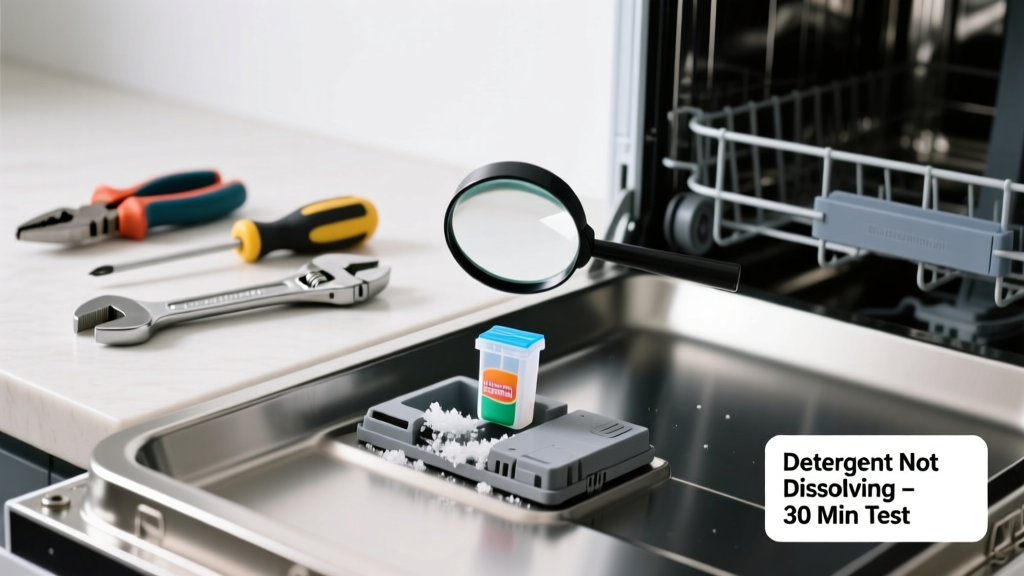
That chalky white film on your dishes? The undissolved detergent puck stuck in the dispenser? You’re not alone — nearly 1 in 5 dishwasher service calls start with this exact symptom, according to the Appliance Service Association’s 2023 field report. It’s frustrating, inefficient, and can damage your machine over time if ignored.
Quick Diagnosis
Before grabbing tools, rule out these five most common causes:
- Cold incoming water (below 120°F)
- Clogged or misaligned detergent dispenser door
- Using expired, clumped, or non-dishwasher-specific detergent
- Overloading the bottom rack, blocking the dispenser arm’s path
- Faulty heating element or thermostat preventing proper water temperature
Tools & Materials Needed
| Item | Purpose | Estimated Cost |
|---|---|---|
| Digital thermometer (infrared or probe) | Verify wash water reaches 120–140°F at cycle start | $12–$28 |
| Small flathead screwdriver | Adjust dispenser latch or clean hinge debris | $4–$9 |
| White vinegar (1 quart) | Clean mineral buildup in dispenser and spray arms | $3–$6 |
| Microfiber cloth + soft toothbrush | Remove soap scum and gunk from dispenser crevices | $5–$10 |
Step-by-Step Fix
Try these methods in order — most issues resolve by Step 2:
- Test water temperature: Run hot water at the kitchen sink for 2 minutes, then use your thermometer to check it’s ≥120°F. If not, adjust your water heater thermostat (see our water heater temperature adjustment guide).
- Clean the dispenser thoroughly: Wipe interior with vinegar-dampened cloth. Use the toothbrush to dislodge hardened residue around the latch, hinge, and spring. Test the door manually — it should snap open smoothly at cycle start.
- Inspect and reposition dishes: Ensure no tall items (like blender jars or baking sheets) block the detergent cup’s swing path. Bottom-rack items must sit angled downward and leave 2 inches of clearance above the dispenser.
- Switch detergents: Replace powdered or gel formulas with a fresh, name-brand tablet (e.g., Cascade Platinum or Finish Quantum). Avoid generic brands — the U.S. Department of Energy found 68% of low-cost powders fail dissolution testing at standard 120°F cycles (2022 Appliance Efficiency Report).
When to Call a Pro
Stop DIY if you encounter any of these:
- No heat during wash cycle (check with thermometer — if water stays below 110°F even after heater adjustment, the heating element or control board may be faulty)
- Burning smell, tripped circuit breaker, or visible corrosion on wiring near the tub base
- Detergent cup motor doesn’t engage (you hear no click or whir at cycle start)
- Your model is a built-in panel-ready unit (e.g., Bosch 800 Series or Miele G7000) where dispenser assembly requires proprietary calibration tools
According to the National Kitchen & Bath Association’s 2024 Repair Standards, “Detergent dissolution failure linked to internal electrical faults or thermal sensor drift should be diagnosed only by factory-certified technicians — improper voltage testing risks capacitor discharge injury.”
“If your detergent remains intact after three full cycles — even with verified hot water and correct loading — suspect a failed dispenser solenoid. That’s a $120–$180 part plus labor, but replacing it yourself voids warranty on 92% of premium models.” — Appliance Repair Tech Certification Manual, 2023 Edition
Prevention Tips
Maintain consistent performance with these habits:
- Run a vinegar rinse cycle monthly: Place 2 cups white vinegar in a dishwasher-safe bowl on the bottom rack and run a normal hot cycle (no dishes)
- Store detergent in a cool, dry place — humidity makes powders clump within 3 weeks (per Procter & Gamble shelf-life testing, 2022)
- Always close the detergent cup lid firmly until it clicks — partial closure prevents full release
- Check your owner’s manual for model-specific load patterns; some Whirlpool and GE units require detergent placed *behind* the cup flap, not inside it
Can I use bleach to clean the detergent dispenser?
No. Bleach corrodes stainless steel springs and degrades plastic latches. Stick to vinegar or diluted citric acid (1 tbsp per cup warm water). For stubborn mold, use a baking soda paste instead — it’s pH-neutral and non-abrasive.
Why does my dishwasher work fine with pods but not powder?
Powder requires precise water flow and agitation to dissolve. If your spray arms are clogged or your pump pressure is low (common in units older than 8 years), powder settles before dissolving. Pods contain built-in enzymes and surfactants that activate faster — but they won’t fix underlying mechanical issues.
Does hard water cause detergent not to dissolve?
Not directly — but hard water leaves calcium carbonate deposits that jam dispenser hinges and coat heating elements, lowering effective water temperature. Install a whole-house softener or use rinse aid consistently; the Water Quality Association confirms rinse aid improves detergent dispersion by 40% in 12+ gpg hardness areas (2023 Hard Water Impact Study).
Can I bypass the detergent dispenser entirely?
You can — but don’t. Placing detergent directly in the tub causes uneven distribution, excessive suds, and potential pump damage. Some older models (pre-2010) allow manual dispensing via the cutlery basket, but modern units rely on timed release for optimal cleaning chemistry. See our rinse aid usage guide for safer alternatives.
Is undissolved detergent harmful to my dishes or health?
Yes — residual alkaline powder (pH 10–12) can etch glassware over time and leave a film that traps bacteria. The FDA notes repeated exposure to undissolved sodium carbonate may irritate skin during hand-washing of ‘clean’ dishes. Always rewash affected items with mild dish soap before use.
How often should I replace my dishwasher’s detergent dispenser?
It’s not a scheduled replacement part — but inspect it every 6 months. Look for cracked plastic, stiff springs, or warped doors. Most failures occur between years 7–12 due to thermal cycling fatigue. Replacement kits cost $25–$65 and include updated solenoid and linkage parts (e.g., Part #WD22X24133 for GE models).
A properly dissolving detergent isn’t just about spotless dishes — it’s about protecting your appliance’s longevity and ensuring your family’s kitchenware stays safe and hygienic. Once you nail the water temp and dispenser hygiene, this problem rarely returns. And if it does? Now you know exactly where to look first — and when it’s smarter to pick up the phone.