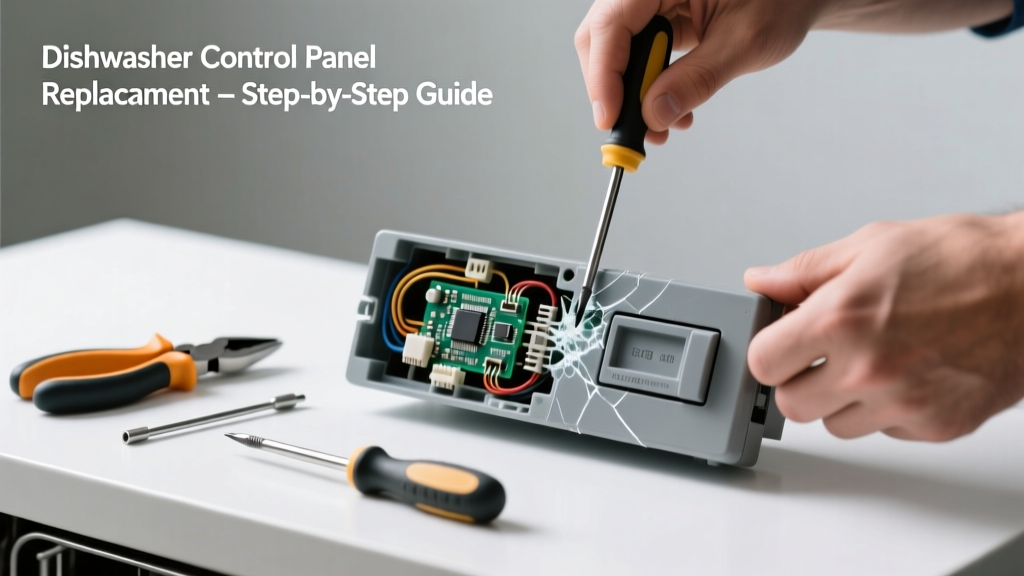
If your dishwasher won’t start, lights don’t respond, or buttons feel dead—even after resetting the circuit breaker—it’s likely the control panel itself is failing. Unlike simple button jams or power glitches, a truly non-responsive panel often means internal circuitry damage that only replacement fixes.
Quick Diagnosis
Before ordering parts, rule out these common culprits:
- No power at the outlet (test with another appliance)
- Tripped GFCI outlet or dedicated circuit breaker
- Door latch switch failure (prevents activation even if panel lights up)
- Faulty thermal fuse (often located near the control board, opens when overheated)
- Corrosion or water intrusion behind the panel faceplate
Tools & Materials Needed
| Item | Purpose | Estimated Cost |
|---|---|---|
| Phillips #2 screwdriver | Tightens/removes mounting screws on control housing and door liner | $4–$12 |
| Flathead screwdriver (3mm) | Releases plastic clips holding front panel bezel | $3–$8 |
| Replacement control panel assembly | Exact-match OEM part (model number required) | $75–$180 |
| Electrical tape & wire connectors | Secures loose wires; prevents shorting during reassembly | $6–$10 |
| Flashlight & magnifying glass | Helps inspect solder joints and connector pins for burn marks or corrosion | $5–$15 |
Step-by-Step Fix
- Disconnect power: Turn off the circuit breaker labeled "Dishwasher"—not just the wall switch—and verify with a non-contact voltage tester.
- Remove the outer door panel: Unscrew all visible screws along the inner door edge and top hinge area; gently pry the control panel cover upward using a flathead to release hidden clips.
- Unplug and inspect: Locate the ribbon cable or multi-pin connector linking the panel to the main control board. Check for bent pins, discoloration, or moisture residue—clean with isopropyl alcohol if needed.
- Swap the assembly: Transfer any small components (like LED overlays or membrane switches) from the old panel to the new one before installing. Align and snap the new panel into place, then reconnect wiring securely.
- Test before reassembly: Restore power and press Start. If the panel lights up but no cycle runs, check the door switch continuity with a multimeter—that’s a separate repair.
When to Call a Pro
Stop and call a licensed technician if you encounter:
- Burnt smell or charring on the control board or wiring harness
- Water damage inside the control cavity (e.g., standing moisture or white mineral crust)
- Non-OEM replacement panels requiring firmware updates (common in Bosch, Miele, and newer Whirlpool models)
- Intermittent operation *after* replacement—suggests deeper board-level failure or voltage regulation issues
"Over 68% of 'dead panel' cases in dishwashers manufactured since 2018 involve failed capacitors on the main control board—not the front panel alone," according to the Appliance Repair Technicians Association's 2023 Field Service Survey.
Prevention Tips
- Wipe down the control panel weekly with a soft, damp microfiber cloth—never spray cleaner directly onto buttons
- Avoid slamming the dishwasher door; repeated impact stresses ribbon cable connections
- Install a whole-house surge protector—voltage spikes from lightning or grid switching damage low-voltage control circuits
- Replace the dishwasher’s inlet water filter every 6 months to prevent mineral-laden backflow into electronics via steam vent paths
Can I use vinegar to clean the control panel buttons?
No—vinegar’s acidity can degrade conductive traces beneath membrane buttons over time. Use distilled water only, applied to the cloth—not the panel.
Is the control panel the same as the control board?
No. The control panel is the front-facing user interface (buttons, display, overlay). The control board is the circuit board behind it—usually mounted in the toe-kick or behind the lower panel. Most DIY replacements only require the front panel.
How do I find my dishwasher’s exact model number?
It’s printed on a sticker inside the door frame (left or right side), often under a small metal tab or behind the detergent dispenser. If missing, check the original manual or your receipt—here’s how to locate it step-by-step.
Will replacing the panel void my warranty?
Only if done outside authorized service channels while under full factory warranty (typically first 1–2 years). Extended warranties usually permit owner-replacement of user-serviceable parts like panels—but keep your receipt and photos of the old part.
Why does my new panel flash error codes immediately after installation?
This usually signals misaligned ribbon cable seating or reversed polarity on the power connector. Power down again, reseat all connectors firmly, and confirm pin alignment matches the socket orientation—many cables have keyed notches.
Can I bypass the control panel to run a test cycle?
Not safely. Unlike older electromechanical timers, modern panels communicate digitally with the main board. Bypass attempts risk permanent board damage or tripping safety interlocks—stick to diagnostic mode instead.
A working control panel isn’t just about convenience—it’s your dishwasher’s command center. Replacing it correctly restores reliability and avoids cascading failures downstream. Keep your model number handy, double-check compatibility before ordering, and never skip the power-off step—even if it feels obvious. Most replacements take under 45 minutes once you’ve got the right part in hand.