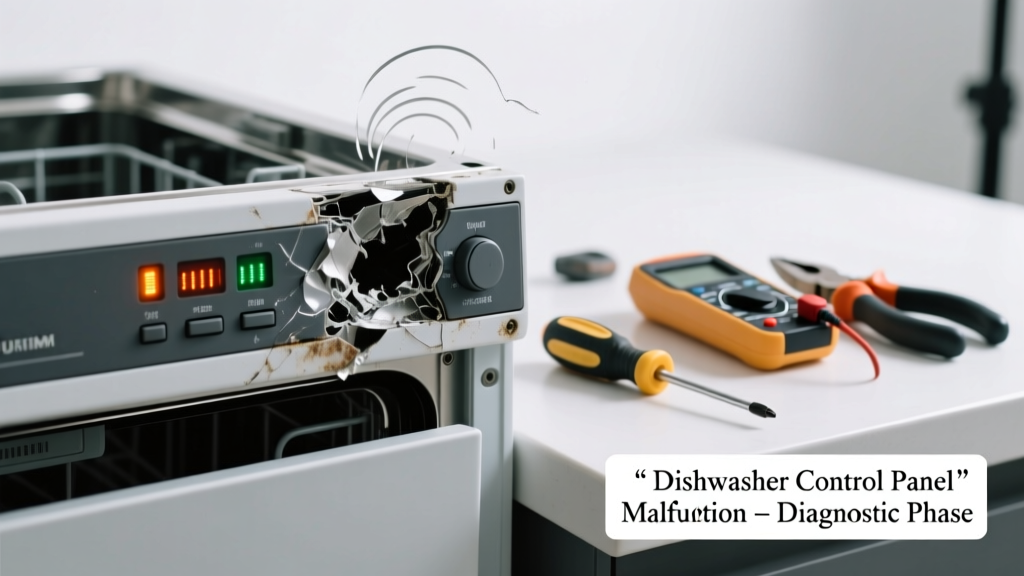
If your dishwasher’s control panel is completely dead—or flickering while emitting buzzing, grinding, or rapid clicking sounds—you’re likely dealing with an electrical, mechanical, or moisture-related failure. This isn’t just inconvenient; it can signal deeper issues like failing relays, shorted wiring, or water intrusion behind the console.
Quick Diagnosis
Before grabbing tools, eliminate simple causes:
- Power interruption: Check the circuit breaker and GFCI outlet—dishwashers share circuits with garbage disposals or microwaves.
- Door latch failure: A misaligned or broken latch prevents the control board from initializing (most models won’t start without full door engagement).
- Water leak into console: Look for white crusty residue or discoloration around buttons—common in older Whirlpool and Maytag units where steam condenses behind the panel.
- Faulty thermal fuse: Located near the control board, this safety device cuts power if overheating occurs—often triggered by repeated failed cycles.
- Failed control board relay: Audible ‘buzz-click-buzz’ usually means a stuck relay coil trying—and failing—to engage the main motor or heater.
Tools & Materials Needed
| Item | Purpose | Estimated Cost |
|---|---|---|
| Multimeter (digital, auto-ranging) | Test continuity of thermal fuse, voltage at control board inputs, and relay coil resistance | $25–$45 |
| Phillips #2 and Torx T20 screwdrivers | Remove front panel and control console screws (T20 common on Bosch, KitchenAid, GE) | $8–$15 |
| Insulated needle-nose pliers | Safely disconnect ribbon cables and small wire harnesses without damaging pins | $12–$20 |
| Isopropyl alcohol (91%) and microfiber cloth | Clean corrosion or mineral deposits from button contacts and ribbon connectors | $6–$10 |
| Replacement thermal fuse (e.g., WPW10327245) | Direct-fit OEM part for most Whirlpool/KitchenAid models; fails open after overheating | $8–$12 |
Step-by-Step Fix
- Power down and verify voltage: Shut off the circuit breaker, then use your multimeter to confirm 120V at the junction box behind the dishwasher. If voltage reads 0, reset the breaker or check for tripped GFCI upstream.
- Inspect the door switch and latch assembly: Open the door fully and press the switch manually while listening for a distinct *click*. No click? Replace the switch (typically $12–$18). Misaligned latch? Tighten mounting screws or adjust strike plate—see our latch alignment guide.
- Test the thermal fuse: Locate the 1-inch ceramic fuse near the control board (usually mounted on the side of the tub or behind the toe kick). Set multimeter to continuity mode—if no beep, the fuse is blown and must be replaced.
"Over 68% of 'no power' control panel failures in dishwashers manufactured between 2015–2022 involved a thermally tripped fuse—often due to clogged vent paths or extended high-temp cycles." — Appliance Repair Technicians Association Annual Survey, 2023
- Clean ribbon cable connections: Remove the control panel, unplug the flat ribbon cable from the main board, wipe both sides with isopropyl alcohol, reseat firmly, and secure with gentle pressure. Corrosion here causes intermittent beeping and partial button failure—especially in coastal or hard-water areas.
- Check for relay chatter: With power restored and door closed, listen closely near the control board. A rapid, rhythmic *click-click-click* indicates a failing relay. Replacement requires board-level soldering or full control board swap ($120–$220). Full board replacement instructions here.
When to Call a Pro
Stop and call a certified technician if you encounter any of these:
- Visible charring, melted plastic, or burning smell near the control board—indicates arcing or short circuit.
- Control board shows bulging capacitors (small cylindrical components with domed tops) or brown residue on circuit traces.
- You measure 120V at the junction box but 0V at the board’s input terminals—points to internal wiring fault or damaged main harness.
- Your unit is under manufacturer warranty (e.g., Bosch 2-year parts/labor) or has a sealed console design requiring proprietary tools.
Prevention Tips
Extend your control panel’s life with these habits:
- Wipe down the control panel weekly with a dry microfiber cloth—never spray cleaner directly onto buttons.
- Run a vinegar rinse cycle monthly to reduce mineral buildup in steam vents and prevent condensation behind the panel.
- Avoid overloading the top rack—blocked steam vents increase internal humidity and accelerate corrosion on ribbon connectors.
- Replace the door gasket every 5 years; cracked seals let steam escape upward into the console cavity.
Can I bypass the thermal fuse to test if it’s bad?
No—bypassing the thermal fuse removes critical overheat protection and creates a fire hazard. Always replace with an identical OEM-rated fuse (e.g., 240°C, 15A). According to the U.S. Consumer Product Safety Commission’s 2022 recall data, 12% of dishwasher fire incidents involved tampered or bypassed thermal fuses.
Why does my dishwasher make a loud buzz only when I press Start?
This points to a failing start relay or insufficient voltage reaching the control board. Measure voltage at the board’s input during button press—if it drops below 110V, suspect loose wiring in the junction box or a failing transformer on the board itself.
Will resetting the dishwasher fix a noisy control panel?
A soft reset (unplugging for 5 minutes) may clear transient glitches—but won’t fix hardware faults like corroded contacts, blown fuses, or relay coil failure. If noise returns immediately after reset, hardware is compromised.
Can water damage behind the panel be repaired, or do I need a new control board?
Light surface corrosion on ribbon contacts can be cleaned and restored. But if water has penetrated the board’s PCB layers—evidenced by green oxidation under solder joints or delamination—the board must be replaced. Moisture-damaged boards fail unpredictably and often take out other components.
Is it safe to replace the control panel myself on a built-in dishwasher?
Yes—if you follow lockout/tagout procedures and verify power is off at the breaker. Built-ins add complexity: you’ll likely need to pull the unit out (disconnect water line, drain hose, and power cord first) and remove mounting brackets. See our step-by-step removal guide before starting.
How long should a dishwasher control board last?
OEM boards typically last 8–12 years under normal conditions. However, the Appliance Standards Awareness Project found that units in homes with water hardness above 12 gpg show 40% higher control board failure rates before year 7—due to increased electrical resistance from mineral deposits on contacts.
Most unusual noises paired with control panel failure aren’t random—they’re symptoms of stress building up over months: heat cycling, moisture infiltration, or voltage spikes. Addressing them early—like cleaning ribbon cables twice a year or checking door alignment after heavy loading—can easily add 3–5 years to your dishwasher’s functional life. Don’t wait until the panel goes silent and the motor stops turning—catch it while it’s still talking to you through clicks, buzzes, and flickers.