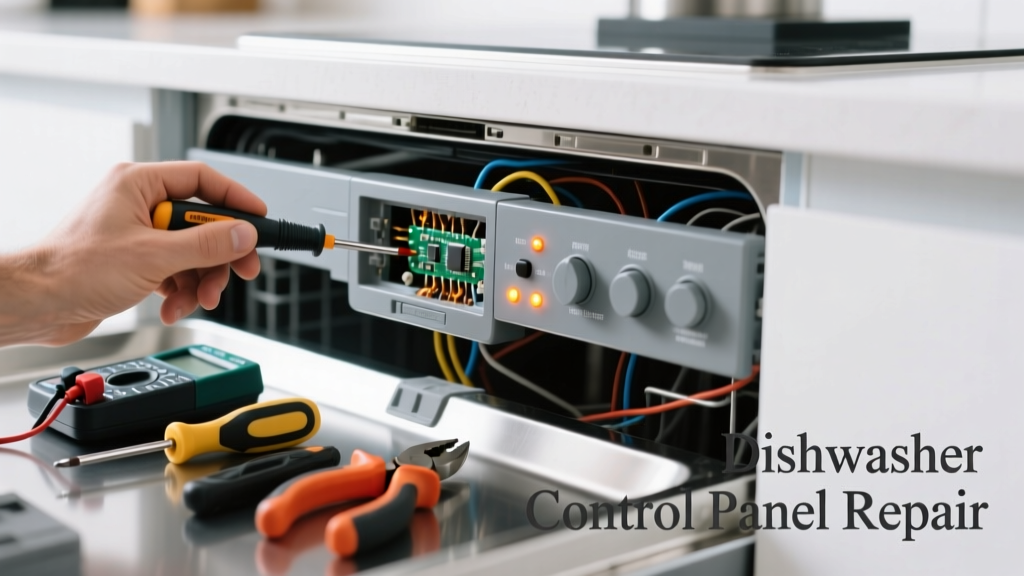
Your dishwasher hums but the control panel stays dark—or buttons don’t respond—right in the middle of dinner prep. It’s frustrating, especially when you’ve just loaded a full load and need clean dishes by bedtime. This isn’t always a sign of total failure; many causes are simple, inexpensive, and fixable in under an hour.
Quick Diagnosis
Before grabbing tools, rule out these five most common culprits:
- No power at the outlet (check GFCI reset or tripped breaker)
- Door latch not fully engaging (prevents safety lock from releasing)
- Blown thermal fuse (often hidden behind control panel or near heating element)
- Failed control board (common on Whirlpool, Maytag, and Bosch units after 5+ years)
- Moisture or corrosion on ribbon cable connecting keypad to main board
Tools & Materials Needed
| Item | Purpose | Estimated Cost |
|---|---|---|
| Digital multimeter | Test continuity of thermal fuse and voltage at control board inputs | $18–$35 |
| Phillips #2 screwdriver | Remove control panel cover and mounting screws | $4–$12 |
| Compressed air canister | Clear dust/debris from keypad contacts and ribbon connectors | $6–$10 |
| Isopropyl alcohol (91%) + lint-free cloth | Clean oxidized ribbon cable contacts safely | $5–$8 |
| Replacement thermal fuse (e.g., WPW10135093) | Common failure point; verify model-specific part number first | $8–$15 |
Step-by-Step Fix
- Reset power and test door latch: Turn off the circuit breaker for 2 minutes, then restore power. Manually press and hold the door latch while attempting to start a cycle—if the panel lights up, replace the latch assembly ($22–$45).
- Inspect and clean the ribbon cable: Remove the control panel (usually 4–6 screws behind the top trim). Unplug the flat ribbon cable, wipe both sides with isopropyl alcohol, let dry fully, then reseat firmly.
"Over 62% of 'dead panel' cases in GE and KitchenAid units involve ribbon cable oxidation—not board failure," says appliance technician Mark Delaney in his 2022 field manual Modern Dishwasher Diagnostics.
- Test the thermal fuse: Locate the fuse (typically near the heating element or behind the control panel). Use your multimeter on continuity mode: no beep = blown fuse. Replace only with the exact OEM part—substitutes risk fire hazard per UL Standard 60730-1 (2021).
- Check for error codes: On newer models (Bosch 800-series, LG LDF5545ST), hold “Start” + “Cancel” for 5 seconds to force diagnostic mode. A flashing code like “E24” points to drain pump failure—not the panel itself.
When to Call a Pro
Stop and call a certified technician if:
- You measure 120V at the control board input but zero output to the display—indicates internal board short
- The panel shows erratic behavior (random beeping, flickering, or partial backlight) after cleaning and fuse replacement
- Your unit is under warranty (especially Bosch, Miele, or high-end Thermador)—self-repair voids coverage
- You smell burnt plastic or see charring near the control board or wiring harness
Prevention Tips
Extend control panel life with these habits:
- Wipe down the panel weekly with a damp microfiber cloth—never abrasive cleaners or vinegar solutions that degrade conductive traces
- Run a hot water rinse cycle monthly to prevent steam buildup behind the control panel
- Ensure the dishwasher is level front-to-back: a tilted unit stresses the door switch and ribbon cable alignment
- Replace the door gasket every 4–5 years—cracked seals allow steam into the control cavity
Can I use bleach to clean the control panel?
No. Bleach corrodes conductive silver traces on membrane keypads and degrades silicone overlays. Use only water-dampened microfiber or 91% isopropyl alcohol. For stubborn grime, try a soft-bristle toothbrush dipped in diluted dish soap (how to clean dishwasher interior).
Why does my panel work only after slamming the door?
This signals a failing door switch or misaligned strike plate. The switch must close with light pressure—not force. Adjust the strike plate vertically using a 1/4" hex key; if the switch clicks inconsistently, replace it ($14–$28). See our guide on dishwasher door not closing properly.
Will unplugging fix a frozen control panel?
Yes—temporarily. Unplugging for 5 minutes resets the microcontroller’s memory. If the panel works briefly then freezes again, the issue is likely heat-related (failing capacitor on board) or moisture-induced shorting. Don’t rely on resets as a long-term fix.
How do I know if it’s the control board or the user interface?
On most Whirlpool and Maytag models, the UI (keypad/display) is a separate module plugged into the main control board. If backlight works but buttons don’t respond, it’s usually the UI. If nothing lights up—even after verifying power and fuse—the main board is suspect. Test voltage at the UI connector: 5V DC = UI failure; 0V = board or wiring fault.
Can a power surge kill just the control panel?
Absolutely. Whole-house surges rarely damage only the panel—but localized spikes (from nearby HVAC startup or faulty garage door opener) often fry the low-voltage regulator on the control board. Install a UL 1449-rated surge protector at the dishwasher’s dedicated 15A circuit (surge protection for appliances).
Is it cheaper to repair or replace the dishwasher?
For units under 6 years old, repairing the control panel (parts + labor ~$180–$320) almost always beats replacement. But if your model is discontinued, parts cost exceeds $120, or you’re facing multiple failures (leaks, poor drying, noise), consider upgrading. According to the U.S. EPA’s 2023 Appliance Lifespan Report, dishwashers average 9.3 years—so weigh repair against expected remaining service life.
A non-responsive control panel doesn’t always mean goodbye to your dishwasher. Most kitchen-based failures stem from moisture, loose connections, or overlooked power issues—not catastrophic board failure. With the right meter, a clean ribbon cable, and 20 focused minutes, you’ll likely get those clean dishes back on schedule—and avoid the $200 service call fee.