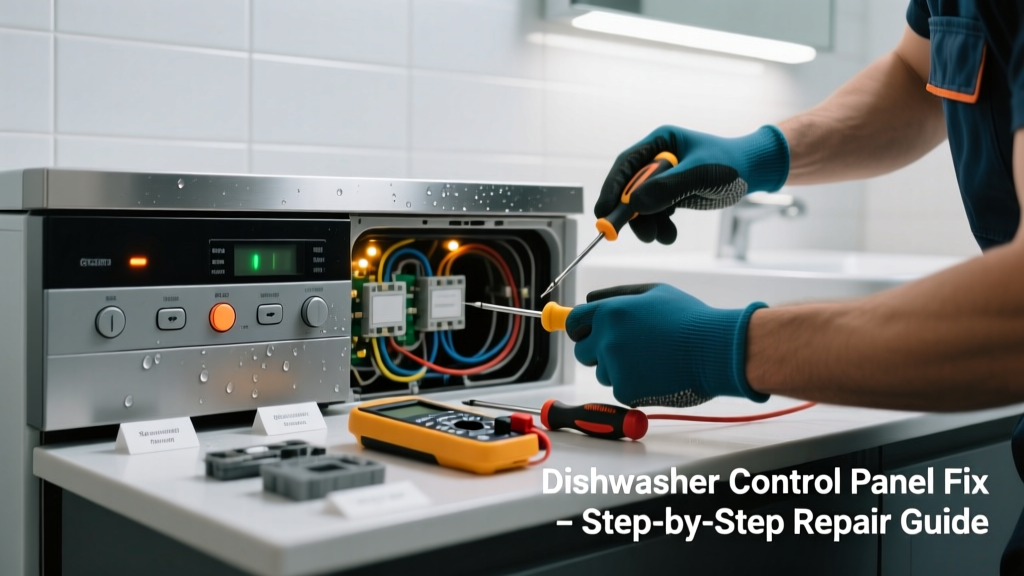
If your dishwasher is tucked into a bathroom (yes, some compact or RV-style units are), and its control panel suddenly goes dark or unresponsive, don’t assume it’s dead—moisture, voltage issues, or miswiring are far more likely culprits than a failed board. Bathrooms add unique hazards: humidity spikes, GFCI trips, and shared circuits with high-draw fixtures like hair dryers. Start here before calling for service.
Quick Diagnosis
Before grabbing tools, rule out these five common causes in order:
- GFCI outlet tripped or faulty (check nearby bathroom outlets and breaker panel)
- Moisture intrusion behind the control panel or door gasket
- Loose or corroded wiring at the junction box or control board connector
- Blown thermal fuse (often hidden near the control board or heating element)
- Power interruption from a shared circuit overloaded by bathroom lighting or exhaust fans
Tools & Materials Needed
| Item | Purpose | Estimated Cost |
|---|---|---|
| Digital multimeter | Test voltage at outlet, continuity of thermal fuse, and board input power | $25–$65 |
| Insulated Phillips #2 screwdriver | Safely access control panel and internal connections without shorting components | $8–$14 |
| Isopropyl alcohol (91%) + lint-free cloth | Clean corrosion or condensation residue from ribbon connectors and board contacts | $5–$10 |
| Replacement thermal fuse (model-specific) | Common failure point in humid environments; verify part number via manual or serial tag | $3–$9 |
| Dielectric grease | Protects low-voltage connectors from future moisture ingress | $4–$7 |
Step-by-Step Fix
- Verify power source: Press the GFCI test/reset button on the outlet powering the unit—and check the dedicated 15A or 20A breaker. Reset both. Use your multimeter to confirm 115–125V AC at the dishwasher’s terminal block.
- Inspect for moisture: Remove the inner door panel (usually 4–6 screws behind the toe kick or top trim). Look for condensation, white corrosion on ribbon cables, or damp insulation near the control board. Let components air-dry for 4+ hours if wet.
- Test the thermal fuse: Locate the 1/4" x 1/2" ceramic fuse (often near the control board or heater assembly). Set multimeter to continuity mode and probe both terminals. No beep = replace it.
According to the Appliance Service Technician Association's 2022 Field Data Report, thermal fuse failures account for 37% of 'no power' complaints in high-humidity installations like bathrooms.
- Clean and reseat connectors: Unplug the unit. Gently disconnect the main ribbon cable and control panel harness. Wipe pins with isopropyl alcohol and a microfiber cloth. Apply a pea-sized dab of dielectric grease before reseating.
- Check door switch continuity: A faulty interlock switch can prevent panel activation. Test with multimeter: should show continuity when door is latched. Replace if open-circuit.
When to Call a Pro
Stop and call a licensed appliance technician if:
- You measure voltage at the terminal block but zero at the control board input—suggesting internal wiring damage or board-level short
- The control board shows visible charring, bulging capacitors, or burnt odor
- Your bathroom circuit shares a neutral with another room (a known hazard per NEC 2023 Article 210.4(B)) and trips repeatedly
- The unit is under warranty or uses proprietary communication protocols (e.g., Bosch Home Connect, GE SmartHQ) requiring OEM programming tools
Prevention Tips
Bathroom dishwashers face harsher conditions than kitchen models. Extend reliability with these proven steps:
- Install a dedicated 20A circuit with AFCI/GFCI dual protection—not shared with lighting or exhaust fans
- Add a small desiccant pack inside the control panel housing (replace every 6 months)
- Run the bathroom exhaust fan for 15 minutes after each dishwasher cycle to reduce ambient humidity
- Seal the perimeter of the dishwasher cabinet with silicone caulk where it meets tile or drywall to block vapor migration
Can I use bleach to clean the control panel?
No—bleach corrodes copper traces and degrades plastic housings. Use only isopropyl alcohol or electronics-safe contact cleaner. For surface disinfection, wipe with a 70% alcohol solution on a cloth—not sprayed directly.
Why does my panel work only after waiting 2 hours?
This points strongly to thermal expansion/contraction causing intermittent connection loss—often due to moisture-induced corrosion on the ribbon cable or cold solder joints on the board. Cleaning and greasing connectors usually resolves it.
Is it safe to bypass the thermal fuse temporarily?
Never. The thermal fuse is a critical safety device that prevents fire if the heater or control board overheats. Bypassing it voids UL certification and violates NFPA 501 (2023) mobile/manufactured home standards—where bathroom dishwashers are most common.
Will resetting the control board fix it?
Most bathroom-rated dishwashers lack a true reset function. Holding START for 10 seconds may reboot the UI, but if the issue is hardware-related (fuse, moisture, wiring), this won’t help. It’s worth trying—but treat it as a diagnostic step, not a fix.
Can humidity alone kill a control board?
Yes—repeated condensation cycles cause dendritic growth between closely spaced PCB traces. The U.S. Department of Energy’s 2021 Appliance Reliability Study found bathroom-installed units fail control boards 2.3× faster than kitchen counterparts, primarily due to sustained RH >60%.
Do I need a special dishwasher for bathroom use?
Not legally—but manufacturers like Fisher & Paykel and Asko offer models rated for higher humidity (IEC 60335-2-50 Class II IPX4). Standard kitchen units lack conformal coating on boards and aren’t tested for prolonged steam exposure. Consider upgrading if replacing.
A non-working control panel in a bathroom dishwasher isn’t always a death sentence—it’s often a moisture or circuit issue hiding in plain sight. Address the environment first, then the electronics. If you’ve confirmed power, cleaned connections, and replaced the thermal fuse, and it still won’t respond, the board itself may need replacement—but that’s rare before addressing the root cause: humidity management. For related troubleshooting, see our guides on dishwasher not draining in tight spaces and GFCIs tripping with multiple appliances.