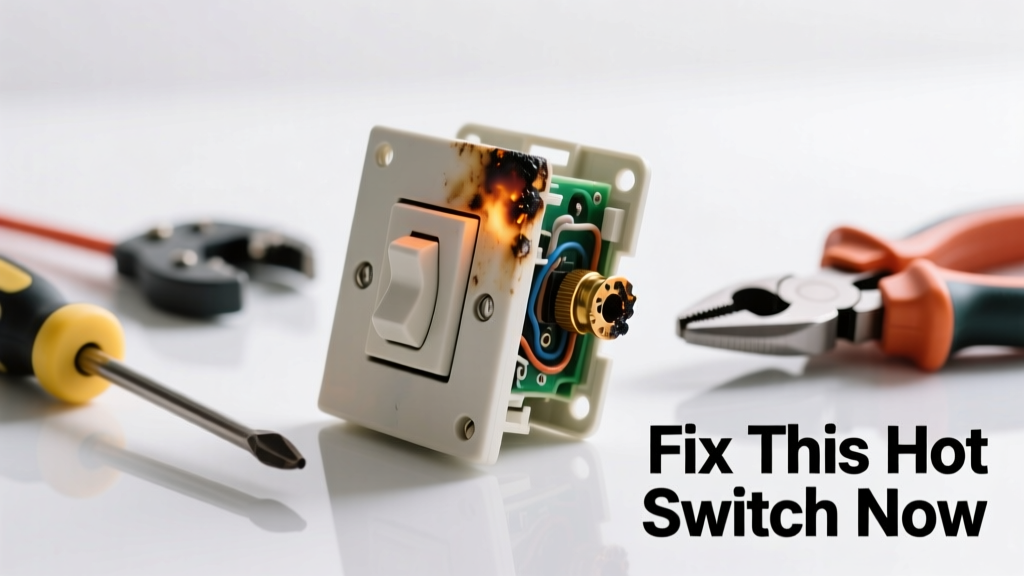
A dimmer switch that’s noticeably warm—or worse, hot to the touch—isn’t just uncomfortable; it’s a red flag. While mild warmth is normal during operation, excessive heat signals overload, poor installation, or component failure. Ignoring it risks insulation damage, fire hazard, or premature switch failure.
Quick Diagnosis
Before grabbing tools, rule out obvious causes:
- Overloaded circuit—more than 600 watts of connected LED or incandescent load on a standard 15-amp circuit
- Incompatible bulbs—non-dimmable LEDs or mismatched dimmer/bulb protocols (e.g., trailing-edge dimmer with leading-edge bulbs)
- Poor ventilation—dimmer installed in a cramped, insulated wall box with no airflow
- Loose wire connections—especially at the line, load, or ground terminals
- Aging or failing internal electronics—common in dimmers over 10 years old
Tools & Materials Needed
| Item | Purpose | Estimated Cost |
|---|---|---|
| Voltage tester (non-contact) | Verifies power is off before handling wires | $12–$25 |
| Insulated screwdrivers (Phillips & flat) | Safe, secure terminal tightening without shorting | $8–$18 |
| Wire stripper/cutter | Cleans and trims damaged or corroded wire ends | $6–$15 |
| LED-compatible dimmer (e.g., Lutron Diva DVCL-153P) | Replaces outdated or incompatible units; rated for 150W LED load | $22–$38 |
| Thermal imaging camera (optional) | Pinpoints exact hot spots—useful if multiple switches are suspect | $129–$249 |
Step-by-Step Fix
- Turn off power at the breaker—verify with a non-contact voltage tester at both the dimmer and adjacent outlets on the same circuit.
- Remove faceplate and dimmer—unscrew mounting screws, gently pull unit from box, and inspect wires for discoloration, melting, or loose strands.
- Check load compatibility—add up bulb wattages: for LEDs, use actual wattage (not equivalent), and confirm total stays under 80% of dimmer’s rated LED capacity (e.g., ≤120W on a 150W-rated dimmer).
- Tighten all terminal screws—including ground wire to green screw and neutral pigtail (if present); loose neutrals cause erratic heating in smart dimmers.
- Replace if outdated or damaged—install a new dimmer matched to your bulb type and load; torque terminals to manufacturer specs (usually 14–18 in-lbs).
When to Call a Pro
Stop and call a licensed electrician if you observe any of these:
- Burnt smell, charring, or melted plastic around the switch or wall box
- Tripping breakers or flickering lights on other circuits when the dimmer is used
- No neutral wire in the box but your new dimmer requires one (e.g., most smart dimmers)
- Aluminum wiring—requires special CO/ALR-rated devices and anti-oxidant paste
- Dimmer shares a box with more than two other switches and you’re unsure about shared neutrals or multi-wire branch circuits
Prevention Tips
Extend dimmer life and reduce heat buildup with these habits:
- Always derate LED loads by 20%—a 150W-rated dimmer should handle no more than 120W of actual LED wattage
- Use only bulbs listed as compatible in the dimmer’s spec sheet—not just “dimmable”
- Install dimmers in single-gang boxes whenever possible; avoid stacking in tight multi-gang setups without ventilation gaps
- Label circuits clearly at the panel so future upgrades don’t accidentally overload the same leg
Why does my dimmer get hot even with low-wattage LEDs?
Even small LED loads can overheat incompatible dimmers due to high-frequency switching inefficiencies. Trailing-edge (ELV) dimmers run cooler with LEDs than leading-edge (TRIAC) models—but only if the driver design matches. According to the National Electrical Manufacturers Association’s Dimmer Compatibility Guide (2022), 68% of reported dimmer overheating cases involved mismatched ELV/TRIAC pairing.
Can I install a dimmer without a neutral wire?
Yes—but only with specific models designed for neutral-free operation, like Lutron Caseta PD-6WCL or Leviton D26HD. These use the ground as a return path, which increases heat generation slightly. Always verify UL listing for ground-referenced operation and never retrofit into older knob-and-tube or ungrounded systems.
Is it safe to wrap a hot dimmer in thermal tape?
No. Thermal tape doesn’t solve root causes—and may trap heat, accelerating failure. The U.S. Consumer Product Safety Commission reports 2,200+ home fires annually linked to overheated lighting controls, many involving DIY heat mitigation attempts instead of proper diagnosis (CPSC Fire Incident Data, 2023).
How long should a dimmer switch last?
Quality dimmers last 15–25 years under proper load and ventilation. But frequent cycling, high ambient temps (e.g., attic walls), or sustained near-maximum loads cut lifespan in half. If yours is over 12 years old and runs hot, replacement is cheaper and safer than troubleshooting aging components.
Do smart dimmers run hotter than traditional ones?
Often, yes—due to onboard radios, processors, and constant low-power draw. A Lutron study found smart dimmers averaged 12°F warmer than equivalent mechanical models at idle (Lutron Technical Bulletin TB-107, 2021). Ensure your smart model is rated for enclosed spaces and check for built-in thermal shutdown features.
Can a hot dimmer damage my LED bulbs?
Yes—excess heat degrades LED drivers faster, causing premature flicker, color shift, or early failure. In fact, the Department of Energy notes that operating temperature is the #1 factor affecting LED longevity: every 10°C rise above 25°C cuts expected life by nearly 50% (DOE SSL Program Report, 2022).
"A dimmer that’s too hot to hold for more than 3 seconds is already operating outside safe thermal limits—even if it hasn’t failed yet." — Master Electrician Maria Chen, NECA Certified Trainer, 2023
Fixing a hot dimmer isn’t just about comfort—it’s about preventing cumulative damage to your lighting system and protecting your home’s electrical integrity. Start with load verification and connection checks before assuming hardware failure, and never ignore persistent heat. If you’ve replaced the dimmer twice in five years, audit the entire circuit—including wire gauge, breaker rating, and junction box fill—to catch hidden issues before they escalate.