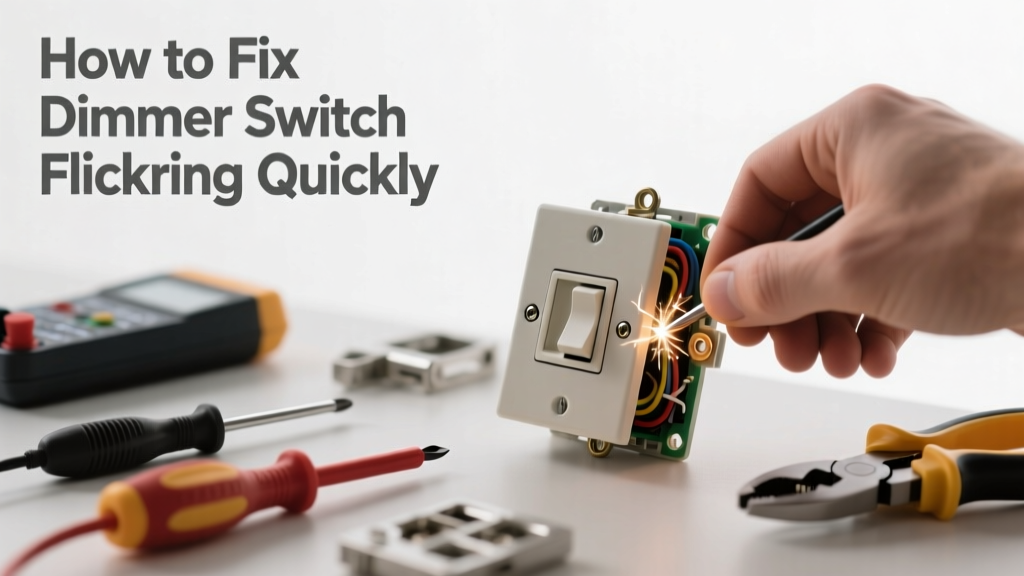
Flickering dimmers aren’t just annoying—they’re often the first sign of an underlying electrical issue that could worsen or even pose a fire risk. If your lights pulse, stutter, or go dark intermittently when dimmed, don’t ignore it. Most cases are simple to diagnose and resolve in under an hour.
Quick Diagnosis
Before grabbing tools, narrow down the cause with these common culprits:
- LED bulbs incompatible with your dimmer’s minimum load or trailing-edge/leading-edge design
- Loose wire connections at the switch, fixture, or junction box
- Overloaded circuit—especially if flickering occurs only when other appliances run
- Aging or failing dimmer switch (most last 10–15 years)
- Neutral wire missing or improperly connected in older homes with smart dimmers
Tools & Materials Needed
| Item | Purpose | Estimated Cost |
|---|---|---|
| Voltage tester (non-contact) | Confirms power is off before working on the switch | $12–$25 |
| Wire stripper/cutter | Removes insulation cleanly and secures connections | $8–$18 |
| LED-compatible dimmer (e.g., Lutron Diva DVCL-153P) | Replaces outdated or incompatible units | $25–$45 |
| Wire nuts (red or yellow) | Secures twisted connections safely | $3–$7 |
| Screwdriver set (flathead & Phillips) | Tightens terminal screws and mounting hardware | $10–$20 |
Step-by-Step Fix
- Verify bulb compatibility: Check the dimmer’s spec sheet for supported bulb types and minimum load (e.g., 10W for LEDs). Swap in a known-dimmable LED like Philips Warm Glow or Cree TW Series—if flickering stops, replace all bulbs accordingly.
- Power off and inspect wiring: Turn off the circuit breaker, verify no voltage with your tester, then remove the dimmer plate. Tighten all wire connections—including ground, hot, load, and neutral (if present). Look for nicks, corrosion, or backstabbed wires; re-terminate any loose or damaged connections to screw terminals.
- Test with reduced load: Temporarily remove half the bulbs on the circuit. If flickering ceases, your dimmer is undersized or the total wattage falls below its minimum load threshold—add a load resistor or upgrade to a low-wattage-rated dimmer.
- Replace the dimmer: Install a modern, LED-optimized dimmer (e.g., Lutron Maestro or Leviton Decora Smart). Match wire colors precisely: black (hot), red (load), green/bare (ground), white (neutral). According to the National Electrical Code (NEC) 2023, neutral wires are now required for most smart and dimmer switches in new installations—and strongly recommended for retrofits.
When to Call a Pro
Stop and call a licensed electrician if you encounter any of these:
- Warm or discolored switch plate, buzzing sounds, or burning odor—signs of arcing or overheating
- No neutral wire available and you’re installing a smart dimmer requiring one
- Flickering persists across multiple circuits or rooms—suggesting panel-level issues like loose main lugs or failing breakers
- You live in a home built before 1980 with aluminum wiring (requires COPALUM crimps and special expertise)
"Over 70% of dimmer-related service calls stem from mismatched LED bulbs—not faulty hardware," says Mike O’Connor, master electrician and NEC instructor at the Independent Electrical Contractors (IEC) National Training Center, 2022.
Prevention Tips
Extend your dimmer’s life and prevent recurrence with these habits:
- Always match dimmer type (leading-edge vs. trailing-edge) to your bulb specs—check both packaging and manufacturer websites
- Label your circuit breaker panel clearly so you can isolate the correct circuit quickly during future troubleshooting
- Use a whole-house surge protector—voltage spikes from storms or grid switching degrade dimmer electronics over time
- Replace dimmers every 12 years, even if working fine; internal capacitors and thermal management degrade silently
Why does my dimmer flicker only when I use the microwave?
This points to voltage drop on an overloaded shared circuit. Microwaves draw 12–15 amps; if your lighting circuit shares a 15-amp breaker with outlets or appliances, voltage sags during startup. Use a circuit load checker to confirm, then consider dedicated lighting circuits or upgrading to 20-amp wiring where permitted.
Can I install a smart dimmer in an old 2-wire switch box?
Only if the model explicitly supports no-neutral operation (e.g., Lutron Caseta PD-6WCL or Inovelli Red Series). Most smart dimmers require a neutral for standby power—using them without one risks erratic behavior, shortened lifespan, or failure to hold settings. Always verify compatibility before purchase.
Will adding more bulbs stop the flickering?
Yes—but only if your current load is below the dimmer’s minimum requirement (often 10–25W for LEDs). However, overloading beyond the dimmer’s max rating (e.g., 450W) creates heat buildup and premature failure. Always calculate total wattage: add up each bulb’s actual wattage—not equivalent lumens.
Is dimmer flickering a fire hazard?
Intermittent flickering alone rarely indicates immediate danger, but sustained arcing from loose connections or failing components generates heat exceeding 1,000°F—well above the ignition point of wood framing. The U.S. Fire Administration reports that 4% of home electrical fires originate at dimmer switches, mostly due to improper installation or overload (USFA, 2021).
Why do my lights flicker only at certain dim levels?
This is classic incompatibility between trailing-edge dimmers and non-dimmable or poorly engineered LED drivers. The driver struggles to regulate current at low voltage thresholds. Try dimming to 30–70%—the sweet spot for most quality LED/dimmer pairings—or adjust the dimmer’s low-end trim setting if available.
Do I need an electrician to replace a dimmer switch?
Legally, no—in most states, homeowners may replace existing switches if they follow NEC guidelines and turn off power. But if you’re uncomfortable verifying grounding, identifying hot vs. switched hot, or handling bundled wires in tight boxes, hire a pro. A $120 service call beats a $15,000 fire insurance deductible.
Flickering dimmers are rarely random—they’re feedback from your system telling you something’s out of sync. Addressing them early keeps your lighting smooth, your energy use efficient, and your home safer. And once you’ve matched the right dimmer to the right bulbs, you’ll wonder why you waited so long to fix it.