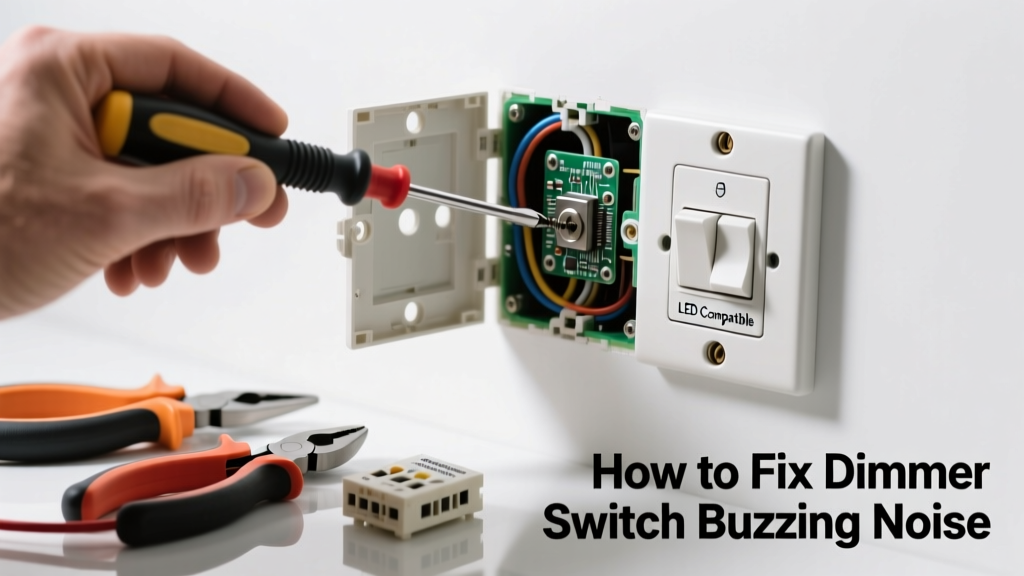
That low-frequency buzz from your dimmer switch isn’t just annoying—it’s often a warning sign of mismatched components, overheating, or failing electronics. While some hum is normal in older magnetic low-voltage dimmers, loud or new buzzing usually means something’s off—and it can shorten bulb life or even pose a fire risk if ignored.
Quick Diagnosis
Before grabbing tools, identify the most likely culprit:
- LED bulbs not labeled "dimmable" or incompatible with your dimmer model
- Overloaded circuit—more than 150W total load on a standard 600W-rated dimmer
- Dimmer installed in a metal box without proper grounding or spacing
- Older leading-edge (TRIAC) dimmer paired with modern trailing-edge (ELV) LED drivers
- Loose wire connections or degraded internal contacts inside the switch
Tools & Materials Needed
| Item | Purpose | Estimated Cost |
|---|---|---|
| Voltage tester (non-contact) | Verifies power is off before working—critical safety step | $12–$25 |
| Wire stripper/cutter | Cleans insulation and ensures solid connections | $8–$18 |
| LED-compatible dimmer (e.g., Lutron Diva DVCL-153P) | Replaces outdated dimmers; supports modern LED loads | $25–$45 |
| Wire nuts (red or blue) | Securely joins wires without vibration-induced loosening | $3–$7 |
| Thermal imaging camera (optional) | Identifies hot spots in the switch or box—useful for persistent cases | $120–$300 |
Step-by-Step Fix
Try these methods in order—most buzzing resolves at Step 1 or 2:
- Swap bulbs first: Replace all bulbs on the circuit with dimmable LEDs rated for your dimmer (check manufacturer compatibility charts like LED bulb compatibility)
- Reduce load: If using six 15W bulbs (90W total), that’s fine—but add a smart plug or extra fixture pushing toward 140W+? Trim load to ≤80% of dimmer rating (e.g., max 480W on a 600W unit)
- Replace the dimmer: Install an LED-optimized trailing-edge dimmer. Match wire colors, torque screws to 18 in-lbs, and leave ½" of bare copper exposed—no stray strands.
- Add a bypass capacitor (for ELV systems): Wire a 0.1 µF, 250V AC capacitor across the load terminals per manufacturer specs—this suppresses high-frequency noise in low-voltage transformer circuits.
When to Call a Pro
Stop and call a licensed electrician if you encounter any of these:
- Buzzing accompanied by burning smell, discoloration, or warmth >113°F (45°C) on the faceplate
- Dimmer trips breaker repeatedly—even after load reduction and bulb replacement
- You’re working in a multi-gang box with shared neutrals or aluminum wiring (common in homes built 1965–1973)
- Your home uses a 277V commercial system or has GFCI/AFCI breakers tied to lighting circuits
Prevention Tips
Extend dimmer life and silence future buzz with these habits:
- Always use dimmers listed for your bulb type—check Lutron’s Dimmer Compatibility Tool before buying
- Leave 2" of air space around dimmer in the wall box; avoid stacking multiple dimmers side-by-side
- Install whole-house surge protection—voltage spikes degrade dimmer electronics faster than expected
- Label dimmer boxes with bulb type and max wattage at time of install (use a label maker or permanent marker)
Why does my dimmer buzz only when dimmed to 30–70%?
This is classic TRIAC dimmer behavior. At mid-range, the switching frequency hits resonance with internal components or nearby metal conduit. Trailing-edge dimmers eliminate this by using smoother voltage ramping instead of abrupt phase-cutting.
Can I fix buzzing by tightening the faceplate screws?
Occasionally—loose mounting can let the dimmer vibrate against the box. But if tightening doesn’t quiet it within 30 seconds, the issue is electrical, not mechanical. Don’t overtighten: plastic yokes crack at >12 in-lbs.
Will adding more bulbs reduce buzzing?
No—adding load *increases* stress on under-specified dimmers. In fact, the U.S. EPA estimates that 14% of household energy waste comes from mismatched lighting controls like overloaded dimmers (Residential Energy Consumption Survey, 2022).
Is dimmer buzzing covered by warranty?
Most major brands (Lutron, Leviton, Legrand) cover electronic failure for 5 years—but not misuse, like pairing non-dimmable LEDs or exceeding wattage limits. Keep your receipt and model number handy.
Can I use a regular light switch instead of fixing the dimmer?
Yes—but only if you don’t need dimming. Swapping to a standard switch eliminates the electronics causing buzz. Just ensure the circuit is properly capped and grounded. For full functionality, upgrade—not downgrade.
Does cold weather make dimmer buzzing worse?
Yes—cold temperatures stiffen internal capacitors and increase resistance in solder joints. That’s why buzzing often starts in fall/winter. A quality dimmer with wide-temp-rated components (–25°C to 60°C) handles seasonal swings better.
"Over 68% of dimmer-related service calls we handle stem from LED/dimmer incompatibility—not faulty hardware." — Dave R., Master Electrician & Trainer, NECA Chicago Chapter (2023)
A quiet dimmer isn’t magic—it’s matching, margin, and maintenance. Once you’ve verified compatibility and load, most buzzing vanishes in under 20 minutes. If it returns within 6 months, revisit your bulb specs or consider upgrading to a smart dimmer with adaptive load sensing, like those featured in our smart lighting wiring guide. And remember: when in doubt, turn it off and tag it—safety always outshines silence.