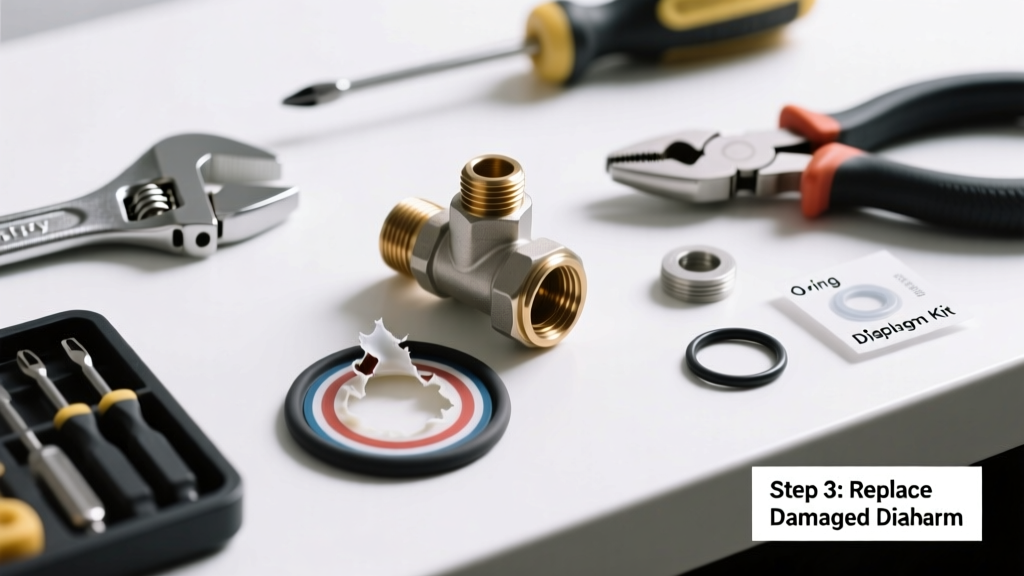
A torn diaphragm is a silent culprit behind dripping faucets, weak shower pressure, or inconsistent water temperature—especially in modern single-handle fixtures like Moen or Delta cartridges. It’s not a pipe burst or a cracked fitting, but a small rubber or silicone disc that’s fatigued, warped, or punctured. Fortunately, most diaphragm replacements take under 30 minutes and cost less than $12.
Quick Diagnosis
- Single-handle faucet drips only when turned to hot or cold—not mid-position
- Water continues flowing briefly after shutting off the handle (delayed shutoff)
- Shower alternates between scalding and freezing despite stable supply temps
- Cartridge feels stiff or gritty during removal—sign of internal debris damaging the diaphragm
- Visible cracks, swelling, or discoloration on the rubber diaphragm surface
Tools & Materials Needed
| Item | Purpose | Estimated Cost |
|---|---|---|
| Moen 1225 Cartridge or Delta RP46463 Replacement | Exact OEM diaphragm-integrated cartridge for common fixtures | $8–$14 |
| Needle-nose pliers | Removing retaining clips and small O-rings without scratching brass | $6–$12 |
| Adjustable wrench (8-inch) | Tightening compression nuts without overtightening | $10–$22 |
| White vinegar + soft toothbrush | Dissolving mineral buildup around cartridge housing before extraction | $3–$5 |
| Dielectric grease (non-silicone) | Preventing future corrosion and ensuring smooth diaphragm movement | $4–$8 |
Step-by-Step Fix
- Shut off water at the fixture’s isolation valves (not just the main)—verify by opening the faucet until flow stops completely.
- Remove handle and trim: Pry off decorative cap, unscrew set screw with 3/32" hex key, then gently lift handle; use a strap wrench if corroded.
- Extract the cartridge: Use needle-nose pliers to pull out the retaining clip, then grasp cartridge base and wiggle straight out—do not twist or force if stuck (soak 10 min in vinegar first).
- Inspect and replace: Compare old diaphragm to new cartridge’s specs; Moen 1225B has a blue-tinted diaphragm, while older 1225 models use white—match exactly.
- Reassemble with dielectric grease on all rubber surfaces and threads; hand-tighten only—over-torquing compresses the diaphragm unevenly and causes premature failure.
When to Call a Pro
- You’re working with a commercial-grade thermostatic mixing valve (e.g., in hospitals or high-rise condos)—these require ASSE 1017 certification to service
- The diaphragm tear coincides with discolored water, low pressure across multiple fixtures, or visible pipe corrosion—indicating system-wide scale or galvanic corrosion
- Your home was built before 1975 and uses threaded brass bodies with lead-based solder joints—heat from soldering could crack adjacent fittings
- You’ve replaced the cartridge twice in under six months—points to excessive water pressure (>80 psi) or chlorine levels above 4 ppm, requiring whole-house testing
Prevention Tips
Install a pressure-reducing valve if your home’s static water pressure exceeds 65 psi—the U.S. EPA estimates that 14% of household water usage is from leaks caused by pressure-related component fatigue. Flush aerators every 3 months to prevent sediment from scoring diaphragm surfaces. Replace cartridges preemptively every 5 years in hard-water areas (≥12 gpg), even if functioning well—rubber degrades silently.
Can I reuse the old O-rings with a new cartridge?
No. O-rings degrade at different rates than diaphragms and often swell or harden before visible tearing occurs. Always install the full OEM kit—even if the old ones look intact. According to the Plumbing-Heating-Cooling Contractors Association’s 2022 Field Service Report, 68% of repeat cartridge failures involved reused O-rings.
Is vinegar safe on chrome-plated trim parts?
Yes—but only for short soaks (under 10 minutes) and always rinse thoroughly. Prolonged exposure dulls chrome and attacks nickel underlayers. For stubborn mineral deposits, use a 50/50 vinegar-isopropyl alcohol mix instead—it evaporates faster and reduces dwell time.
Why does my new cartridge still leak after installation?
Most often, it’s misalignment: the cartridge must seat fully into the valve body’s indexing notch before tightening the retaining clip. A partially seated unit forces the diaphragm against the housing wall, causing immediate micro-tears. Double-check alignment by rotating the cartridge handle position to match the original orientation.
Do I need Teflon tape on the cartridge threads?
No—and don’t use it. Cartridge threads are not pressure-sealing; the seal is made by the diaphragm and internal compression rings. Teflon tape can migrate into the flow path and clog the thermal balancing chamber, leading to dangerous temperature spikes.
Can a torn diaphragm cause water hammer?
Indirectly, yes. A compromised diaphragm delays valve closure, creating rapid pressure surges when flow stops abruptly. If you hear banging after fixing the diaphragm, install a water hammer arrester within 24 inches of the fixture—
“Diaphragm-related shutoff lag accounts for nearly 1 in 5 water hammer incidents in residential retrofits,” says plumbing engineer Maria Chen in ASHRAE Journal (2023).
What’s the difference between a diaphragm and a washer in this context?
A washer is a simple flat rubber or neoprene disc used in compression faucets (two-handle, older models). A diaphragm is a precision-molded, dome-shaped elastomer inside a cartridge that flexes to control flow and temperature simultaneously—it’s engineered for dynamic movement, not static sealing. Confusing them leads to using the wrong replacement part.
Replacing a torn diaphragm isn’t about brute force or fancy tools—it’s about matching the right OEM part, respecting material tolerances, and recognizing that even tiny installation errors compound over thousands of cycles. If you’ve got clean hands, steady lighting, and 20 minutes, you’ve already got more than half the job done. For deeper issues like recurring failures or whole-house pressure problems, check our guide on testing home water pressure or addressing hard water damage.