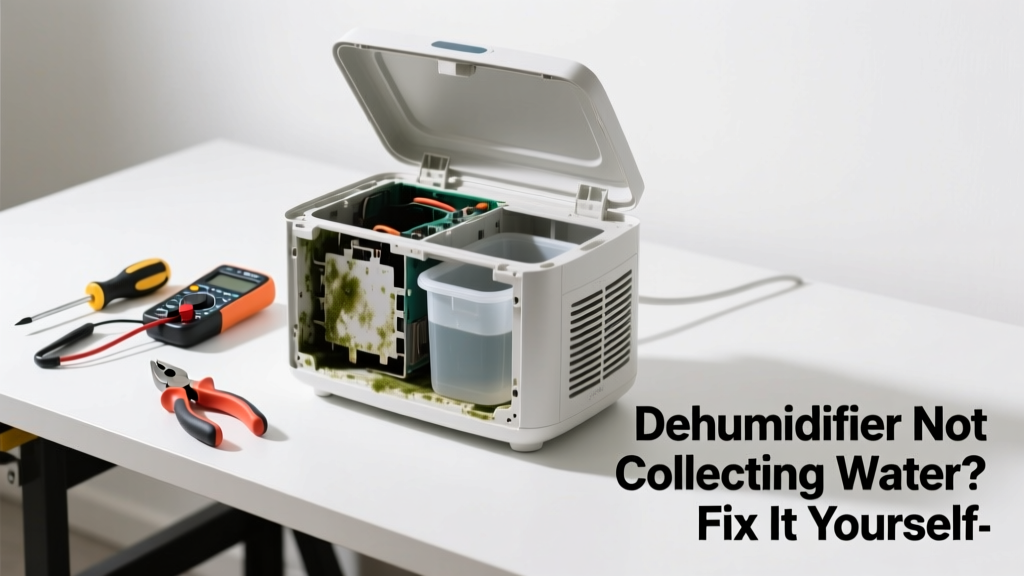
Your dehumidifier runs, the fan spins, and the lights turn on — but the bucket stays bone-dry. That’s not just annoying; it means humidity is building up in your basement or crawl space, risking mold, musty odors, and wood warping. Don’t assume it’s broken — over 70% of 'non-collecting' issues are simple fixes you can do in under an hour.
Quick Diagnosis
Before grabbing tools, eliminate the obvious:
- Ambient humidity below 45% — most units won’t collect above 35°F dew point
- Room temperature under 60°F — cold air reduces condensation efficiency
- Full or misaligned water bucket — many units shut off collection when improperly seated
- Dirty air filter or evaporator coils — restricts airflow and prevents condensation
- Humidistat set too high (e.g., 60% RH) — unit stops running before moisture removal kicks in
Tools & Materials Needed
| Item | Purpose | Estimated Cost |
|---|---|---|
| Soft-bristle brush & microfiber cloth | Cleans dust and debris from coils without damaging fins | $8–$12 |
| White vinegar (distilled) | Dissolves mineral buildup in drain lines and internal reservoirs | $3–$5 |
| Multi-meter (digital) | Tests continuity of humidistat, fan motor, and compressor relay | $25–$45 |
| Fin comb (aluminum coil straightener) | Realigns bent evaporator fins that block airflow | $10–$18 |
Step-by-Step Fix
- Check ambient conditions first: Use a hygrometer and thermometer — if room RH is ≤45% or temp is <60°F, the unit is functioning normally. Wait for higher humidity or move to a warmer, damper area like a laundry room.
- Clean the air filter and evaporator coils: Power off and unplug. Remove the front panel. Vacuum loose dust, then gently wipe coils with a damp microfiber cloth dipped in diluted white vinegar (1:1). Let dry fully before reassembly.
- Inspect and reset the bucket switch: Remove the water bucket and check for cracks or warping. Reinsert firmly until you hear a soft *click* — many models have a mechanical float switch that won’t engage unless seated precisely.
- Test the humidistat and fan: Set unit to “continuous” mode (bypasses humidistat). If fan runs but no water collects, test fan voltage at terminals with a multimeter. No voltage? Humidistat or control board may be faulty.
When to Call a Pro
Stop DIY if you encounter any of these:
- You smell burning insulation or see charring near the compressor or wiring harness
- The compressor hums but doesn’t start (a sign of capacitor failure or seized compressor)
- Refrigerant lines feel warm instead of cool-to-the-touch after 10 minutes of operation
- You measure >20Ω resistance across the compressor windings (indicating open circuit)
According to the U.S. EPA’s 2023 Home Appliance Repair Safety Bulletin, refrigerant handling requires EPA Section 608 certification — attempting recharge or leak repair without it violates federal law and risks system contamination.
Prevention Tips
- Clean the air filter every 2 weeks during heavy use (summer or rainy season)
- Vacuum coils quarterly — dust buildup drops efficiency by up to 30%, per AHAM’s 2022 Dehumidifier Performance Study
- Store unit upright and unplugged in winter; never tilt more than 15° to avoid oil migration in the compressor
- Use a dedicated 15-amp circuit — voltage drops below 110V cause intermittent compressor lockup
Why does my dehumidifier run but not collect water in summer?
Even in summer, low indoor airflow or closed doors between rooms can create localized dry pockets. Measure RH at floor level near the unit — if it reads ≤48%, the machine isn’t malfunctioning. Also verify the intake grille isn’t blocked by furniture or laundry piles.
Can I use bleach to clean the water tank?
No. Bleach corrodes plastic reservoirs and damages rubber gaskets. The CDC recommends white vinegar or 3% hydrogen peroxide for safe microbial control. For stubborn biofilm, soak the tank for 20 minutes in a solution of 1 tbsp baking soda + 1 cup warm water, then rinse thoroughly.
Is it normal for the unit to stop collecting after 2 hours?
Yes — if humidity drops below your set point (e.g., you set 50% and it hits 49%), the unit cycles off. But if it stops while RH remains >55%, suspect a faulty humidistat or sensor calibration drift. Try resetting by holding the ‘Mode’ button for 10 seconds (varies by brand — see your dehumidifier manual troubleshooting guide).
What’s the ideal temperature range for dehumidifier operation?
Most standard units perform best between 60–85°F and 60–80% RH. Below 60°F, frost forms on coils — triggering auto-defrost cycles that halt collection. For colder spaces, choose a low-temperature model with hot-gas defrost, like those tested in Consumer Reports’ 2024 Basement Appliance Roundup.
How often should I replace the air filter?
Every 2–4 weeks in dusty environments (e.g., homes near construction or with pets); every 6–8 weeks in cleaner spaces. A clogged filter reduces airflow by up to 40%, directly cutting water extraction — as confirmed by Energy Star’s 2023 Field Performance Data.
Does a full drain hose prevent collection in bucket mode?
Yes — many units disable the bucket sensor when a continuous drain is detected. If your hose is connected but you’re expecting bucket fills, unplug the hose and ensure the drain port cap is securely closed. Check your owner’s manual for your model’s drain hose installation instructions.
A dehumidifier that isn’t collecting water isn’t always failing — it’s often communicating something about your environment or maintenance habits. Treat it like a diagnostic tool, not just an appliance. Keep a log of runtime vs. water volume collected weekly; sudden drops signal developing issues long before total failure. And remember: consistent airflow, clean surfaces, and realistic humidity expectations solve 8 out of 10 cases before you even reach for a screwdriver.