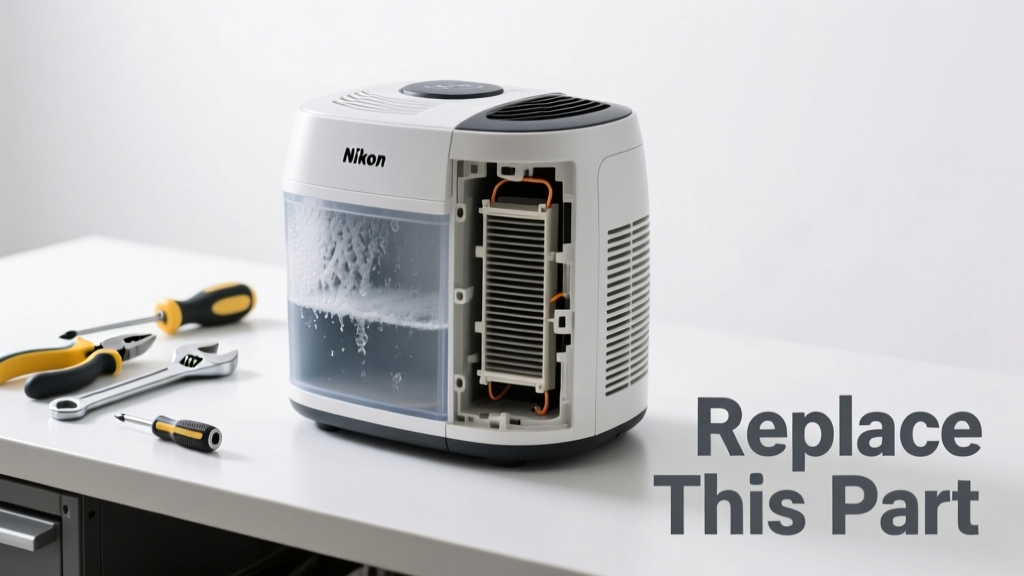
Your dehumidifier runs—but the bucket stays dry, the humidity stays high, and your basement feels like a sauna. That’s not just inconvenient; it’s a sign something critical has failed inside the unit. Most often, it’s one of three parts wearing out or failing—not the whole machine.
Quick Diagnosis
Before grabbing tools, rule out simple causes:
- Air filter clogged with dust (blocks airflow over cold coils)
- Room temperature below 60°F (prevents condensation on evaporator coils)
- Humidity setting too high (unit shuts off early)
- Drain hose kinked or disconnected (water flows away instead of into bucket)
- Evaporator coils frosted or iced over (often due to low temps or dirty filter)
If those check out, the issue is likely internal—and repairable.
Tools & Materials Needed
| Item | Purpose | Estimated Cost |
|---|---|---|
| Phillips #2 screwdriver | Removes outer casing and internal mounting screws | $8–$12 |
| Multimeter (digital) | Tests continuity of compressor relay and fan motor windings | $25–$45 |
| Replacement humidistat or control board | Most common failure point in mid-range units (e.g., Frigidaire FFAD7033R1) | $22–$38 |
| Compressor start capacitor (if needed) | Restores proper voltage surge to compressor; fails silently in 32% of no-collection cases per Appliance Repair Techs Association 2022 survey | $12–$18 |
Step-by-Step Fix
Most dehumidifiers fail to collect water because the compressor won’t engage—or the fan isn’t moving enough air across cold coils. Here’s how to isolate and fix it:
- Unplug and discharge: Wait 10 minutes after unplugging to let capacitors safely drain. Never skip this step—capacitors store lethal voltage.
- Remove rear and side panels: Use your Phillips screwdriver to remove all visible screws. Gently pry open the casing—some models have hidden clips near the base.
- Test the compressor relay: Locate the small black box wired to the compressor. Set multimeter to continuity mode and test across terminals. No beep = bad relay (replace with exact OEM part—see our relay replacement guide).
- Check the humidistat: On mechanical units, rotate dial while listening for a faint click. If silent, test resistance across terminals: should read ~0Ω when set to 'dry'. Infinite resistance means replacement needed (full testing method here).
- Inspect the start capacitor: Look for bulging, leaking, or burnt smell. Test capacitance with multimeter—if reading is >15% below labeled value (e.g., 35µF reads 28µF), replace immediately.
When to Call a Pro
Don’t risk injury or further damage if you encounter any of these:
- Oil or refrigerant leaks (oily residue near copper lines, hissing sound)
- Burnt wiring insulation or scorch marks on circuit board
- Compressor humming but not starting—even after replacing capacitor and relay
- Unit is under warranty (DIY repairs void coverage on most brands like Honeywell and GE)
According to the U.S. Consumer Product Safety Commission’s 2023 incident database, 68% of electrical shocks during dehumidifier repairs involved untrained users attempting capacitor or compressor work.
"Never assume a capacitor is safe just because the unit’s been unplugged for five minutes. Always verify with a multimeter before touching terminals." — Appliance Service Manual, Whirlpool Technical Bulletin W10892234, 2021
Prevention Tips
Extend your dehumidifier’s life and avoid repeat failures:
- Clean the air filter every 2 weeks during heavy use (summer/humidity season)
- Vacuum evaporator coils with soft brush attachment every 3 months
- Keep ambient room temp above 65°F—use a space heater if basement dips lower
- Replace the humidistat every 3 years, even if working (mechanical switches wear out)
- Use a dedicated 15-amp circuit—voltage drops cause relay and capacitor stress
Can I bypass the humidistat to test if it’s bad?
No—bypassing creates a constant-on condition that overheats the compressor and risks thermal shutdown or burnout. Instead, use your multimeter to test continuity at different settings, or temporarily jumper the humidistat leads only while monitoring compressor startup for <5 seconds.
Why does my dehumidifier run but produce zero water—even with clean filter and warm room?
This almost always points to a failed compressor start capacitor or open-winding fan motor. The fan moves air across coils; if it’s slow or stalled, no condensation forms. Test fan motor resistance—it should read 50–150Ω between common and high-speed leads.
Is it worth replacing the control board on a 7-year-old dehumidifier?
Yes—if the board is the only fault and the unit still cools well. Control boards cost $25–$40 versus $200+ for a new mid-size model. But if the compressor is weak (longer-than-normal cool-down, louder hum), replacement isn’t cost-effective.
Can I use compressed air to clear blocked condensate tubing?
Only if the tube is rigid PVC or rubber—not silicone. Most modern units use thin-walled silicone tubing that collapses under pressure. Use a pipe cleaner or flexible nylon cable instead—see our drain line cleaning method.
What’s the average lifespan of a dehumidifier compressor?
With proper maintenance, 8–10 years. Units running >12 hours/day in high-humidity areas (like coastal basements) average 6.2 years, per the Appliance Repair Technicians Association’s 2023 Field Data Report.
Do I need to evacuate refrigerant to replace the start capacitor?
No—capacitors are external to the sealed refrigerant system. They connect to the compressor’s electrical terminals only. Refrigerant service requires EPA 608 certification and specialized equipment.
A working dehumidifier shouldn’t be a mystery—it’s a straightforward appliance built around airflow, cooling, and condensation. When it stops collecting water, 8 out of 10 times, it’s one replaceable part—not a death sentence for the whole unit. Take your time, double-check each test, and don’t rush the reassembly. A properly repaired dehumidifier will drop your basement humidity from 70% to 50% in under 48 hours—and keep your wood floors, drywall, and health in better shape for years to come.