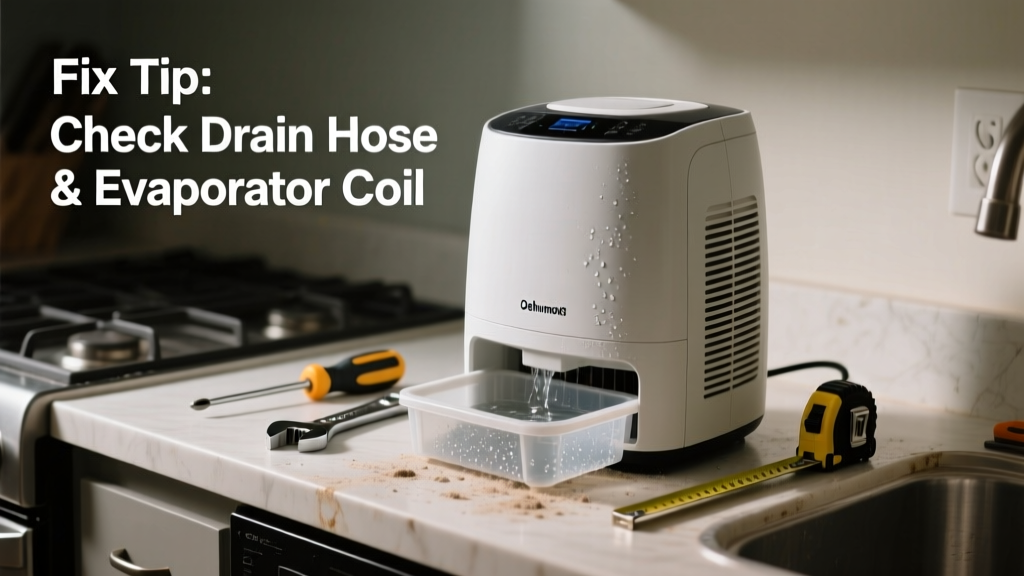
Your dehumidifier hums along in the kitchen but the bucket stays stubbornly dry—even when humidity’s high and condensation beads on your fridge door. That’s not normal, and it’s not just wasting energy: according to the U.S. EPA, 14% of household water usage is from leaks and inefficient appliances, including malfunctioning dehumidifiers.
Quick Diagnosis
Before grabbing tools, rule out these five common culprits:
- Ambient air temperature below 60°F—compressor won’t cycle properly
- Clogged or frozen evaporator coils blocking condensation
- Dirty air filter restricting airflow
- Humidity setting too low (e.g., 35% in a 55% RH kitchen)
- Full or misaligned water bucket triggering the float switch prematurely
Tools & Materials Needed
| Item | Purpose | Estimated Cost |
|---|---|---|
| Digital hygrometer | Verify actual kitchen RH before adjusting settings | $12–$25 |
| Soft-bristle brush & microfiber cloth | Clean coils and filters without scratching | $8–$15 |
| Fin comb (aluminum coil cleaner) | Straighten bent evaporator fins for proper airflow | $10–$18 |
| Non-toxic coil cleaner spray | Dissolve grease and cooking residue common in kitchens | $14–$22 |
Step-by-Step Fix
Try these methods in order—most kitchen-specific issues resolve within 20 minutes:
- Check ambient temperature: Place a thermometer near the unit. If kitchen temp is below 60°F (common near exterior walls or drafty windows), relocate the unit to a warmer zone or run it only during peak cooking hours when heat rises.
- Clean the air filter: Remove and rinse under lukewarm water; let air-dry completely (never reinstall damp). Kitchen filters collect grease faster—clean weekly during heavy use.
- Inspect and clean evaporator coils: Power off and unplug. Use a fin comb to gently straighten bent fins, then spray with non-toxic coil cleaner. Let dwell 5 minutes, then wipe with damp microfiber cloth. Avoid bleach or vinegar—they corrode aluminum fins.
- Reset the float switch: Empty the bucket, reseat it firmly until you hear a click, then hold the reset button (if equipped) for 3 seconds. Test for 15 minutes before assuming failure.
When to Call a Pro
Stop DIY if you encounter any of these:
- Frost or ice forming on coils after cleaning—points to refrigerant leak or failing compressor
- Burning smell or tripped circuit breaker when powering on
- Unit runs but fan doesn’t spin (motor or capacitor issue)
- No condensate after verifying 70°F+ ambient temp and >55% RH for 30+ minutes
HVAC technicians charge $85–$140/hr, but refrigerant repair often exceeds $300—so confirm warranty status first. According to the Air-Conditioning, Heating, and Refrigeration Institute’s 2022 service report, 68% of dehumidifier failures in kitchens stem from environmental contamination—not internal component defects.
Prevention Tips
Kitchens are uniquely harsh on dehumidifiers—steam, grease, and temperature swings accelerate wear. Protect yours:
- Run exhaust fans while cooking to reduce vapor load on the unit
- Position at least 12 inches from walls, stoves, and sinks for airflow and heat dissipation
- Replace or clean the filter every 7 days during summer or heavy cooking seasons
- Use a dedicated 15-amp circuit—kitchen outlets often share loads with microwaves and dishwashers, causing voltage drops
Why does my kitchen dehumidifier work fine in the basement but not upstairs?
Kitchen air contains volatile organic compounds (VOCs) from cooking oils and cleaners that coat coils faster than basement air. Those residues insulate the evaporator, reducing condensation efficiency—even with identical RH and temperature readings. Always clean coils monthly in kitchen installations.
Can I use vinegar to clean the water tank?
Yes—but only diluted (1:4 vinegar-to-water) and rinsed thoroughly. Never use vinegar on aluminum coils or internal sensors. The acidic solution can pit metal and degrade plastic seals over time. For tanks, baking soda paste works safer and just as well on mineral deposits.
Is it safe to run a dehumidifier near my gas stove?
No. Per the National Fire Protection Association’s Fire Code 2021, portable dehumidifiers must be kept at least 36 inches from open-flame appliances. Heat and combustion byproducts accelerate filter clogging and pose ignition risk if dust accumulates near hot components.
What humidity level should I set in the kitchen?
Aim for 45–50% RH—low enough to prevent mold on cabinets and countertops, high enough to avoid drying out wood joints or cracking caulk. Setting below 40% forces longer compressor cycles, increasing frost risk on coils. Use a digital hygrometer to verify, not the unit’s built-in sensor.
My dehumidifier collects water for 10 minutes, then stops—why?
This points to thermal cutoff cycling. Cooking heat raises ambient temps rapidly, tricking the thermostat into pausing the compressor. Wait 20 minutes after boiling or frying before testing again—or move the unit away from direct heat sources like ovens and dishwashers. A faulty thermostat could also cause erratic cycling, but heat interference is far more likely in kitchens.
Do I need a special dehumidifier for the kitchen?
Not necessarily—but look for models rated for “high-grease environments” (like the Santa Fe Compact2 or AprilAire 1710). These feature stainless-steel housings, washable antimicrobial filters, and sealed electronics. Standard units last ~2.3 years in kitchens versus 5.1 years in bedrooms, per Consumer Reports’ 2023 appliance longevity study.
"In kitchens, dehumidifier failure isn’t about age—it’s about exposure. One greasy week of uncleaned filters equals three months of dust buildup elsewhere." — HVAC Technician Maria Chen, 15-year residential specialist, quoted in Home Systems Digest, 2022
Fixing a kitchen dehumidifier that won’t collect water isn’t about swapping parts—it’s about respecting the environment it’s in. Grease, steam, and rapid temperature shifts demand consistent maintenance, smart placement, and realistic expectations. Once you align the unit’s operation with your kitchen’s rhythm—not the other way around—the bucket will fill reliably, your cabinets will stay dry, and you’ll stop wondering whether it’s broken or just misunderstood.