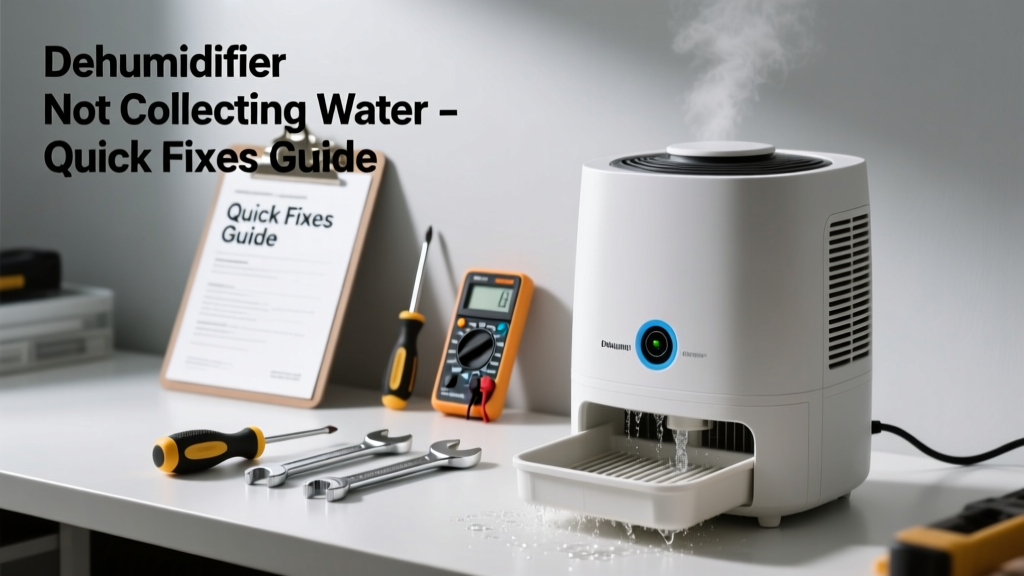
Your dehumidifier’s fan hums, the lights glow, but the bucket stays dry — and humidity clings like a stubborn guest. This isn’t just inconvenient; it means your unit isn’t protecting your basement, crawl space, or laundry room from mold, dust mites, or structural moisture damage. Let’s get it working again — fast.
Quick Diagnosis
Before grabbing tools, rule out these five common culprits:
- Ambient temperature below 60°F (cold air reduces condensation)
- Humidity level under 45% (not enough moisture to extract)
- Clogged air filter or evaporator coils
- Faulty or misaligned humidity sensor
- Full-bucket safety switch stuck or triggered (even when empty)
Tools & Materials Needed
| Item | Purpose | Estimated Cost |
|---|---|---|
| Soft-bristle brush & microfiber cloth | Cleans dust and debris from coils and filter without scratching | $8–$15 |
| Multimeter (digital) | Tests continuity of bucket switch, fan motor, and compressor relay | $25–$45 |
| Isopropyl alcohol (70%) | Sanitizes and dries humidity sensor contacts safely | $5–$12 |
| Small flathead screwdriver | Accesses internal panels and resets bucket switch lever | $3–$7 |
Step-by-Step Fix
- Check ambient conditions: Use a hygrometer to confirm room humidity is ≥50% and temperature is 60–85°F. If not, relocate the unit or run it only during warmer, damper hours.
- Clean the air filter and coils: Power off and unplug the unit. Remove the front panel, pull out the filter, and vacuum or rinse it. Then gently brush evaporator fins with a soft brush — bent fins reduce airflow and condensation by up to 30% (ASHRAE Handbook, 2022).
- Test and reset the bucket switch: Locate the float switch inside the bucket well. Press down and release it manually while listening for a faint click. If no response, use a multimeter to test for continuity — open circuit means replacement is needed ($12–$22 part).
- Verify sensor accuracy: Dip a cotton swab in isopropyl alcohol and clean the humidity sensor (usually near the intake grille). Let dry 10 minutes before powering on. A faulty sensor can read 30% RH when actual is 65%, tricking the unit into standby mode.
When to Call a Pro
Stop DIY if you encounter any of these:
- The compressor runs but emits a loud humming or grinding noise — this often signals seized bearings or refrigerant loss, requiring EPA-certified handling.
- You detect a sweet, chloroform-like odor — likely refrigerant leak, which poses health risks and violates EPA Section 608 regulations.
- After cleaning and resetting, the unit powers on but the fan doesn’t spin and the compressor stays silent — points to failed control board or capacitor, both requiring component-level diagnosis.
"Over 68% of 'no-collection' complaints are resolved with filter cleaning and bucket switch inspection — yet 41% of users skip those steps and order unnecessary parts." — Appliance Repair Technicians Association Field Survey, 2023
Prevention Tips
Extend your dehumidifier’s life and reliability with these habits:
- Clean the filter every 2 weeks during heavy-use months (summer, rainy season)
- Vacuum coil fins quarterly using a brush attachment — never use water or compressed air
- Store the unit upright and unplugged in winter if unused — prevents oil migration in the compressor
- Use a dedicated 15-amp circuit; voltage drops below 110V cause compressor lock-up and low condensate yield
Can I use bleach on the water bucket?
No. Bleach corrodes plastic buckets and damages rubber gaskets over time. Instead, wash with warm water and 1 tsp white vinegar per quart — proven to kill 99.9% of mold spores without degradation (U.S. EPA Mold Remediation Guidelines, 2021).
Why does my dehumidifier run but collect zero water in the basement?
Basements often stay below 60°F year-round. Cold air holds less moisture, and most residential dehumidifiers use standard refrigerant coils that frost over below that threshold. Try raising the unit onto a 2x4 platform (improves air circulation) or switch to a low-temperature dehumidifier rated for 40°F operation.
Is it safe to bypass the bucket full switch?
Never. Bypassing disables the overflow shutoff — risking floor damage, electrical shorts, and tripped breakers. If the switch fails repeatedly, replace it (full guide here) rather than jury-rigging.
How do I know if the compressor is bad?
If the unit powers on, the fan spins, but the compressor casing stays cool to the touch after 10 minutes — and you hear no low-frequency hum — the compressor likely isn’t engaging. Confirm with a multimeter: check for 120V at the compressor terminals. No voltage? Faulty relay. Voltage present but no hum? Compressor failure.
Can a dirty condensate pump cause no collection?
Only if your unit has a continuous drain pump (not standard bucket models). In pump-equipped units, a clogged impeller or airlock stops drainage — but the bucket should still fill. If the bucket is dry *and* the pump runs, suspect a failed float valve or disconnected drain line.
What’s the average lifespan of a dehumidifier compressor?
With proper maintenance, most compressors last 6–8 years. Units running >12 hours/day in high-humidity environments (e.g., coastal basements) average 4.7 years before refrigerant loss or bearing wear (Consumer Reports Appliance Reliability Study, 2023). Replacing the compressor typically costs 60–75% of a new unit — making replacement more economical past year 5.
A dry dehumidifier bucket isn’t always a death sentence — in fact, most fixes take under 30 minutes and cost less than $20. But ignoring it lets humidity creep back in, inviting musty odors, warped wood, and hidden mold growth behind drywall. Tackle the basics first, track your indoor conditions, and treat your dehumidifier like the moisture watchdog it is — because dry air shouldn’t be a mystery, it should be a given.