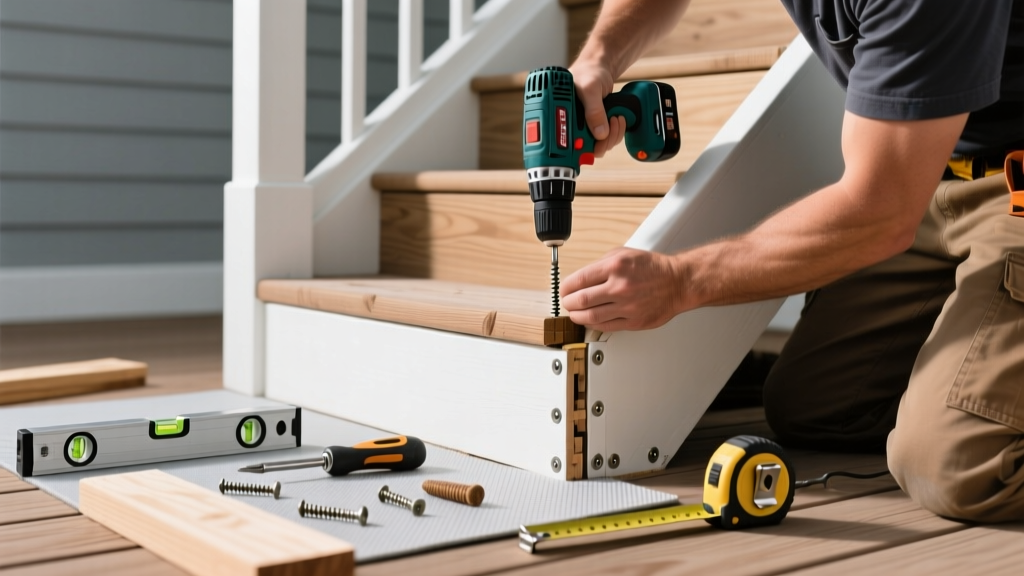
Wobbly deck stairs aren’t just annoying—they’re a liability. A single misstep on loose treads or shifting stringers can lead to serious injury, especially for kids or older adults. According to the U.S. Consumer Product Safety Commission, over 300,000 stair-related injuries occur annually in residential settings—many tied to structural instability like loose connections or rot.
Quick Diagnosis
Before grabbing tools, identify the source of the wobble. Most often, it’s one (or more) of these:
- Loose or corroded lag screws or carriage bolts connecting stringers to the deck frame
- Rotted or cracked stringers—especially where they attach to the ledger board or landing
- Gapped or warped treads slipping side-to-side or lifting at front/back edges
- Settled or uneven concrete landing causing lateral movement
- Missing or improperly installed riser boards allowing vertical flex
Tools & Materials Needed
| Item | Purpose | Estimated Cost |
|---|---|---|
| 18V cordless impact driver | Drives lag bolts without stripping heads; essential for tight spaces | $129–$199 |
| 3/8" stainless steel lag screws (4" long) | Re-secures stringers to deck framing; corrosion-resistant for outdoor use | $8–$15 per pack |
| 2x8 pressure-treated sister stringer | Reinforces weak or cracked original stringer; must match existing depth | $12–$18 |
| Construction adhesive (polyurethane-based) | Bonds treads to stringers and fills micro-gaps; adds shear strength | $10–$14 |
| Level and 4-ft straightedge | Verifies tread flatness and detects sagging before and after repair | $15–$25 |
Step-by-Step Fix
Most wobbles stem from connection failure—not full replacement. Try these methods in order of increasing complexity:
- Tighten all fasteners: Use an impact driver to re-torque every lag screw attaching stringers to the deck rim joist and landing. Replace any stripped or rusted hardware with new 3/8" × 4" stainless lags.
- Glue and screw loose treads: Lift each tread slightly, inject polyurethane construction adhesive into gaps between tread and stringer, then clamp and drive 3" deck screws every 6 inches along both edges.
- Sister a failing stringer: Cut a new 2×8 pressure-treated stringer to match length and notch pattern. Attach it alongside the damaged one using 3" structural screws every 6" and adhesive—don’t rely on nails alone.
- Add blocking under treads: Install 2×4 blocking between stringers directly beneath each tread’s center third. This prevents mid-span bounce and reduces deflection by up to 40% (per American Wood Council’s 2022 Design Guide).
When to Call a Pro
DIY stops where safety and code compliance begin. Call a licensed contractor if you observe any of these:
- Stringers with >1/4" depth loss due to rot or insect damage (especially near attachment points)
- Visible cracking or splitting in the ledger board where stairs connect to the house
- Stair rise/run measurements violating local building code (e.g., rise >7-3/4" or run <10")
- Concrete landing that’s cracked, heaved, or sinking more than 1/2" relative to adjacent soil
- No visible fasteners anchoring stairs to the deck frame—suggesting unsupported cantilevered design
Prevention Tips
Wobbly stairs rarely appear overnight. Catch issues early with seasonal checks:
- Inspect all stair fasteners twice yearly—spring and fall—with a wrench or impact driver
- Keep treads swept and dry; standing water accelerates rot and loosens adhesives
- Apply water-repellent sealer to stringers and underside of treads every 2 years
- Install aluminum or composite stair nosing to reduce tread edge wear and slippage
"Over 68% of deck stair failures traced by the International Code Council involved undersized or missing lateral bracing at the top and bottom connections." — ICC Residential Code Commentary, 2021 Edition
Can I just tighten the existing screws and call it done?
Only if they’re intact, fully threaded, and haven’t stripped the wood. Stripped holes lose up to 70% of their holding power—even with re-torquing. Drill out stripped holes, insert hardwood dowels with epoxy, then reinstall lags. Or better: replace with longer screws that bite into fresh wood deeper in the rim joist.
Do I need permits for stair repairs?
Minor fastener replacement or tread re-attachment usually doesn’t require a permit. But adding sister stringers, changing stair geometry, or replacing the entire stair run typically does—check with your local building department before starting. In Portland, OR, for example, any structural stair modification requires plan review per Title 26.12.050.
What’s the best screw type for outdoor stair connections?
Use ASTM A153 Class C hot-dip galvanized or 304 stainless steel lag screws—not deck screws. Deck screws lack shear strength for critical load paths. The American Wood Council recommends minimum 3/8" diameter lags with 1-1/2" minimum embedment into the rim joist.
How do I know if my stringer is too rotten to save?
Probe suspect areas with a screwdriver. If the blade sinks in more than 1/4" with light pressure—or if you see white fungal growth, crumbly texture, or hollow-sounding taps—replace it. Don’t trust visual inspection alone: cut a small exploratory notch at the top attachment point to check interior integrity.
Can I add diagonal bracing instead of sistering?
Yes—but only as supplemental support. Diagonal 2×4 braces (cut at 45°) between stringers and deck framing help resist racking, but they don’t restore lost bending strength in a compromised stringer. Use them alongside sistering, not instead of it.
Should I replace all treads if only one is wobbly?
Not necessarily—but inspect them all. Treads fail in sequence due to shared exposure and load history. If one shows cupping, checking, or fastener pull-out, check the others with a straightedge and tap test. Replace any with >1/8" gap under a 6-ft level or audible hollow sound when tapped firmly.
A solid staircase shouldn’t sway, creak, or shift under weight—it should feel anchored, predictable, and quiet. Fixing wobble isn’t about perfection; it’s about restoring confidence every time someone steps onto your deck. Pair these repairs with routine maintenance, and your stairs will carry families safely for another decade. For related guidance, see our deck rot repair and ledger board inspection guides.