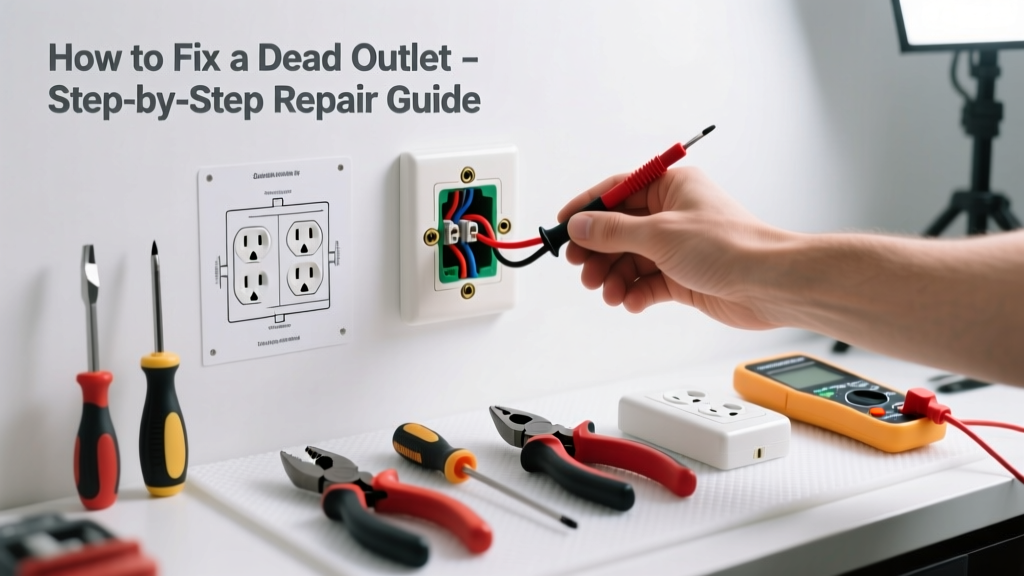
A dead outlet is one of the most common household electrical issues—and often the easiest to fix yourself. But before you grab a screwdriver, remember: electricity doesn’t forgive mistakes. Most dead outlets aren’t caused by faulty receptacles; they’re symptoms of tripped breakers, loose connections, or upstream GFCI trips.
Quick Diagnosis
Before assuming the outlet itself is bad, rule out these five most frequent causes:
- A tripped circuit breaker in your main panel
- A tripped GFCI outlet upstream (often in bathrooms, kitchens, or garages)
- A loose or disconnected wire at the outlet or in a junction box
- A failed backstab connection (wires pushed into spring-loaded holes on the rear)
- A shared neutral issue—especially if multiple outlets go dead together
Tools & Materials Needed
| Item | Purpose | Estimated Cost |
|---|---|---|
| Voltage tester (non-contact) | Verifies power is off before touching wires | $12–$25 |
| Outlet tester (3-light) | Detects open hot/neutral, reversed polarity, or ground faults | $8–$15 |
| Insulated screwdrivers (flat & Phillips) | Safely tighten terminal screws without shorting | $10–$20 |
| New tamper-resistant receptacle | Code-compliant replacement (required in homes built after 2008) | $2–$5 |
| Wire strippers & needle-nose pliers | Preparing and bending 14- or 12-gauge NM cable ends | $15–$30 |
Step-by-Step Fix
Follow this sequence—never skip step 1. If any test shows voltage where there shouldn’t be, stop and call a pro.
- Shut off power at the breaker and verify it’s dead using your non-contact tester at the outlet and adjacent ones on the same circuit.
- Remove the faceplate and outlet, checking for scorch marks, melted plastic, or brittle wires—signs of arcing or overheating.
- Inspect connections: Backstabs are the #1 failure point. Cut and re-strip wire ends, then secure them to brass (hot) and silver (neutral) screw terminals—tighten firmly.
- Test continuity with your outlet tester after reassembly but before mounting. If lights show “open hot” or “open neutral,” trace wiring to the last working device upstream.
- Replace the receptacle if terminals are corroded or the housing is cracked—even if it tests live. Modern tamper-resistant models cost under $3 and prevent child-related shocks.
When to Call a Pro
DIY stops where safety begins. Call a licensed electrician immediately if you encounter:
- Aluminum wiring (silver-gray, stiff, used in homes built 1965–1973)—splicing requires special COPALUM crimps
- Two circuits sharing a neutral (a multi-wire branch circuit), which can remain energized even with the breaker off
- Breaker that trips repeatedly after resetting—or feels warm to the touch
- No voltage at the outlet box but power confirmed at the breaker (indicates hidden damage or open neutral in wall)
"Over 40% of home electrical fires start at outlets or switches, often due to loose connections or outdated devices." — National Fire Protection Association, Electrical Fires Report 2022
Prevention Tips
Extend outlet life and avoid future failures with these habits:
- Replace outlets every 15 years—even if they still work (contacts wear out)
- Avoid daisy-chaining power strips; limit load to 1,500 watts per 15-amp circuit
- Use screw terminals instead of backstabs during installation or repair
- Install AFCI breakers if your panel supports them—they detect dangerous arcing before it ignites
Why does only one outlet in a room stop working?
This usually means it’s the last device on a daisy-chained circuit—or it’s downstream from a tripped GFCI. Check all GFCIs within 30 feet (including garage, basement, and exterior outlets). Reset each one, even if its indicator light isn’t glowing.
Can I replace a dead outlet with a USB outlet?
Yes—if the box has enough depth (minimum 2⅛” deep) and you’re replacing a standard 15- or 20-amp receptacle. Ensure the USB model is UL-listed and rated for the same amperage. Avoid retrofitting USB outlets in aluminum-wired homes without professional evaluation.
What if the outlet works but the tester says "open ground"?
An open ground means the bare copper wire isn’t properly connected—either at the outlet, a junction box upstream, or the main panel. This is a shock hazard and violates NEC code. Never ignore it. If the ground wire is missing entirely (common in pre-1960 homes), consult an electrician about adding a GFCI as a code-compliant alternative.
Do I need a permit to replace an outlet?
Replacing a like-for-like receptacle generally doesn’t require a permit in most U.S. jurisdictions—but always check with your local building department. Upgrading to GFCI/AFCI outlets or adding new circuits does require permits and inspections.
Why did my outlet die after plugging in a space heater?
Space heaters draw 1,200–1,500 watts—pushing older outlets and wiring to their thermal limits. If the outlet failed right after plugging one in, inspect for discoloration behind the faceplate. That outlet likely had high-resistance connections that finally overheated and opened up. Replace it—and consider whether the circuit is overloaded.
Can I use a plug-in surge protector on a dead outlet?
No—not until the outlet is fully repaired and verified safe. Plugging anything into a compromised outlet risks fire, shock, or damage to your surge protector. Test first with a known-good lamp or outlet tester, and never bypass grounding or polarity warnings.
A dead outlet isn’t just an inconvenience—it’s a clue. Treat it as a warning sign from your home’s electrical system. Most fixes take under 30 minutes and cost less than $10, but knowing when to pause and hand it off is what separates safe DIY from dangerous guesswork. For deeper issues like flickering lights or buzzing outlets, see our guide on flickering lights or buzzing outlet repair.