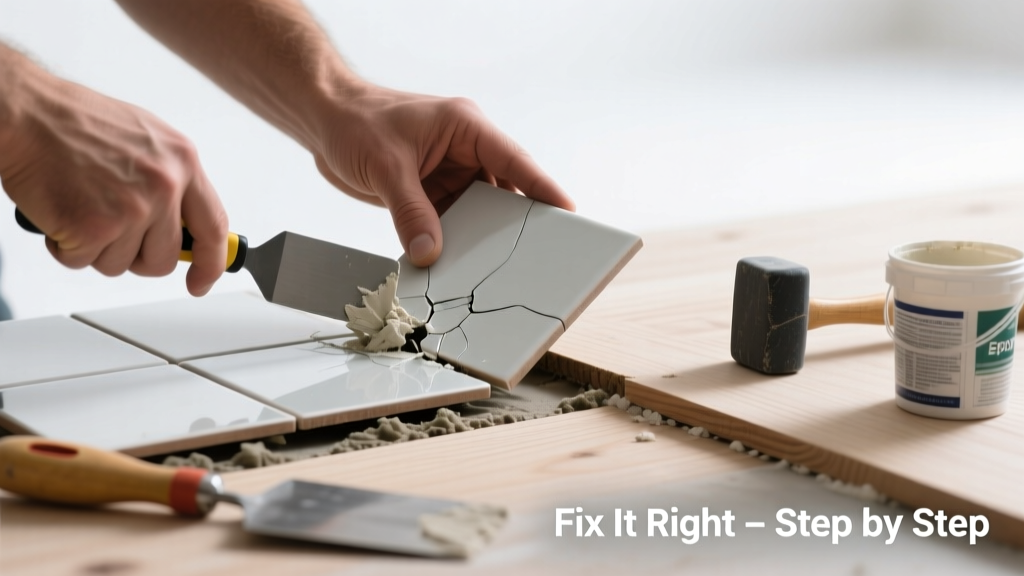
That sudden 'pop' underfoot in your kitchen or the persistent squeak every time you step on your bathroom floor isn’t just annoying—it’s a red flag. A cracked tile making unusual noise often signals underlying movement, moisture, or structural issues beneath the surface. Ignoring it can lead to further cracking, grout failure, or even water damage behind the tile.
Quick Diagnosis
Before grabbing tools, identify the root cause. Noisy cracked tiles rarely stem from the crack alone—something else is shifting or failing underneath:
- Subfloor movement due to loose or warped plywood or OSB
- Missing or deteriorated thinset mortar beneath the tile
- Moisture buildup causing swelling in particleboard or green board backing
- Grout joints that have fully failed, allowing lateral tile motion
- Expansion gaps blocked by caulk, baseboard, or debris
Tools & Materials Needed
| Item | Purpose | Estimated Cost |
|---|---|---|
| Carbide-tipped grout saw | Removes grout around cracked tile without damaging adjacent tiles | $12–$22 |
| Small notched trowel (1/8" x 1/8") | Applies fresh thinset evenly under replacement tile | $8–$15 |
| Epoxy-based tile adhesive | Bonds cracked tile back down if intact; stronger than standard mastic | $14–$26 |
| 3M Scotch-Weld DP100 epoxy | For stabilizing hairline cracks *before* reseating tile | $24–$32 |
| Laser level + 4-ft straightedge | Confirms subfloor flatness and detects subtle dips or humps | $45–$120 |
Step-by-Step Fix
Choose the method based on crack severity and subfloor condition:
- Stabilize & Reseat (for hairline cracks with minor lift): Drill two 1/8" pilot holes near the crack’s ends, inject 3M DP100 epoxy into the gap using a syringe, then clamp with painter’s tape and a weighted book for 4 hours.
- Rebond (for cracked but intact tile with hollow sound): Remove grout, gently pry up tile using a stiff putty knife, scrape old thinset, apply fresh polymer-modified thinset, and press tile back with spacers. Let cure 24 hrs before walking.
- Replace (for spiderweb cracks or missing chunks): Carefully remove tile with hammer/chisel, inspect substrate for rot or deflection, repair subfloor if needed, then install new tile using proper 1/4" backer board over 3/4" plywood per ANSI A108 standards.
When to Call a Pro
DIY stops where safety or code compliance begins. Call a licensed tile contractor if:
- The noise occurs across multiple tiles in a pattern—suggesting joist deflection beyond 1/360 span (per IRC R502.3.1)
- You detect musty odors or soft spots near the tile—possible hidden water damage or mold behind walls or under slab
- The tile sits over radiant heating tubing: improper removal risks puncturing lines
- Your home was built before 1980 and asbestos-containing mastic or backing may be present
Prevention Tips
Long-term quiet starts with smart installation and maintenance:
- Use uncoupling membranes like Schluter-DITRA on wood subfloors to absorb movement
- Maintain indoor humidity between 35–55% year-round to minimize seasonal expansion/contraction
- Recaulk perimeter expansion joints every 2 years—never let them bridge with grout or paint
- Install transition strips at doorways between rooms with different subfloor materials (e.g., concrete to wood)
Can I use regular construction adhesive instead of tile-specific thinset?
No. Construction adhesives lack the flexibility and shear resistance required for ceramic or porcelain tile. The U.S. Tile Council of North America (TCNA Handbook, 2023 Edition) explicitly prohibits non-mortar adhesives for floor tile installations due to long-term bond failure risk.
Will sealing the crack stop the noise?
Sealing only masks symptoms. Grout or caulk over a crack won’t address the underlying void or movement. In fact, rigid sealants can trap moisture and worsen subfloor decay. According to the National Tile Contractors Association, 72% of ‘quieted’ cracked tiles fail within 18 months when sealed instead of repaired.
How do I know if my subfloor is too bouncy?
Place a laser level on the floor and walk across the area while watching the beam on a wall 10 ft away. Movement exceeding 1/8" indicates excessive deflection. Or use a 6-ft straightedge: any gap >1/8" under it signals unacceptable unevenness requiring subfloor reinforcement.
Can I reuse the same tile after removing it?
Only if it’s undamaged and hasn’t warped. Soak it in warm water for 20 minutes to loosen residual thinset, then scrape with a carbide scraper. Hold it against a known flat surface—if light passes under any edge, discard it. Warped tiles create stress points that accelerate future cracking.
Is this a sign of foundation problems?
Rarely—but possible. If noisy cracked tiles appear near exterior walls, corners, or along stairwells—and coincide with diagonal drywall cracks, sticking doors, or sloping floors—get a structural engineer assessment. The American Society of Civil Engineers estimates that 12% of foundation-related claims originate from misdiagnosed tile movement.
Do I need to replace all grout in the room?
No. Only remove grout around the affected tile(s) and adjacent joints showing powdering or shrinkage. Use a grout removal tool with depth stop to avoid cutting into tile edges. Re-grout only the disturbed joints with sanded grout matching the original color and batch number if possible.
"A noisy tile isn’t broken—it’s communicating. What you hear is energy being released from movement that should be absorbed by the system." — Mike O’Leary, Certified Tile Installer (CTI), NTCA, 2022
Once the tile is secure and silent, keep an eye on surrounding areas for early signs of stress—like hairline grout cracks or slight discoloration near seams. Address those quickly, and you’ll extend the life of your entire floor by years. For deeper issues like subfloor sagging or moisture intrusion, don’t hesitate to consult a certified tile contractor or check our guide on testing for subfloor moisture. And if you’re working with natural stone, review our tips for repairing cracked marble floor tile—the approach differs significantly.