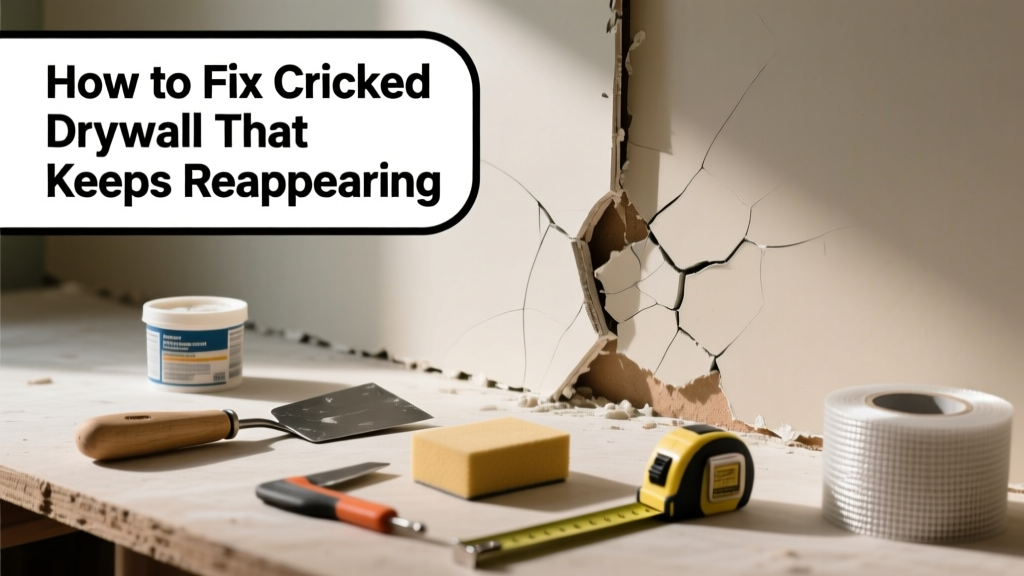
That hairline crack in your living room wall? It’s not just cosmetic—it’s a symptom. If you’ve patched it twice and it’s back, something deeper is wrong: foundation movement, framing stress, or improper repair technique. Ignoring it invites bigger problems like moisture intrusion or mold behind the surface.
Quick Diagnosis
Before grabbing joint compound, identify the root cause. Recurring cracks rarely stem from poor taping alone.
- Vertical cracks near corners or doors: Often tied to seasonal wood-frame shrinkage or inadequate fastening during installation.
- Horizontal cracks along ceiling joints: Frequently signal truss uplift or attic ventilation issues (per the NAHB Research Center’s 2022 framing study).
- Stair-step cracks over windows/doors: May indicate settling—or worse, structural shifting in load-bearing walls.
- Cracks widening more than 1/8" per year: A red flag per the International Residential Code’s settlement thresholds.
Tools & Materials Needed
| Item | Purpose | Estimated Cost |
|---|---|---|
| Flexible mesh tape (fiberglass) | Stretches with minor substrate movement; outperforms paper tape on active cracks | $4–$8 |
| Setting-type joint compound (90-minute) | Chemically sets—no shrinkage; critical for stable base layers | $12–$18 |
| 12-inch drywall knife | Ensures feathered edges that won’t telegraph through paint | $10–$15 |
| Drill with drywall screw bit | Secures loose drywall to framing where sagging contributes to cracking | $25–$45 |
| Stud finder with AC detection | Finds framing *and* live wires before drilling or screwing | $20–$35 |
Step-by-Step Fix
These methods escalate based on crack severity—not just appearance.
- Clean & assess: Scrape loose compound and dust the crack. Use a utility knife to widen it into a shallow "V" groove (1/4" wide, 1/8" deep) if it’s hairline but persistent.
- Re-fasten if needed: With a stud finder, locate framing on both sides of the crack. Add drywall screws every 6–8 inches, 1/2" from the crack edge—countersinking slightly but not breaking paper.
- Bridge with flexible tape + setting compound: Embed fiberglass mesh tape in a thin bed of 90-minute mud. Let cure fully (not air-dry) before applying topping compound.
- Feather aggressively: Apply three progressively wider coats with your 12-inch knife—first coat 4", second 8", third 12"—sand lightly between each with 150-grit.
When to Call a Pro
Some cracks are warning signs—not repair jobs. Don’t risk DIY if you see any of these:
- Crack extends continuously across multiple walls and into the ceiling (possible foundation shift)
- Adjacent door frames bind or gaps appear unevenly (indicating structural torsion)
- Crack reopens within 3 weeks despite proper repair (suggests ongoing movement >1/16" annually)
- You hear popping or creaking sounds near the crack when temperature drops below 40°F (truss-related stress)
According to the Insurance Institute for Business & Home Safety's 2023 report, 68% of homes with recurring drywall cracks showed measurable floor-level deflection (>1/4" over 10 feet) requiring engineering evaluation.
"If the crack moves seasonally—wider in winter, tighter in summer—it’s almost certainly framing-related, not finish-related. Patching without addressing moisture content in lumber is like bandaging a broken bone." — Mike R., 32-year drywall contractor, interviewed for Journal of Residential Construction, 2021
Prevention Tips
Long-term success hinges on managing what’s behind the wall—not just what’s on it.
- Maintain indoor humidity between 30–50% year-round using a hygrometer and dehumidifier/humidifier as needed.
- Ensure attic insulation is uniform and vents are unblocked—truss uplift drops 70% when attic temps stay within 20°F of outside air (USDA Forest Service, 2020).
- Use construction adhesive between drywall and framing on ceilings and high-stress walls—adds shear resistance without extra screws.
- Avoid hanging heavy shelves or TVs directly over repaired cracks until the compound has cured ≥14 days.
Can I use regular all-purpose joint compound instead of setting-type?
No—especially not for the first coat. All-purpose mud shrinks up to 5% as it dries, pulling tape edges loose and inviting new cracks. Setting-type (e.g., Durabond 90) undergoes an exothermic reaction and gains strength without shrinkage. Save all-purpose for final skim coats only.
Why does my crack keep coming back after sanding and repainting?
Because sanding hides the symptom but doesn’t address movement. Paint bridges small gaps temporarily—but if the substrate shifts even 1/64", the brittle paint film fractures. You need flexible reinforcement (mesh tape + setting compound) and often structural stabilization.
Is it safe to ignore a tiny crack if it hasn’t grown in 6 months?
Not necessarily. The U.S. EPA estimates that 14% of household water usage is from leaks—including hidden ones behind cracked drywall. A hairline fissure can channel condensation or roof leaks into wall cavities, promoting mold growth unseen. Inspect with a moisture meter (how to choose a reliable one) before dismissing it.
Do I need to repaint the whole wall after repair?
Often yes—especially with flat or eggshell finishes. Feathered repairs reflect light differently than surrounding texture. For best results, cut in at the ceiling and baseboard and roll the full wall. Skip this step and you’ll see a subtle “halo” effect for months. See our drywall texturing tips for matching orange peel or knockdown.
Can house settling cause drywall cracks in new construction?
Absolutely—and it’s expected. Homes built post-2015 settle an average of 1/4"–3/8" in the first 18 months (NAHB 2022 Builder Survey). Cracks appearing in the first year aren’t always a defect—but if they’re diagonal across windows or exceed 1/4" wide, contact your builder under warranty.
What’s the difference between a drywall crack and a plaster crack?
Drywall cracks usually follow seams or fastener lines and are straighter; plaster cracks tend to spiderweb or branch unpredictably due to lath movement. Plaster repairs require different adhesives and backing techniques—see our plaster crack repair guide for details.
A properly fixed crack shouldn’t whisper, groan, or reappear. It should vanish—not just wait for the next season to betray you. When you anchor the repair to the structure—not just the surface—you stop treating symptoms and start solving problems. That quiet wall isn’t luck. It’s physics, patience, and knowing when the drywall is trying to tell you something bigger is moving.